As China's top political advisory body, it has been an important
responsibility of the Chinese People's Political Consultative Conference (CPPCC)
National Committee to collect and reflect real social conditions and public
views. Known as the government's "think tank", the CPPCC committees at all
levels, local, provincial and national, have a large numbers of members and
public figures from different walks of life. Minister of Health Gao Qiang, China
Construction Chairman and Board Director Guo Shuqing and actress Gong Li are
some of them.
The CPPCC National Committee is an open forum where the Communist Party of
China, the non-Communist parties and people with no party affiliations discuss
State affairs freely and on an equal footing. It is indeed a manifestation of
China's socialist democracy.
Since March last year, political consultants have raised 5,158 proposals,
with more than 98 percent of them getting a response from the relevant
departments or being handled in line with the country's laws and regulations.
Many proposals have a nationwide impact and are important to the development
of the country's economy, culture, sports, politics, social security, and
science and technology.
Listed below are some of the pioneering suggestions from the members.
Last year, Liang Chaoran from southern Guangxi Zhuang Autonomous Region,
suggested a renewable biomass energy base be set up in the South China region.
On the basis of the that suggestion, the National Development and Reform
Committee (NDRC) sent officials and experts to carry out a field research.
Later, discussions were held and studies conducted with the help of experts from
agriculture and forestry fields.
Guangxi has a favorable climate and land resources and with abundant raw
materials, such as sugar cane and cassavas, for developing biomass energy. Key
biomass projects in the area use cassavas to produce ethanol, diesel oil,
methane and molding compound fuel.
The result: the NDRC listed Guangxi as a key area for renewable energy
development during the 11th Five-Year Plan (2006-10), vice-minister Bi Jingquan
said at a press conference on Saturday.
|
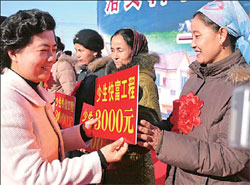 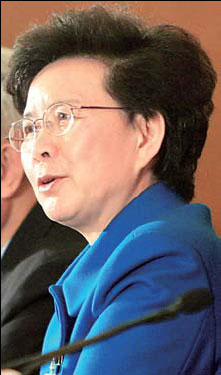
(Left) Women in Yili, Xinjiang Uygur Autonomous Region, who gave up the
chance of having a second or third child, get an allowance from a family
planning official. This policy was made possible thanks to the proposal
raised by NPC deputy Pan Guiyu (Right).
Liu
Chenggang/Xinhua |
A member of the standing committee of the CPPCC National Committee, Pan Guiyu
realized that the wide expanse of rural China badly needed an endowment
insurance system and that the financial condition of families with one child or
two daughters was particularly poor. So as a former vice-minister of the
National Population and Family Planning Commission, Pan suggested that the
central government allocate pension subsidies to those families. That was in
2003.
A year later, five western and 10 central provinces were selected as
demonstration areas for the project, and last year it was extended to the entire
country.
Till date, 1.8 million rural couples have received 1,200 yuan ($152) each.
Farmers have welcomed the policy because the money was often a relief in areas
where people have little income, except the crops they grow.
Wang Xiang, of East China's Jiangxi Province, submitted in his 2005 proposal
that train and bus fares should not be raised during Spring Festival. Later more
members joined him.
Their suggestion prompted the NDRC not to increase ticket prices. The usual
practise, though, had been to raise them to offset the cost of handling a sudden
jump in the volume of passengers moving across the country to celebrate the
lunar new year with their families and friends.
The status quo ante may have left the national exchequer poorer by 300
million yuan ($37.5 million) but it benefited the majority of people, especially
the migrant workers.
New proposals
At the ongoing annual session of the CPPCC, members are playing a more active
role and come up with many quality proposals of great importance, getting
extensive support from the grassroots people.
A group of members, including Shan Jixiang, director of the State
Administration of Cultural Heritage, have called for publishing a regulation on
the conservation of the Grand Canal.
The 2,500-year-old canal is a vital trade and transport route, linking
Beijing and Tianjin and the provinces of Hebei, Shandong, Jiangsu and Zhejiang.
Twenty-seven members, including renowned economist Wu Jinglian, have urged
the government to abolish the seven-year tax on interest earned on bank savings.
China began levying 20 percent tax on interest earned both on yuan and foreign
currency savings.
"Rich people with huge savings don't care much about the tax. But people in
the middle- and low-income group will lose a lot of the money," says CPPCC
member Qin Xiao.
 (China Daily 03/13/2007 page8)