|
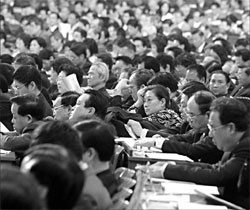
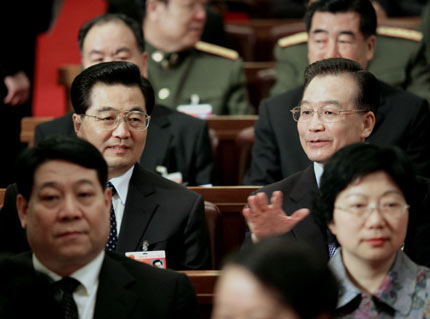
CPPCC members attend the second plenary meeting of the ongoing session
of the 10th CPPCC National Committee on Friday.
Jiang
Dong
|
China's top political advisers have called for the public to play a greater
role in the evaluation, selection and promotion of government officials.
"We suggest changing the current appraisal system, which depends on mainly
higher-level officials assessing lower-level ones to enlarge and strengthen the
participation of citizens," said Chen Qingtai, deputy director of the Economic
Affairs Committee of the Chinese People's Political Consultative Conference
(CPPCC) National Committee.
"We should study and establish an evaluation system that allows government
officials to pursue political achievements in line with sustainable economic and
social development."
Chen made the call yesterday in a keynote speech on political system reform
during a plenary meeting attended by more than 2,100 CPPCC members.
Chen, the former deputy director of the Development Research Centre under the
State Council, did not give further details.
During his government work report delivered to the National People's Congress
on Monday, Premier Wen Jiabao also pledged to enhance the transparency of
government work and the participation of the public.
The move was apparently aimed at lessening local government officials'
preoccupation with economic growth while ignoring public welfare.
CPPCC member Ma Peihua suggested the government focus more on performance in
environmental protection rather than GDP growth when evaluating officials.
"Some local governments still blindly pursue GDP growth at the cost of a
worsening environment and a huge amount of energy consumption," Ma said in his
speech. "Although the government has included 'restrictive targets' such as
pollutant discharge and energy conservation in its political performance
appraisal."
As a result, the two major pollutants discharged last year in China increased
by 1.2 and 1.8 percent respectively from 2005, with GDP and finance income up by
10.7 and 23.3 percent.
"When the two contradict each other, we should absolutely not sacrifice those
restrictive targets for other benefits," Ma said. "Otherwise we are pursuing a
short-term economic goal."
Ma suggested the country establish a responsibility and accountability system
as soon as possible, with intensified supervision to follow.
But some CPPCC members considered it impractical to change the country's
government official evaluation system in the near term.
"The current official appointment system is such a complicated political
issue and it is impossible to extend much participation to the grassroots in
China today," said economist Wu Jie. He added that although China's economic
system has been overhauled over the past two decades, there is still a long way
for the country to go in reforming its political system.
(China Daily 03/10/2007 page3)