|

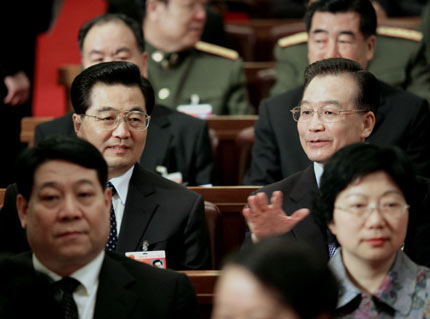
Staff with the proposal-handling branch of the CPPCC on Friday sort out
submissions from CPPCC members. Friday was the deadline for delivering
proposals at the ongoing national session.
Xinhua |
China's first national over-the-counter (OTC) equity bourse is likely to be
set up soon in Tianjin in an effort to diversify its capital market, a senior
official told China Daily.
Pi Qiansheng, director of the Administrative Committee of the Binhai New Area
(BNA) in Tianjin, said the new OTC exchange would be established within the year
if "everything goes smoothly" meaning it still needs approval from the State
Council.
The BNA is widely considered to be the country's third economic engine after
Pudong in the Yangtze River Delta and Shenzhen in the Pearl River Delta.
A series of preferential financial policies were introduced to boost its
development last year.
The State Council is also considering using the BNA to carry out a series of
pilot reforms in finance and land management.
The OTC market will mainly deal with equity transactions of unlisted public
companies, Pi said.
In an OTC market, securities are traded by dealers who negotiate directly
with one another over computer networks, rather than via a central exchange.
In general, securities are traded over-the-counter because the companies are
not big enough to meet the requirements for exchange listing.
Chinese mainland has two main boards in Shanghai and Shenzhen, a small and
medium-sized enterprise board in Shenzhen, as well as an OTC trading system for
Beijing-based technology firms.
Pi said the new OTC bourse would be supplementary to the current capital
market in China.
"It is a very important attempt to diversify property rights and capital," he
said.
It will also give more attention to companies that focus on scientific
innovation.
Though the city is actively pushing forward financial reforms like the OTC
market and the newly founded Bohai Industrial Fund, the BNA was originally
intended as a manufacturing and international logistics hub.
Analysts said Tianjin was likely to be edged out by neighboring Beijing, home
to the headquarters of the country's major banks, in any bid to become a
financial center.
"Tianjin never said it intended to become a financial hub, but that it would
establish a complete financial services and innovation system," Pi said.
Rather than being competitors, Beijing and Tianjin could cooperate, Pi said.
"Beijing has human resources and adequate capital, while Tianjin has more
land, and convenient transportation," he said.
Lin Yifu, an economist and member of the Chinese People's Political
Consultative Conference (CPPCC) National Committee, agreed.
"North China needs a manufacturing base," he said.
"The research and development capability of Beijing, combined with the sound
manufacturing basis of Tianjin would form an economic power engine that drives
the development of North China," he said.
A high-speed express railway connecting the two cities is expected to be
completed in the next year and will shorten travel time to 30 minutes.
(China Daily 03/10/2007 page2)