The Three Gorges Project Construction Committee will draw up its first annual
supervision plan next month.
The move follows reports that $34.8 million of funds earmarked for the
project had been misused.
|
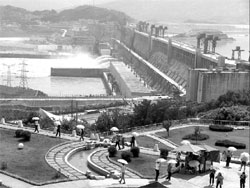
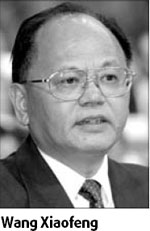
Tourists visit a scenic spot near the Three Gorges Dam. Wang Xiaofeng,
deputy director of the Three Gorges Project Construction Committee, said
the project had had a minimal impact on the quality of drinking water. Liu
Junfeng |
The supervision plan will require the different units involved in the project
to regularly report on their finances throughout the years, said Wang Xiaofeng,
deputy director of the committee, which is under the State Council.
"The plan will effectively monitor the capital flows within the project, and
close the loopholes in the process," Wang told China Daily on the sidelines of
the fifth session of the 10th National People's Congress.
Funds drawn from banks and those funnelled into work bids will be given
priority to prevent embezzlement and corruption.
Wang said a supervision network run by the country's top anti-graft
authorities, the finance ministry and banks had been overseeing the project's
funds since 1997.
He added that about 90 percent of the misused funds had been recovered.
He said local officials had been responsible for most of the
misappropriations, and that few members of the project's management board had
been involved in such behavior.
The National Audit Office (NAO) reported in January that 272 million yuan
($34.8 million) that had been allocated to support the resettlement of residents
displaced by the Three Gorges project in 2004 and 2005 had been misappropriated
in Hubei Province and Chongqing Municipality.
The central government allocated 9.6 billion yuan ($1.2billion) in
resettlement funds in 2004 and 2005.
However, instead of supporting resettlement work, the money was used to open
local government-run businesses, repay the debts of other local departments, pay
salaries to employees of administrative departments and build more office
buildings and houses for people unrelated to the resettlement project. It was
also used to pay off bank loans.
 Wang said the misuse of funds had not affected his committee's work to
resettle people affected by the project.
Wang said the misuse of funds had not affected his committee's work to
resettle people affected by the project.
More than 1.2 million people, or over 85 percent of those covered by the most
recent plan, have been resettled.
But due to lack of arable land and job vacancies, the unemployment rate among
the displaced people reached a record 12 percent last year.
Efforts are being made to create more jobs for the resettled population, said
Wang.
Professional training programs for the displaced people are expected to help
them find jobs in other regions. About half of the five million rural residents
affected by the dam work outside the region.
Authorities in the region are also planning to make full use of barren
mountainous land in the region to ease land shortage.
"The region will catch up with the national average employment level within
five years," Wang said.
The central government also plans to invest 55 billion yuan ($6.88 billion)
in a bid to settle residents relocated by the project and support local
industries to provide job opportunities over the next five years.
The funds will also be used for infrastructure construction, environment
protection and social development in the region.
Chongqing Municipality and Hubei Province have also made it mandatory for at
least one member of each relocated family to be employed in the non-farming
sector by the end of this year.
Launched in 1993 at an estimated cost of 180 billion yuan ($22.5 billion),
the Three Gorges Dam Project on the middle reaches of the Yangtze River will
eventually have 26 generators with a combined power-generating capacity of 18.2
million kilowatts.
It will be able to generate 84.7 billion kilowatt hours of electricity
annually.
(China Daily 03/09/2007 page7)