China will close down its worst polluting facilities as part of a new plan
for sustainable economic growth.
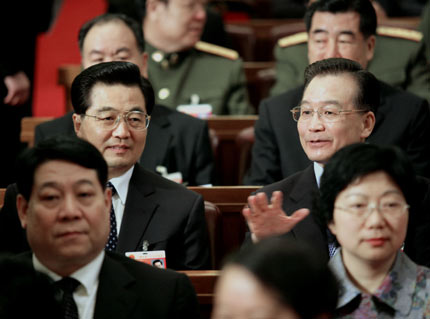
In a speech at the opening meeting of the Fifth Session of the 10th National
People's Congress (NPC) yesterday Premier Wen Jiabao outlined a new vision for a
wealthier, greener China.
The target gross domestic product (GDP) growth has been scaled down to 8
percent this year, compared with 10.7 percent in 2006.
After earlier failing to meet energy consumption targets, China wants to
reduce major pollution by 10 percent and energy consumption for per unit of GDP
by 20 percent from 2005 to 2010, Wen said.
In 2006, sulphur dioxide and chemical oxygen demand edged
up slightly.
|

A farmer in Ganyu County, East China's Jiangsu Province, displays a
dead fish, poisoned by pollution. At least 100,000 fish died as a result
of pollution leaking into waterways in October, causing big losses for
local farmers. Cai Xiaoyu |
Wen blamed slow industrial restructuring, growth of heavy industry and
backward production facilities for China's excess pollution and energy
consumption last year.
"This year, on the basis of structural improvements, improved productivity,
reduced consumption of energy and environmental protection, GDP is forecast to
grow by about 8 percent," Wen said.
"Meeting these two mandatory targets cannot be revised, so we must work
resolutely to reach them."
China plans to take "strong measures" to conserve energy, lower energy
consumption and protect the environment this year.
Under new plans to reduce pollution, small coal-firing plants with a total
capacity of 10 million kilowatts will be shut down, as will outdated production
facilities in the cement, electrolytic aluminium, ferrous alloy, coke and
calcium carbide industries.
"It is very impressive for the Chinese leader to highlight environmental
problems in such a high-profile report," Yang Ailun, campaigner manager of
Climate and Energy from Greenpeace's Beijing Office, said.
"But most of the measures to combat pollution and save energy mentioned by
Wen are just effective in the short term. China needs to reform its energy
structure to move away from its dependence on coal burning, which provides about
70 percent of the country's energy."
Daniel J. Dudek, chief economist of the Environmental Defense Fund, which is
based in New York City, told China Daily: "We are glad to see that overall
targets are emphasized for the entire five-year plan and an integrated index and
evenly divided yearly reduction targets of energy efficiency and total emission
discharge are no longer mandated in the premier's report.
"It is also good that a monitoring and evaluation system is recommended to
facilitate the achievement of these targets."
Zhou Shengxian, minister of the State Environmental Protection
Administration, told a symposium on pollution emission cuts last month, that he
was "very confident" of China meeting pollution reduction targets in 2007,
provided the measures could be fully enforced.
(China Daily 03/06/2007 page6)