At no stage of development have social concerns been ignored by China's
leaders. But complaints about social issues have been rising in recent years,
the transitional stage of development and reforms that have accelerated by the
further opening up of the country. And these complaints, too, have not escaped
legislators' attention.
But Zheng Gongcheng, a NPC deputy and a professor at the Renmin University of
China, says the government should no longer be dragging its feet to redress
social grievances. Too much energy, money and time have gone into China's
economic growth and reforms, and "the key task for the government this year
should be to let everyone share the success of the country", Zheng has been
quoted by the Southern Weekend as saying.
After fulfilling their basic needs, people are now
craving for other requirements such as social equality and the fruits of the
reforms.
|

Graduates flock to a job fair in Chongqing on Sunday. This summer a
staggering 4.95 million students, 820,000 more than 2006, will graduate
from institutions of higher learning, with about 1.4 million of them
unlikely to find a job befitting their degree. Zhong
Guilin |
Just before the annual sessions of the National People's Congress (NPC) and
the Chinese People's Political Consultative Conference (CPPCC) surveys conducted
by the media and leading websites showed that social concerns were topmost on
the public mind.
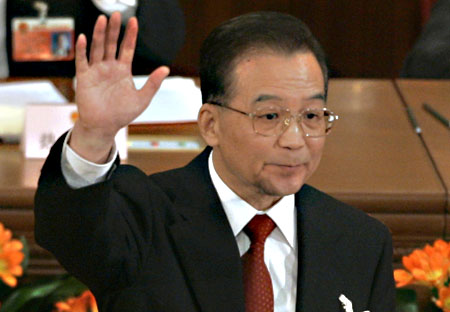
To the joy of many, a large part of the Government Work Report delivered by
Premier Wen Jiabao yesterday at the Fifth Session of the 10th NPC was devoted to
issues directly concerning the well being of the common people.
As China's top legislature and political advisory body deliberate the
policies and steps to be taken in future China Daily take a look at the key
social issues, the success achieved in tackling them and how they can be
ultimately be resolved.
Employment
Despite China's rapid economic growth, more than 84 million urban residents
survive on government dole and unemployment in rural areas remains a big problem
forcing rural people to migrate to cities in search of work. Moreover, this
summer a staggering 4.95 million students, 820,000 more than 2006, will graduate
from institutions of higher learning, with about 1.4 million of them unlikely to
find a job befitting their degree.
Such is the demand for new jobs that China needs to create an estimated 13
million jobs every year to prevent unemployment from rising.
Solution: The central government has allocated 23.4 billion yuan for
employment and reemployment programs. The specific goal for this year is to
create at least 9 million new jobs and relocate about 5 million laid-off
workers. Also, the government proposes to control the registered unemployment
rate below 4.6 percent in the urban areas, and "basically" solve the employment
problem by 2020.
Social security
Only a small percentage of the Chinese population has been brought under the
country's social security system. In fact, just 1 percent of the population is
covered by the entire set of social securities. The vast majority of the rural
poor has no social security, and only 13 million of the 800 million needy
farmers get government dole.
Nearly 22 million urban residents survive on monthly handouts of 169 yuan
($22).
Solution: Last year, the central government spent 13.6 billion yuan as
allowances for basic cost of living for urban residents, that is, 2.4 billion
yuan more than 2005. Doling out the basic cost of living to rural residents has
benefited 15 million people in 25 provinces. The country has promised to build a
social security system covering the rural and the urban areas which would
include social aid, social insurance, social welfare and charity from all walks
of life. But such a system needs time to be in place. The government is trying
to include about 195 million workers in its pension scheme, 113 million in the
unemployment security network and 170 million in the medical insurance system.
Food safety
Last year saw a series of unsafe food scandals, including the red dye Sudan
found in yolks of ducks' eggs. Loose supervision and outdated food procedures
are the major hurdles the country has to overcome to have a secure food system.
Solution: Government bureaus have begun a series of food security inspection
campaigns, and supervision has been tightened and extended to cover all food
production procedures and sales. The country's food security authorities have
vowed to crack down on companies processing spurious food products and using
known brands' labels.
Fight against corruption
The Party's discipline inspection organs punished 97,260 members at various
levels, that is, 0.14% of the total number of members, last year. Many
high-ranking officials, including Shanghai's former Party chief Chen Liangyu and
former National Bureau of Statistics Director Qiu Xiaohua, were detained on
corruption charges. Chen was the highest-ranking Communist official to be
charged with corruption in a decade.
Solution: The central government has always considered the fight against
corruption to be of utmost importance. Central anti-graft authority sources have
repeatedly said that the government will set up special organs to deal with
corruption and make concerted efforts to draft detailed laws and regulations.
Tasks such as improving the government's image and adjusting its functions,
speeding up administrative management reform and setting up and perfecting an
administrative accountability system will be the administration's key tasks this
year.
Education
China's nine-year compulsory education system that is supposed to be free and
should cover the entire country is yet to reach all rural areas. In cities,
parents eager to get their wards into top schools have to fork out extra money.
Rising fees have come under fire in recent years, as has the mismatch between
what is being taught in many institutions and the demands of some newly created
jobs.
Solution: The government will start a national scholarship and tuition
assistance system for undergraduate institutions, secondary vocational schools
and vocational colleges this year. It will implement the State student loan
policy scheme, too, to help children from poor families get proper education.
Also, rural students across the country will get free nine-year compulsory
education from this year. China exempted students in rural areas of Western
China from paying the compulsory education fees last year, and the policy was
extended to the rest of the country this year.
Healthcare
A 2006 national survey showed 48.9 percent of Chinese didn't bother or
couldn't afford to see a doctor when they fell ill, and 29.6 percent couldn't be
admitted to a hospital on medical advice because the cost was too high. Medical
costs, in general, are considered to be too high, with calls from the public and
some leaders to expand medical treatment and make it more affordable.
Solution: Minister of Health Gao Qiang has promised to reform the country's
healthcare system this year by raising government investment, tightening
professional supervision and cutting costs. The government will continue to
extend the healthcare network both in rural and urban areas. By the end of this
year, the rural cooperative medical care system is expected to cover at least 80
percent of counties. Under the rural system, each farmer now pays 10 yuan into a
medical fund every year, with the state and local governments each contributing
the same amount. And when a person falls ill, he can use a certain percentage of
the money for his treatment.
Income gap
The income gap in China is widening. Statistics show that the richest 10
percent of the population now own more than 40 percent of all private assets,
while the poorest 10 percent share less than 2 percent. The Gini Coefficient
uses zero to indicate equal income distribution while 1 represents the largest
income disparity. China's GINI Coefficient has reached 0.496, worse than that of
the United States. The gap has become especially notable in some regions. The
per capita personal income in urban areas of Heilongjiang was only half of that
in Shanghai in 2005.
Solution: The government has proposed to improve the proportion of industrial
output to grant salaries to urban workers. Also, it proposes to gradually raise
the income level of the poor in the urban areas, increase the proportion of the
middle-income group and coordinate the high-income group in the population.
Precisely speaking, the country will strengthen its supervision on employers in
monopoly firms.
Pollution
Environmental degradation continues to exact a heavy toll and upset the
everyday life of the people more severely. According to the State Environmental
Protection Administration (SEPA), 70 percent of China's rivers and lakes are
polluted, and more than 300 million people have no access to clean water. Some
experts even refer to some settlements along the Huaihe River and near Taihu
Lake in East China's Anhui and Jiangsu provinces as "cancer villages". Last
year, SEPA received 600,000 complaints, 30 percent more than in 2005, on the
environment. Apart from the weak environment protection efforts, other factors
that SEPA has been handicapped with are dearth of staff, funds and power.
Even though the administration shut down 163 environmentally dangerous
projects, cumulatively worth 770 billion yuan ($96 billion) in 2006, the country
flunked its first test to reduce major pollutants in the first phase of the 11th
Five-Year Plan period (2006-10). In fact, sulphur dioxide emissions increased by
nearly 463,000 tons last year.
Worse still, about two environmental accidents took place every day last
year.
Solution: SEPA stopped a dozen key chemical projects initiated by State-owned
enterprises at the beginning of this year. It has proposed extending to the
whole country the practice of "Green GDP", a GDP accounting method that
calculates the environment cost, too. Moreover, the central government has
promised to fully implement a responsibility system to meet its energy-saving
and environmental protection targets.
(China Daily 03/06/2007 page8)