Top News
Paulson: China should not be made an enemy
(AP)
Updated: 2007-03-05 08:56
 |
Large Medium Small |
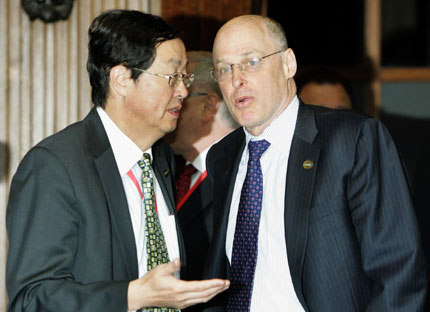 US Treasury Secretary Henry Paulson (R) talks to Zhou Xiaochuan, Governor of the People's Bank of China during the G7 Finance Ministers and Central Bank Governors Meeting in the western German city of Essen February 10, 2007. [Reuters]  |
Paulson, who this week makes his third visit to China as treasury secretary, said it is essential that both countries manage disagreements to maintain strong economic ties.
"I would say that our relationship with China is multifaceted and it's a very important relationship for the US And I don't believe we need to make China an enemy," Paulson said. "If we manage the relationship -- the overall relationship with China properly, it's going to benefit both of our countries for a long time to come."
The former head of the investment company Goldman Sachs is seen as a rare China expert in an administration that is trying to strengthen its diplomatic focus on relations with the rising Asian power -- a fellow permanent member of the UN Security Council, a major trading partner and an important player on such diplomatic problems as North Korea, Iran and Sudan.
John Negroponte, newly installed as the State Department's No. 2 official, is expected to sharpen the administration's focus on the national security dimensions of the relationship. On Sunday, he was in Beijing and raised concern about the country's secrecy on its defense spending levels and rapid military modernization.
"We think it's important in our dialogue that we understand what China's plans and intentions are," he said.
Paulson has been resisting calls from some quarters for projectionist barriers as the trade deficit with China has risen to a record level of $232.5 billion, the highest trade gap ever recorded with a single country.
Paulson said it is "a top priority to get this long-term economic relationship right between our two countries and to deal with the most pressing short-term issues."
He said that he would continue to press for improving flexibility in the Chinese currency.