China will enact laws this year aimed at improving the living standards of
its 800 million rural people and ensuring equitable public services, according
to the chairman of a advisory body.
"We will focus on ways to stimulate social development and solve problems
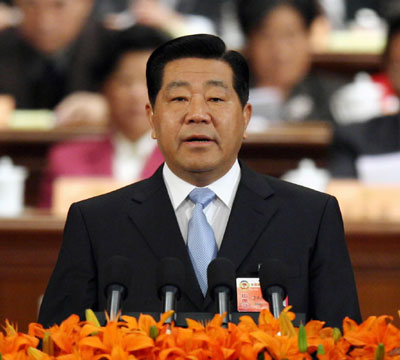
concerning the people's wellbeing," Jia Qinglin, chairman of the Chinese
People's Political Consultative Conference, said at the start of the body's
annual meeting in Beijing Saturday, March 3.
President Hu Jintao and Premier Wen Jiabao have made the rural two-thirds of
China's population their policy focus, seeking to preserve public confidence in
the ruling Communist Party and to prevent the widening income gap from causing
social unrest. Economic growth has benefited eastern cities more than the
countryside.
"China must cater to the broader interests of the population and spread the
wealth if it truly wants sustainable growth," said Justin Lin Yifu, an economist
at Peking University, and a delegate to today's conference.
Last year, the economy expanded 10.7 percent, the fastest pace in 11 years,
and is now the world's fourth-largest. Urban incomes are three times those in
rural areas, a gap that doubled in the past 25 years.
Other Priorities
Other government priorities are strengthening macroeconomic regulation,
restructuring the economy, changing the pattern of growth, conserving energy and
resources, protecting the environment and foster innovation, Jia said in today's
speech.
The government gathered grassroots opinions to prepare for the conference and
subsequent National People's Congress meeting, Jia said, adding that the
Communist Party also puts a premium on working more closely with delegates who
aren't party members.
"We should also work more closely with religious groups and make use of their
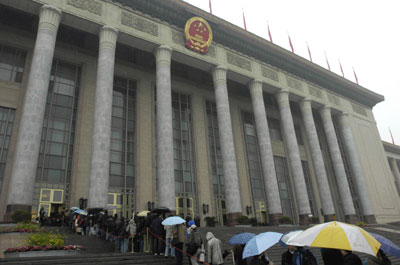
contributions to build a harmonious society in China," Jia said in his speech,
given at the Great Hall of the People in central Beijing.
Elsewhere, China will continue to oppose independence activity in Taiwan, and
strengthen ties with Hong Kong, Macau, Taiwan and overseas Chinese, Jia said. It
will seek continued stability and prosperity in Hong Kong and Macau, he said.
Diplomacy
"We'll continue to pursue more diverse and flexible channels of diplomacy,
including non-governmental mechanisms," Jia said. "We've communicated China's
commitment to pursuing a peaceful rise."
China will continue to apply Deng Xiaoping's thought, Jiang Zemin's writings
and the "Three Represents" principle to build "a socialist economy with Chinese
characteristics suitable to China's policy of reform and opening," Jia said.
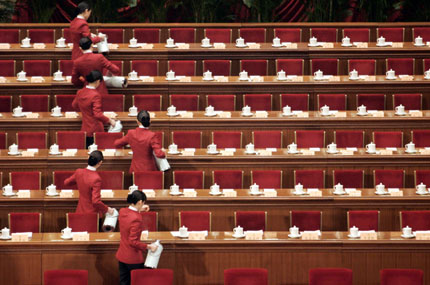
More than 2,200 delegates of the Chinese People's Political Consultative
Conference convened in Beijing March 3 to advise the legislature, the National
People's Congress, which meets in the Chinese capital starting March 5.
"The focus of the suggestions in 2006 were to build a Socialist rural
economy, energy conservation and energy security, building an equitable national
healthcare system and ensure reasonable market prices," advisory group Vice
Chairman Huang Mengfu said in a speech today.
Ordinary People
Last year, the consultative conference helped the government establish a
6-billion yuan ($770 million) fund to provide 300 yuan in annual allowances for
23.7 million rural residents, the group's spokesman Wu Jianmin said yesterday.
China's political advisers are "paying a lot of attention to the interests of
ordinary people," Wu said. Other proposals address concerns about the costs of
economic growth, which include environmental damage, corruption and the widening
income gap, he said.
Delegates are more focused than ever on issues relating to "maintaining
social stability, and that means catering to the interests of the poor," Guan
Anping, a Beijing-based lawyer and former trade official said in a phone
interview on March 1.