Top News
China embraces 'piglets' boom
(Xinhua)
Updated: 2007-02-21 09:35
 |
Large Medium Small |
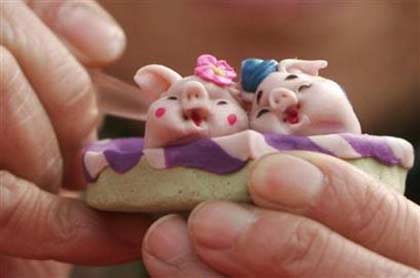 A man makes a sculpture of pigs at a temple fair in Shenyang, northeast China's Liaoning province, February 13, 2007. [Reuters]  |
More members of the generation born under the one-child policy have reached the age of marriage and child-bearing and China is bracing itself for a comparative baby boom. But a mixture of tradition and superstition means that 2007 will be set to the tune of some serious dummy sucking.
According to the Chinese lunar calendar, 2007 is the year of the Golden Pig, a particularly auspicious year that only comes round once every 60 years.
Xu Wen, a young woman in Shanghai, became pregnant a few months ago and is just one of the millions of Chinese parents who succumbed to the belief that a 2007 baby would be showered with good fortune.
"The oldies in my family said the Golden Pig will bring luck and blessings to my child," said Xu.
"2007 is the year of "Jin", meaning gold, according to the rotation of five elements of gold, wood, fire, water and earth," said Yu Yue, an expert on folk culture.
"The pig, as a major livestock, has been a symbol of wealth and abundance in China since ancient times," Yu explained.
According to forecasts by the Shanghai population and family planning committee, the city will see over 137,000 babies born in 2007, almost double the number in 2006. Beijing has also announced it expects 150,000 babies to be born in 2007, compared with 129,000 last year.
The boom has begun to put strains on hospitals in major cities.
The Shanghai Punan Obstetrics and Gynecology Hospital are packed with women coming for health checks in preparation of pregnancy. Other visitors are already in the final stages of pregnancy, waiting in long queues for routine prenatal tests.
The Haidian Obstetrics and Gynecology Hospital in the capital Beijing has received an average of 3,000 patients in January, far exceeding the hospital's capacity.
Maternity doctors in the cities of Harbin, Taiyuan, Fuzhou and Haikou have been working double shifts and struggling to find enough beds on the wards. In some hospitals, the obstetrics departments are fully booked until April.
"Yue Sao" or maternity maids, are benefiting from the boom. Soon-to-be dads and moms in Beijing have to make reservations six months before their children are due, and monthly salaries of popular maids in Shanghai have tripled to reach 6,000 yuan (about 774 U.S. dollars).
"The birth rush will create similar shortages down the line when the babies grow up, go to school and look for jobs," said Yu Hai, a sociology professor in the Shanghai-based Fudan University.
Parents who chose to have babies in the millennium have found the simple task of getting their kids into kindergarten a frustrating ordeal, because there were not enough openings," said Yu.
In 2000, also the Year of Dragon, more than 36 million babies were born in China, nearly double the number in 1999 and 2001.
"Chinese parents usually make meticulous plans to have their baby born in the most desirable environment given in most areas one couple is only allowed to have one child. But selective birth in lucky years such as the millennium and the pig year will worsen the shortage of social resources like education and jobs," Yu added.
Relating the animal signs with luck in life is a long-standing Chinese custom, with certain years like dragon, monkey and pig deemed lucky and others like the goat and snake are regarded as the opposite.
Some parents have even used medicines and caesarean sections to rush their babies into the world in a desirable year, leading many to criticize these actions as being outdated superstitious beliefs.
"A person's fate can't be decided by which year he or she was born," said Shanghai resident Gong Rong.
"It's irresponsible and vane of parents to blindly follow so-called tradition," said Cao Kai, a 25-year-old journalist in Beijing.
According to Chen Jing, director of the Folk Culture Research Center in Nanjing University, China's celebrity files are rife with big names born in "bad" years like the goat year, but they prove just as lucky, successful and long-living as anyone else.
A large number of "goats" have made a name as high-ranking officials, scientists, sportsmen and movie stars, including He Guoqiang, member of the Political Bureau of the CPC Central Committee, top mathematician Wu Wenjun, female basketball player Zheng Haixia and gymnast Mo Huilan.
"Parents may want golden pig babies out of a wish for happiness but these traditional customs should not be used as an excuse for abuses," Chen said.
