|
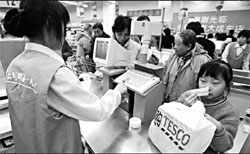
Shoppers check-out at the new Tesco Plc store in Beijing. The consumer
price index, a key barometer for inflation, grew by 2.2 percent year on
year in January. Stephen Shaver/Bloomberg
News
|
This year's late Spring Festival meaning
housewives weren't yet stocking up their kitchens last month has been credited
for the slow growth in consumer prices.
The end of a consumer prices surge has been put down to the late New Year,
amid market speculation about an interest rate hike.
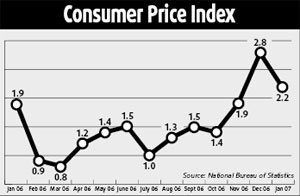
The consumer price index (CPI), a key barometer for inflation, grew by 2.2
percent year on year in January, 0.6 percentage points lower than that its
growth over the previous month, the National Bureau of Statistics (NBS) reported
yesterday.
"The timing of the Chinese New Year, which fell in January last year but in
February this year, seems to be partly behind the slower growth," said Qu
Hongbin, chief China economist with banking giant HSBC.
"The January CPI in 2006 was 1.9 percent year on year at that point the
highest for 10 months," pointed out Stephen Green, a senior economist with
Standard Chartered Bank.
When the Chinese New Year came early last year, it pushed up January food
prices as everyone prepared for the week-long holiday. That explains why this
year's January CPI appears comparatively low.
Inflation pressure in China remained low during most of last year. NBS
statistics show the country's CPI grew by only 1.5 percent in 2006, 0.3
percentage points lower than the previous year.
Yet, a jump in CPI last December fuelled market expectations that the
People's Bank of China (PBOC), the central bank, will hike rates soon.
The country's CPI rose to 2.8 percent year-on-year in December from 1.9
percent in November, mainly driven by rising food prices.
That has caused the real deposit rate for 1-year maturity to turn negative
(the nominal deposit rate is currently at 2.52 percent). This is the main reason
behind expectations of an imminent rate hike, noted a report by Lehman Brothers.
 However, the central bank has recently repeated its
satisfaction with the current interest rate level.
However, the central bank has recently repeated its
satisfaction with the current interest rate level.
"I think the interest rate at this time is appropriate," Yi Gang, assistant
governor of the PBOC, said on Tuesday.
Without hiking the interest rate, the central bank has managed to mop up
excessive liquidity in the market and prevent credit growth from rebounding by
raising bank reserve ratios four times in the past seven months.
NBS figures show that food prices rose 5 percent in January while grain
prices rose by 6.9 percent year-on-year.
Yi said the rising CPI in the past three months was mostly a result of rising
grain prices, and the trend might not continue.
"This should be temporary given China's massive stockpiles of grain after
three good harvests," echoed HSBC economist Qu.
But some experts thought otherwise about the trend.
"We think food prices are getting hit by a structural shift in consuming and
farming patterns and that its not so short-term." said Green, from Standard
Chartered Bank.
China's CPI is expected to climb 2.5 percent in 2007, according to a forecast
from the Ministry of Commerce.
In spite of differences over food prices, observers agree that they will need
to see February's CPI before they can relax about inflation.
Last year, China's economy managed high growth and low inflation.
World Bank view
"China's internal macro challenges remain manageable, but the external
imbalance is on the rise," noted the World Bank's China Quarterly Update.
"Thus, policy measures that address domestic concerns could ideally also
reduce the external imbalance," said Bert Hofman, the World Bank's lead
economist for China.
A ballooning trade surplus and accelerated inflow of direct foreign
investment has boosted China's foreign exchange reserve to more than US$1
trillion.
But they also pumped liquidity into the domestic market, adding to the
difficulties of macroeconomic control.
The Quarterly Update finds that near term prospects remain broadly favorable,
and a significant surge in inflation is unlikely.
But China's industry, investment and export based growth are increasingly
exposed to trade tensions and environmental and resource constraints.
The World Bank report also suggested that China should pursue a growth
pattern that relies more on services and labor-intensive urban growth.
(China Daily 02/15/2007 page2)