Top News
Baby boom may put strain on hospitals
By Wu Jiao (China Daily)
Updated: 2007-02-03 07:28
 |
Large Medium Small |
To prevent a medical shortage caused by the high number of births expected in the auspicious Year of the (Golden) Pig, Beijing's health authority has suggested expectant mothers steer clear of the top hospitals to avoid overloading them.
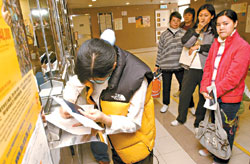
Expectant mothers pay their fees at Queen Elizabeth Hospital in Hong Kong on Friday. The region adopted new measures on February 1 to reduce the number of mainland babies born in Hong Kong. [China Daily] |

Xiao said the city currently has 3,800 beds and 3,000 medical workers available in its 170 obstetrics departments and hospitals.
"The difficulty is that many pregnant women only choose a few top hospitals to have physical checks and deliver, while the other hospitals have beds available," Xiao was quoted by the Beijing Times as saying.
Xiao said the auspicious Year of the (Golden) Pig had fueled the birth rate this year, and Beijing expected a total of 150,000 babies to be born in 2007, compared with 129,000 in 2006.
The lunar calendar designates one of 12 zodiac signs to each year. The years also rotate through five elements gold, wood, water, fire and earth.
In 2007, the Year of the Pig coincides with the element of gold. It is said children born in this year are blessed with a carefree life.
This notion has sparked a baby boom across the country.
Qian Hailin, a 23-year-old in Shanghai due to give birth in May, said she had no intention of becoming a mother at such a young age, but her family decided the Year of the (Golden) Pig would be the luckiest for her to have a baby.
The baby boom has already put hospitals and doctors on alert in major cities.
The delivery rooms in major hospitals in Shanghai have been fully booked until March, although some are squeezing up to six expectant mothers into a room designed for four, and will cut short the hospitalization period.
Experts warned that irrational family planning would result in a shortage of social resources.
"Given China's large population, selective birth in so-called lucky years may worsen the existing shortage of social resources, including education and employment," Ren said.
Ren's contention is backed by the shortage of education resources last year caused by the baby boom in 2000.
(China Daily 02/03/2007 page1)
