On the afternoon of June 13, Foreign Ministry Spokesperson Jiang Yu held
a press conference.
Good afternoon, ladies and gentlemen. My name is Jiang Yu. As a new
spokesperson, I hope we can establish congenial work relations in the future. I
have no announcement to make. Now I'd like to take your questions.
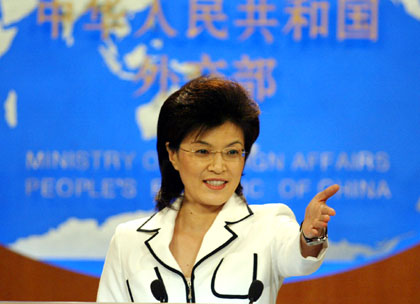
Jiang Yu, a new
Foreign Ministry spokeswoman, asks for a question at her first press
briefing in Beijing June 13, 2006. Newly-appointed Jiang, 42, is the 23rd
public face of the Foreign Ministry, since the spokesman system was
established in 1983. She is also the fourth woman to take the post.
Jiang graduated from the China Foreign Affairs University in 1987 and
is now vice-director of Foreign Ministry's Information Department.
[newsphoto] |
Q: The Spanish national court
accepted the lawsuit filed by "Tibet independence" and "Falungong" Cult
organizations. What's your comment?
A: The libel by "Tibet independence" group and "Falungong" Cult is completely
based on fabrication out of apparent political motives, aimed at smearing
China's international image and sabotage China-Spain relations. According to
international law and universally recognized basic norms governing international
relations, the court of the country concerned has no right to accept and hear
cases of this kind.
China and Spain have established an all-round strategic partnership, with
rich fruits yielded on all fronts. We hope Spain can properly handle this
matters so that our bilateral relations can keep its momentum of healthy
development under our joint efforts.
Q: What message will President Hu convey to the Iranian President
when they meet?
A: Iran is an SCO observer. According to the SCO documents and on the basis
of consensus of member states, China invited the Iranian President to attend the
summit. During the summit, President Hu will hold talks with leaders of member
states and observers. Arrangements are yet to be finalized.
We think there is a new opportunity to resolve the Iranian nuclear issue
peacefully through diplomatic negotiation. China appreciates the fact that Iran
expressed its intention to earnestly consider the proposal, and hopes Iran will
respond positively and create favorable condition for resuming the negotiation.
Only when we resume dialogue can we resolve differences. China hopes all parties
can keep patience, exercise restraint and do more to help resume negotiation.
Q: The human rights group Amnesty International issued a report early
this week, saying that weapons exported by China to Myanmar, Sudan and Nepal
fueled the local conflict. What's your comment? Does China track the exported
weapon or not? How can you ensure the weapons being used properly?
A: The accusation of relevant group is groundless and does not comply with
fact. China adopts prudent and responsible attitude towards military export and
abides by three principles. The export should boost the legitimate self defense
capability of the recipient countries, should not prejudice regional and
international peace, security and stability, and should not interfere in the
internal affairs of recipient countries.
China has normal cooperation with many countries on conventional military
trade. The cooperation complies with China's military trade policy, regulations
and international obligations.
I can offer some figures for your reference. China is the smallest weapon
exporter among the major countries. According to the statistics of Stockholms
International Peace Study Institution, from 2000 to 2004, the conventional
weapon exported, the US valued $25.93 billion, whereas China's export $1.436
billion, only 1/20 of that of the US.
China controls all the export of conventional military items, including small
arms, in line with Regulations on Control of Military Product Export, and
exercise unified export of military items. In addition, China has established
and end-user control system to prevent weapons from being transferred to
hotspots or sensitive regions.
Q: What's China's position on the Western Sahara question?
A: China has a consistent position on the Western Sahara question. We
maintain that the question should be properly resolved through dialogue and
consultation on the basis on the UN resolutions. China hopes that the parties
concerned will bear in mind the overall purpose of maintaining regional unity,
stability and development and return to the track of friendly consultation. We
support a solution acceptable to all parties.
Q: Last week, it was reported by the Xinhua News Agency that Vice
Mayor of Beijing Liu Zhihua was removed from office due to corruption. Liu
Zhihua was in charge of the construction projects of Beijing. Will his
corruption case affect the preparation for Olympic Games?
A: The officials of Beijing Municipal Government and Beijing Organizing
Committee for the Olympic Games have talked on this matter. The handling of the
issue will not affect the Olympic Games at all.
Q: It is reported by the US and Japanese media that the DPRK might
plan to conduct a missile test. What comment does China have? Yesterday, the US
House of Representative passed a resolution, accusing China of suppressing
religious freedom. What's China's comment?
A: On your first question, we have taken note of the report. Now, the
Six-Party Talk encounters some difficulties. China hopes parties concerned will
take a flexible and pragmatic attitude, make concerted efforts and do more to
enhance trust, dissolve misgivings and promote the talks, so as to resume talks
at an early date and make progress.
On your second question, the resolution passed by the US House of
Representatives is a groundless attack and vile slander on China's human rights
and religion. It violated the basic norms governing international relations and
grossly interfered with China's internal affairs. China expresses its strong
concern and firm opposition.
The Chinese Government protects Chinese citizens' freedom of religious belief
in accordance with law, and Chinese citizens enjoy broad and full freedom of
religious belief. The Chinese people are most qualified to speak on this matter.
All religions in China follow the principle of "running religious affairs
independently" and admit of no interference by foreign forces.
Since the start of reform and opening up, China has made remarkable
achievements in social and economic development and our democracy and legal
system have steadily forged ahead. Chinese people enjoy human rights and basic
freedom according to law. This is a fact obvious to all.
We advise the US Congressmen to take care of the problems in the US and think
more about how to redress the grave human rights violation in the US. They
should stop interfering with China's internal affairs under the pretext of human
rights and religion.
Q: Some US experts questioned the authority of Shanghai Cooperation
Organization, because this organization, which proclaims itself as an
anti-terrorist organization, granted observer status to Iran. What comment does
China have? Will Iran become a full member of SCO?
A: The SCO Summit will be held in Shanghai. On the sideline of the summit,
the heads of states will exchange views on the development of the SCO and the
major international and regional issues of common interest. The summit will also
make a thorough review of the success and experience in the development of SCO
and work out the orientation and measures for its future development.
Iran is one of the four observer countries of SCO. According to the documents
of SCO and through consensus of member states, China invited Iranian President
Ahmadinejad to the summit. This is not the first time for Iran to attend the SCO
meeting. Last year, Iran attended the Astana Summit and Moscow Prime Ministers'
Meeting.
Q: The three EU countries, the US and Russia may have direct
negotiation with Iran on the Iranian nuclear issue. Will China join in the
negotiation?
A: China has always stood for peaceful solution of the Iranian nuclear issue
through diplomatic negotiation. We are supportive of the international
non-proliferation regime and oppose proliferation of nuclear weapons. We do not
wish to see new disturbance in the Middle East due to the Iranian nuclear issue.
We have always called on the parties concerned to put forward a solution both
feasible and acceptable to all, so as to promote the talks on the issue. China
has all along stayed in close contact with the parties concerned on the issue.
Recently, President Hu Jintao and Premier Wen Jiabao respectively made telephone
conversations with US President Bush and German Federal Chancellor Merkel.
Foreign Minister Li Zhaoxing made telephone conversations with Iranian Foreign
Minister Mottaki, EU High Representative of Common Foreign and Security Policy
Solana and the Spanish Foreign Minister. In addition, he met with Iranian Vice
Foreign Minister Araqchi, who came to China for consultation. China will
continue to play a constructive role in promoting reconciliation through talks.
We will work with other parties for the proper solution of the Iranian nuclear
issue through diplomatic negotiation.
Q: It is reported that Venezuelan President Chavez will visit China
in September. Please brief on the date and purpose of his visit.
A: I am not aware of this matter. China maintains normal relations with
Venezuela.
Q: In late June, the UN Human Rights Council will hold its first
session in Geneva. Who will represent China at the meeting? What proposition
will China forward? What does China expect from the first session?
A: The first session of the Human Rights Council will be held in Geneva on
June 19th and 30th. The Chinese Government attaches great importance to the
meeting. Vice Foreign Minister Yang Jiechi will attend the high-level meeting
and make a speech. Ambassador Sha Zukang, Representative of Chinese Permanent
Mission to the UN Offices at Geneva and Other International Organizations in
Switzerland, will head Chinese delegation at the meeting.
This session will focus on discussing the work methods and rules for the
Council and the imminent international questions on human rights. We hope all
interested parties will show their political willingness and take earnest
actions to ensure that the Council will respect the historical, cultural and
religious background of all countries and regions, push forward dialogues
between different civilizations, cultures and religions and pay equal attention
to economic, social and cultural rights as well as civil and political rights.
It should handle human rights questions in a just, objective and non-selective
manner, play a effective role in promoting and safeguarding human rights and
avoid following the old path of the sessions of Commission on Human Rights,
which was plagued with double standards and political confrontation.
The Chinese delegation will advance its view and proposition on the future
work of the Council and participated in the deliberation on all questions with a
positive and constructive attitude. We are willing to work with other parties to
make this session a successful opening for the Council.
If there are no more questions, thank you for presence! See you.
