In the lower reaches of the Yangtze River and on the
shores of the Taihu Lake lies the 2500-year-old city of Suzhou, the cradle of Wu
culture. It takes up an area of 8,488 square kilometers with a population of
5.75 million people.
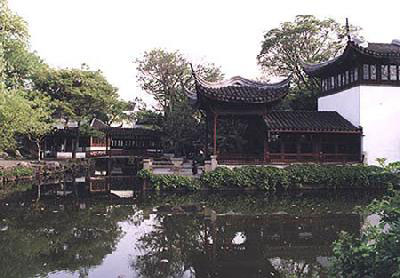
The Humble Administrator's Garden.
[File] |
The name "Wu" is often applied to refer to Suzhou, derived from the local
tribes who named themselves "Gou Wu" in the late Shang Dynasty about 11th
century BC. Later, King Helu of Wu State in 514BC built his capital here known
as the "Great City of Helu" and since then the city's site and scale have
remained virtually unchanged, making Suzhou a rare city of historical and
cultural renown in the world.
Bordering on Shanghai in the east, Zhejiang Province in the south, the
Taihu Lake in the west and the Yangtze River in the north, Suzhou enjoys a mild
and humid climate, with an annual temperature of 15 to 17¡æ and an annual
rainfall of 1076.2mm. It is easily accessible by water, land and air
communications.
Talking about Suzhou, people would mention the old saying: "Paradise in
Heaven, Suzhou and Hangzhou on earth." The style of Suzhou lies in "Softness",
like the tone of Wu dialect, which also sums up the character in feminine
beauty, tenderness, serenity, subtlety and elegance.
The natural scenery of hills and waters in Suzhou is as charming as a
delicate beauty. Of the whole area, 10% is cultivated fields, 30% hills, and the
rest covered with water. Streets and alleys in Suzhou extend side by side with
canals. Small bridges and flowing waters, white walls and dark gray roof tiles
match one another in tranquil elegance. As a poem describes, "On arriving in
Suzhou you behold: Houses are all pillowed on water's edge." The gentle waters
make the prominent urban scenery.
The poetic and picturesque Suzhou gardens are a typical demonstration of
simple elegance, with intriguing scenes found in every season and in all
weathers. The Humble Administrator's Garden and the Lingering Garden in the city
are listed in China's Four Most Famous Gardens and exert great influence on
China's and even the world's garden architecture. Endowed with abundant native
products, the rich and exquisite Suzhou cuisine sets a style of its own on this
"land of plenty". The traditional performing arts of Suzhou are best represented
by Kunqu Opera, Suzhou Opera and Pingtan (ballad singing), reputed both in China
and overseas for their minute acting and harmonic melody. The folks here are
honest, good-natured, friendly and hospitable.
A metropolis of industry and commerce along the southeastern coast of China
since ancient times, Suzhou has always been a hub for merchants, which, as the
Tang (618-907) poet Bai Juyi described over a thousand years ago, "...has a
population greater than Yangzhou Prefecture and more than half of the shops in
Chang'an, the capital". The Italian traveler Marco Polo praised Suzhou as a
"noble and great city" 600 years ago.
Today's Suzhou is an open city with developed economy and frequent exchanges
with the outside world. It has been officially declared as part of the coastal
economic open zone of the Yangtze River Delta. Comprehensive industrial system
has taken shape, and Suzhou has seen tremendous expansion in foreign trade and
international economic co-operation, establishing friendship with cities in
Italy, Canada, Japan and the United States.
