Jiangsu Province, Su for short, lies in East China. The industries
and the agriculture here are well developed. Among its agricultural produces,
the outputs of rice, cotton, silk, tea, oil and freshwater fish hold important
positions in China. Its most important industries are machinery, chemical
industry, electricity, electronics and cement. Known as a "land of fish and
rice", Jiangsu gets its name from the first character of its two cities,
Jiangning (now Nanjing) and Suzhou.
Jiangsu boasts the largest number of historical and cultural cities, such as
Worldly Heaven Suzhou, Yangzhou, Nanjing, Zhenjiang, Huai'an, and Xuzhou, etc.
Of the more than 200 lakes, the larger ones are the Hongze Lake, the West Lake,
the Tai Lake, the Xuanwu Lake, and the Gaoyou Lake, which earn Jiangsu the name
"Water Countryside". Historical relics include the Stone City in Nanjing, Dr.
Sun Yat-sen's Tomb, the Xiao Tomb of the Ming Dynasty (1368-1644), Han Mausoleum
and Pits of Terracotta Soldiers, etc. Other places of interest are Yuntai
Mountain, Zhongshan Mountain, the Suzhou Garden and the Three Caves in Yixing.
Geography
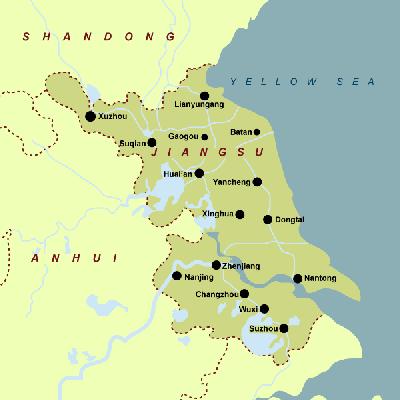
Jiangsu lies in East China and the lower reaches of the Yangtze and Huaihe
rivers, with an area of 102,600 square kilometers. Jiangsu borders the Huanghai
Sea in the east, Shandong Province in the north, Anhui Province in the west, and
Zhejiang Province in the south. The vast plains, dotted with lakes and
crisscrossed by rivers, cover 18% of the province's total land mass. With three
major river systems from north to south -- the Yishu River, the Huaihe River and
the Yangtze River, Jiangsu has well-developed irrigation systems and shipping.
The Grand Canal is an artery between the north and south.
Climate
Jiangsu Province is situated in the temperate zone and subtropical zone, with
a humid and semi-humid monsoon climate. The annual average temperature is
13¡æ-16¡æ, -2¡æ-4¡æ in January, and 26¡æ-29¡æ in July. Nanjing area is one of the
three well-known "furnaces" in the Yangtze River basin in the summer season of
China. The annual average precipitation is about 800-1200 millimeters. The
recorded heaviest precipitation of a day is 314.3 millimeters (in Dongtai City
on August 21,1965). There is more rain when plums are ripe at the time when
spring is changing into summer. It rains for a short time, but frequently. It is
a common phenomenon that it is raining while the sun is shining. Rains of this
period are generally called "plum rains". But on the other hand, because of damp
climate and appropriate temperature, mould grows quickly, so this period is also
called "mould rains". Typhoons often hit this province at the end of summer and
the beginning of autumn.
Administrative Division and Population
It is divided into 13 prefecture-level cities, 31 county-level cities and 33
counties, with a population of 74.38 million as of 2000. It is one of the most
densely populated provinces.
