Visiting Chinese President Hu Jintao in Seattle on Wednesday
called for joint efforts to resolve the issue of trade imbalance between China
and the United States.
Speaking at a luncheon here hosted by the Washing State, the Seattle business
community and local organizations, Hu said China took trade imbalance between
the two countries seriously and worked hard to address the issue.
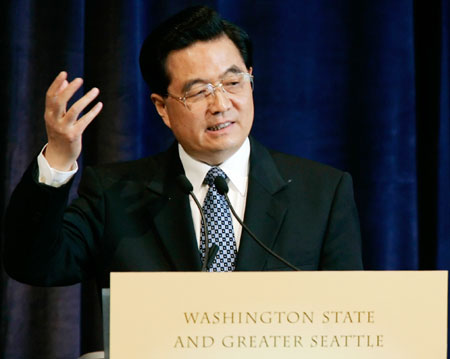
Chinese President Hu Jintao answers a question
from the audience during a luncheon at the Future of Flight, near Boeing
headquarters, in Everett, Washington, April 19, 2006. Hu is in the United
States for his first formal visit as president and a meeting with U.S.
President George W. Bush on Thursday.
[Reuters] |
"China continues to implement the
policy of expanding domestic demand to drive its economic and social
development," he said. "China does not seek a large trade surplus."
The Chinese president said his country's trade surplus with the United
States, fundamentally speaking, results from different industrial restructuring
of the two countries and the accelerated international division of labor driven
by economic globalization.
At least 90 percent of US imports from China are goods that are no longer
produced in the United States, he said.
Hu added that China had been increasing import from the United States and
worked hard to reduce its trade surplus with the country.
China will further open its market to US goods and services, the president
noted.
"On our part, we hope that the United States will take steps to
promote the export of U.S. products to China, including easing export controls
and reducing protectionist measures in the interest of addressing the trade
imbalance issue in a better and more effective way," Hu said.
On the protection of intellectual property rights (IPR), Hu said China was
firm in protecting the IPR and fighting piracy.
"We will continue to improve the legal regime for IPR protection, set up law
enforcement and crack down hard on IPR infringement to protect the lawful rights
and interests of foreign IPR proprietors in China in accordance with the law,"
Hu said.
China will continue to strengthen cooperation in IPR protection
with the United States and the international community, he noted.
As for the issue of the RMB exchange rate, Hu said China had taken "a highly
responsible attitude" in deciding upon an exchange rate regime suitable to its
national conditions in light of the actual state of its economic and social
development and the need to ensure global financial and economic stability.
He noted that last July, China put in place a managed floating exchange rate
regime based on market supply and demand with reference to a basket of
currencies.
China will continue to firmly promote financial reforms, improve the RMB
exchange rate setting mechanism, develop the foreign exchange market, increase
the flexibility of the RMB exchange rate, and improve the capacity of financial
institutions to set prices at their own discretion and to conduct risk
management, Hu said.
"Our goal is to maintain the RMB exchange rate basically stable at an
adaptive and equilibrium level," said the president. "This serves the interests
of China, the interests of the United States and the common interests of all
countries in Asia and the world at large."
On the issue of energy and resources, Hu said, "As China's economy continues
to grow, so does its demand for energy."
China, as a major energy consumer and producer, "follows the basic principle
of meeting its energy needs mainly through domestic supply," he said.
China places equal importance on energy development and conservation and
focuses on more efficient use of energy, Hu said.
He said that since the 1990s, China had met over 90 percent of its energy
demand with domestic supply.
In 2010, China's per capita gross domestic product (GDP) is projected to
double that of year 2000 and the energy consumption per unit of GDP is to be
reduced by 20 percent from that of 2005, Hu said.
"At the same time, China will speed up changing the pattern of economic
growth, vigorously develop a circular economy and build a resource-conservation
and environment friendly society to achieve sustainable development," said the
president.
He promised that China would follow international practices and
work together with the United States and other countries to conduct energy
cooperation and maintain order in the international energy market.
Hu arrived here Tuesday for his first state visit to the United States, with
Seattle being the first stop of his four-day stay in the country which ends on
Friday.
The United States is the first leg of his five-nation tour, which will also
take him to Saudi Arabia, Morocco, Nigeria and Kenya.