Top News
Deals worth US$4.4b signed with US
By Cao Desheng and Li Weitao (China Daily)
Updated: 2006-04-08 07:00
 |
Large Medium Small |
A Chinese entrepreneurial delegation led by visiting Vice-Premier Wu Yi signed an array of procurement contracts worth US$4.44 billion in Los Angeles on Thursday.
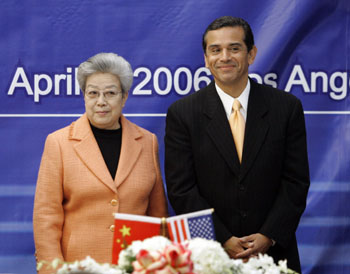 China's Vice-Premier Wu Yi (L) and Los Angeles Mayor Antonio Villaraigosa attend the signing ceremony of purchasing contracts and agreements between China and US companies during Wu's visit to Los Angeles April 6, 2006. [Reuters] |
Wu is heading more than 200 executives from 110 State-owned and private-sector companies in the visit.
She is expected to meet with US Trade Representative Rob Portman and Commerce Secretary Carlos Gutierrez next week in Washington.
The delegation signed deals with 27 US firms including software giant Microsoft Corp, GE Energy and General Motors.
The projects range from software and power generation equipment to automobiles and electronic products.
Washington and Beijing should resolve trade disputes in a spirit of "objectivity, equality and consultation and avoid politicizing economic and trade issues," Wu said at the contract-signing ceremony.
The signing ceremony was also attended by Los Angeles Mayor Antonio Villaraigosa.
"Economic and trade relations between China and the United States constitute an important part of the bilateral relations," Wu said.
"Developing healthy and stable trade ties between the two countries is conducive to the interests of the two peoples."
Last year, the China-US trade volume rose to US$211.63 billion, an increase of more than 86 times from 1979, when the two countries established diplomatic relations.
China has become the fourth-largest exporting market and the third-largest trading partner for the United States.
The United States has become China's second-largest trading partner, with bilateral trade rising 27.4 per cent annually between 2001 and 2005, Wu noted.
To date, US companies have invested in nearly 50,000 projects in China with an accumulated actual investment of over US$50 billion. In 2004, US companies recorded a sales volume of more than US$75 billion.
In the meantime, Wu said, the bilateral partnership has created millions of job opportunities in the United States.
Describing trade frictions as "natural in bilateral trade," Wu urged the United States not to politicize them.
Among the deals signed were those between US wireless firm Qualcomm Inc and China's top two telecoms equipment makers Huawei Technologies and ZTE Corp.
Each of the two contracts was valued at about US$300 million, an industry source told China Daily on Friday.
Under the deals, Huawei and ZTE will buy chipsets and software solutions from Qualcomm, a developer of mobile phone technology.
Huawei and ZTE have been focusing on the telecoms equipment business and have grown into strong rivals to established global companies.
"We believe Chinese telecom equipment manufacturers will become increasingly competitive globally," said Forrest Miller, group president of AT&T, the largest telecoms operator in the United States.
In recent years, Huawei and ZTE have also ramped up their efforts in the mobile phone sector.
ZTE last December signed a 3G handset supply agreement with Hutchison 3G.
Handset business accounted for 20.1 per cent of ZTE's total turnover of 21.6 billion yuan (US$2.7 billion) last year.
In February, Vodafone Group and Huawei clinched a landmark deal under which Huawei will supply exclusive Vodafone-branded consumer 3G handsets for Vodafone across 21 countries for at least 5 years.
By the end of last year, Huawei shipped more than 10 million mobile terminals, including 3G handsets, 3G data cards and CDMA (code division multiple) phones worldwide.
Ted Dean, managing director of technology research and consulting firm BDA (China) Ltd, said the US$600 million deals with Huawei and ZTE will "help to solidify Qualcomm's position with both vendors."
Xinhua contributed to the story
(China Daily 04/08/2006 page1)