Top News
Chinese premier arrives in Australia
(Xinhua/chinadaily.com.cn)
Updated: 2006-04-02 08:52
 |
Large Medium Small |
PERTH, Australia, April 1 -- Chinese Premier Wen Jiabao arrived in Perth on Saturday night for a four-day visit to Australia.
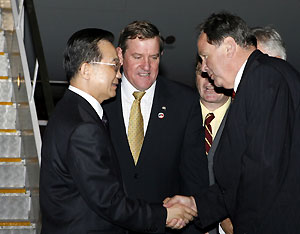 Premier Wen Jiabao is greeted by Australian officials at airport in Perth, April 1, 2006. [Xinhua] |
|
The two countries have been nutting out the deal since August last year and it will open the way for China to begin buying Australian uranium.
Wen delivered a speech at the airport, saying that China and Australia, both located in the Asia-Pacific region, share extensive common interests in many fields. "China-Australia relations now enjoy good momentum of growth; our trade ties are flourishing," he said, adding that the bilateral relations are solidly grounded and face new development opportunities.
"Fostering the all-round growth of China-Australia relationship serves the fundamental interests of our two countries and two peoples and enhances stability and prosperity of the Asia-Pacific region and the world at large," he said.
"I am visiting Australia to further the development of China- Australia relations in all fields. I look forward to exchanging views with Prime Minister John Howard and other Australian leaders on China-Australia relations and international and regional issues of mutual interest," he said.
"I also look forward to entering into extensive contact with the Australian people to enhance understanding and friendship and promote the growth of China-Australia relationship of all-round cooperation," he said.
Australia is the first-leg of Wen's four-nation tour, which will also take him to Fiji, New Zealand and Cambodia. He is also scheduled to attend the opening ceremony of the first China- Pacific Island Countries Economic Development and Cooperation Forum and deliver a keynote speech.
China-Australia ties, in particular the bilateral trade, have seen rapid development. China is now Australia's second largest goods trading partner and its second largest overseas market. Energy and mineral products account for about 60 percent of Australia's exports to China, which has become Australian's largest buyer of iron ore and nickel.
Dual-track trade between the two countries hit 27.3 billion U.S. dollars in 2005.