China's top advisory body, the National Committee of the Chinese People's
Political Consultative Conference (CPPCC), concluded its annual full
session Saturday afternoon, vowing to better serve the country's peaceful
reunification and the building of a "harmonious society".
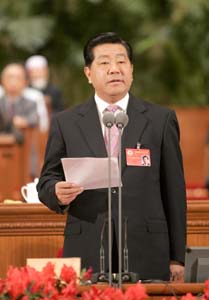
Jia Qinglin, chairman of the National
Committee of the Chinese People's Political Consultative Conference
(CPPCC), chairs the closing ceremony of the Third Session of the 10th
CPPCC National Committee in the Great Hall of the People in Beijing March
12, 2005. [Xinhua] |
"All CPPCC National
Committee members shall unite with all forces that can be united..., contribute
to the building of a harmonious socialist society..., and promote the
development of cross-Straits relations and the motherland's peaceful
reunification," urged Jia Qinglin, chairman of the CPPCC National Committee, in
his speech at the closing meeting of the 9.5-day session.
All top Party and state leaders, including President Hu Jintao,top lawmaker
Wu Bangguo and Premier Wen Jiabao, were present at the closing meeting, which
began at 3 p.m. in the Great Hall of the People in downtown Beijing.
As usual, the 2,110 advisors participating in the closing meeting voted to
adopt a "political resolution", a written document reflecting the consensus they
have reached after numerous rounds of panel discussions, voicing their full
support to the enactment of an anti-secession law aimed at preventing Taiwan's
secession from China.
The National People's Congress (NPC), China's top legislature, is expected to
vote on the adoption of the law Monday when it concludes its annual full session
in Beijing.
"Formulation of the anti-secession Law embodies our persistent stand to seek
peaceful reunification of the motherland with utmostsincerity and greatest
efforts, and manifests the common aspiration and firm determination of the
entire Chinese people to safeguard national sovereignty and territorial
integrity and neverto allow 'Taiwan independence' secessionist forces to secede
Taiwan from China in any name or by any means," said the resolution.
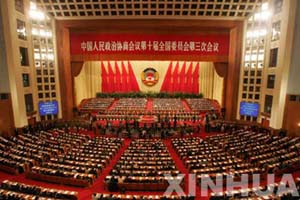
The closing ceremony of the Third Session of
the 10th National Committee of the Chinese People's Political Consultative
Conference (CPPCC) is held in the Great Hall of the People in Beijing
March 12, 2005. [Xinhua] |
Also at the closing meeting, the advisors elected Tung Chee Hwa,chief
executive of the Hong Kong Special Administrative Region whoon Thursday formally
announced his resignation request to the central government, Zhang Meiying and
Zhang Rongming as new vice chairpersons of the CPPCC National Committee.
The three new CPPCC leaders were invited to take seats at the front row of
the central rostrum immediately after the election.
The advisors also adopted several other resolutions, respectively regarding
the work of the Standing Committee of the CPPCC National Committee over the past
year, the handling of and feedback to the proposals and suggestions they put
forth at last year's full session, and the examination and acceptance of their
proposals this year.
Proclaiming the "complete success" of the session, Jia said the once-a-year
gathering of the advisors has been "democratic, truth-seeking, united and
progressive", resulting in "fruitful outcomes."
"We shall earnestly study and implement the important guidelines set forth by
the Communist Party of China (CPC) Central Committee regarding the building of a
harmonious socialist society," he said.
According to Jia, a harmonious socialist society refers to a society that
features democracy and a rule of law, justice and fairness, honesty and rapport,
vitality and stability, as well as a harmonious co-existence between man and
nature.
Political advisors nationwide shall also earnestly study and implement the
"four-point guidelines" set forth by President Hu Jintao on the development of
cross-Straits relations under new circumstances, and unite with all patriotic
personages at home and abroad to "resolutely oppose and check 'Taiwan
independence' secessionist activities," added Jia.
Founded in 1949, the CPPCC consists of elite members of the Chinese society
who are willing to serve as the think tank for the government and for the
country's legislative and judicial organs.
As an open forum where the CPC, the country's non-Communist parties and
people without party affiliation discuss state affairsfreely and on an equal
footing, the CPPCC is also regarded as an ideal interpretation of China's
"socialist democracy".
(For more biz stories, please visit Industry Updates)