China's taxation
administration will speed up reform to levy unified income tax on domestic and
overseas-funded firms, said top tax official Xie Xuren at a press conference on
the sidelines of the ongoing annual parliament session at the Great Hall of the
People in Beijing.
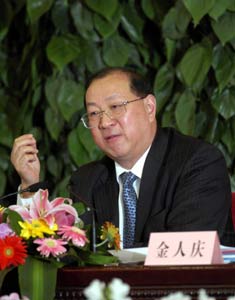
Finance Minister Jin Renqing speaks during a
press conference for the Third Session of the 10th National People's
Congress (NPC) of China in Beijing, March 9, 2005.
[Xinhua] |
"We have to unify income tax for local
companies and overseas-invested firms to cater to the new situation brought
about by China's entry into the World Trade Organization (WTO) in 2001 and boost
fair competition among all businesses," said Xie, director general of the State
Administration of Taxation.
China's top legislature, the National People's Congress, has listed the Law
on Enterprises' Income Tax in its lawmaking plan for 2005.
NPC deputy Cheng Faguang revealed earlier Wednesday that China might unify
the income tax rates in 2008.
"This was in my most optimistic forecast," Cheng, also a member of the NPC
Financial and Economic Committee, told Xinhua on the sidelines of the NPC's
annual session.
Xie said his administration has carried out in-depth research on the
unification with other departments concerned, and would speed up reform of the
taxation systems in line with the legislative procedure.
The actual income tax rate has remained at 14 percent for overseas-funded
businesses, much lower than the 24 percent for domestic firms, since China
formulated the preferential policy for overseas-funded enterprises in mid-1980s
in a bid to lure foreign investment.
Experts and local companies have complained the policy does notcomply with
WTO principles and as a kind of discrimination against domestic firms, it also
results in reduction of China's tax revenues.
Personal income tax base line
While answering the question about personal income tax, Xie said it was
necessary to raise the base line of personal income tax to a certain extent
because of increased urban workers' salary income and residents' expenditures.
The Ministry of Finance and the State Administration of Taxation have drafted
a preliminary plan for the raise and would submit it to the State Council, or
the central government, for deliberation, he said.
The State Council then will submit it to the national legislature for further
deliberation and, once the bill was approved, the related clauses of the
personal income tax law will be amended, said Xie.
According to China's tax law, Chinese citizens are entitled to pay personal
income tax for their salary and ten other kinds of incomes. In case of personal
income tax, the part of their monthly income exceeding the 800-yuan (97 US
dollar) mark has been taxed ever since the tax was introduced in 1980. Some
localities have adjusted the norms for taxation but a unified national
adjustment is still available yet.
If the government fails for long to raise the 800-yuan mark when the people
earn much more, argue experts, the role of taxation as a lever to adjust the
income gap will be negligible.
State-owned commercial banks reforms
China is capable of financing reforms of its state-owned commercial banks,
said Finance Minister Jin Renqing on Wednesday at the same press conference.
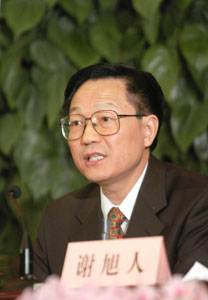
Xie Xuren, director general of China's State
Administration of Taxation, speaks during a press conference for the Third
Session of the 10th National People's Congress (NPC) of China in Beijing,
March 9, 2005. [Xinhua] |
"We have to pay for the transformation of state-owned banks into joint-stock
banks and their asset reshuffle, and the Treasury is ready to foot the bill,"
Jin said.
Jin said the Finance Ministry has issued 270 billion yuan (32.5billion US
dollars) of treasury bonds to boost the banking sector,and will probably finance
the separation of an additional 1.4 trillion yuan (168 billion US dollars) of
non-performing assets from state-owned banks.
The finance department may also adopt preferential tax policies to support
the banks' joint-stock reform, either by allowing the banks to dispose of some
non-performing assets before tax payment, or returning to them some of the
income tax proceeds. "Whatever measures to be taken depends on the future
financial situation," he said.
The Chinese government has spent 45 billion US dollars of its foreign
exchange reserves to bolster the balance sheets of state-owned Bank of China
(BOC) and China Construction Bank (CCB).
Governor Zhou Xiaochuan of the People's Bank of China, or the central bank,
said on Monday the share-offerings and listings of BOC and CCB are "not too far
away."
Prudent fiscal policy suits demand for macro-control ¡¡¡¡
On the issue concerning fiscal policy, Jin said China's decision to shift its
fiscal policy from "proactive" to "prudent" this year was in line with the
changes in the macroeconomic situation and suits the needs for macro-regulation.
Following the prudent fiscal policy, the government would cut this year's
fiscal deficit by 19.8 billion yuan (2.4 billion dollars) to 300 billion yuan
(36.2 billion dollars, he said.
Long-term treasury bonds to be issued this year would be 30 billion yuan (3.6
billion dollars) less than last year, continuinga dropping streak to stand at 80
billion yuan (9.7 billion dollars).
Meanwhile, the share of fiscal deficit to the gross domestic product (GDP)
would further shrink to an estimated 2 percent this year, 0.5 percentage points
lower than last year, the minister said.
The Finance Ministry would spend more T-bond proceeds to agriculture,
science, education, culture, health and social security, while promoting tax
reforms in the countryside and improving the export tax rebate system.
"We'll vigorously promote the reform and the value-added tax and the
unification of income tax for domestic and overseas-funded firms" to improve the
investment environment, said the minister.
Implementing the prudent fiscal policy also calls for intensified efforts to
increase tax revenue and reduce financial expenditures, he added.
Jin spoke highly of the proactive fiscal policy the government adopted since
1998 in the wake of the Asian financial crisis, saying a total of 910 billion
yuan (110 billion US dollars) of long-term T-bonds were issued in the seven
years, which contributed 1.5 to 2 personage points to China's economic growth
and helped achieve a "soft landing" of the economy.
Despite the achievements, some unhealthy and unstable factors have occurred
in China's economic development, said Jin, pointing to the excessive and
fast-increasing investment in some industries, the excessive increase of money
supply and the huge amount of non-government investment.
To follow the scientific concept of development, "we should boost the
development of agriculture, science, education, culture and health, social
insurance and other industries," said the minister.
"Under such circumstances, it is completely necessary and possible to reduce
the actual investment of the government," he added.
Fuel tax
Commenting on the fuel tax issue, Jin Renqing said the government is
determined to levy fuel tax but needs to find an "opportune time."
The launch of fuel tax would help cut consumption of gasoline and diesel oil
and preserve the environment, Jin said.
"We already put in place plans to replace road tolls with the fuel tax
several years ago," he said.
However, the minister explained, it's not the right time to roll out the fuel
tax now because China still needs to consider the price factor.
"Although the fuel tax will not increase the burden of consumers as a whole,
it will result in more tax payment from taxi drivers if the present taxi fare
remains unchanged," said Jin.
"If we don't raise the taxi fare for the benefit of the ordinary people, car
users will have to pay more."
To maintain a stable price, "we need further study on how to balance the
interests of various social groups," said the minister.
He said it's also unwise to roll out the fuel tax when oil price is soaring
on the international market.
International oil price has jumped from 20 US dollars per barrel to top 45 US
dollars, or the highest of 60 US dollars.
"To levy the fuel tax when oil price stays at such a high levelmay add the
costs of businesses and affect the country's economic development," he added.
(For more biz stories, please visit Industry Updates)