BJW's pick of traditional ways to mark the important occasion of China's National Day in the capital, as well as some favorite places to enjoy your holiday.
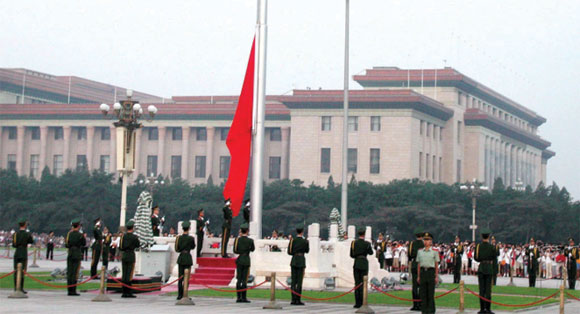
Tian'anmen flag raising
Since late August, Tian'anmen Square has been adorned with colorful, floral displays of the Olympic flame, Hall of Prayer, Great Wall and the ancient Parthenon of Athens, all in mini-scale. October 1's grand dawn flag raising ceremony is an inspiring sight. Thousands of people from every corner of the nation camp out overnight under the flagpole, seizing a better vantage point from which to watch the morning ceremony. Visitors can enter the venue from 2am. Flag raising 6:10am.
Drum and Bell Towers
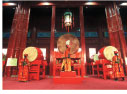
Hearing the first bell sound on National Day at the Drum and Bell Towers (Zhong-Gu Lou) is another way to mark the occasion. In Dongcheng District, the towers represent the old city. They were originally used as musical instruments, and later for telling the time. The copper bell is the largest and heaviest in China and can be heard from far away. The drum tower once housed one large and 24 smaller drums, but only the big drum remains. It is beaten quickly 18 times and then slowly another 18 times. 9:10am - 5pm. Entry 15 yuan Bell Tower; 20 yuan Drum Tower.
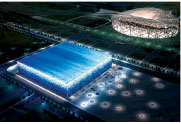
Bird's Nest
See the star of Beijing's Olympic preparations -- the National Stadium, fondly known as the Bird's Nest. At a cost of $500 million, it lies north of the forth ring road, and will seat 100,000 during the Games. The national aquatics center, or water cube, another landmark building in the Olympic Green, is north of the stadium. The design uses state-of-the-art technology and material to create a building that is visually striking, energy efficient, and ecologically friendly.
Beijing Zoo
Hordes of visitors come to see the famous giant panda and golden monkey, but there are many other interesting animals from Chinese provinces and overseas, including the red panda, Manchurian tigers, yaks from Tibet, enormous sea turtles, Indian elephants, and zebras and giraffes from Africa. The grounds feature cultivated flower gardens, dense groves of trees, grassland, a small stream, lotus pools and hills dotted with pavilions and halls. CD-like ticket contains music and video clips of the wild animals. Located west of Beijing City (2km west of XiZhiMen subway station), next to Beijing Exhibition Hall. Entry 15 yuan. 7:30am - 5:30pm.
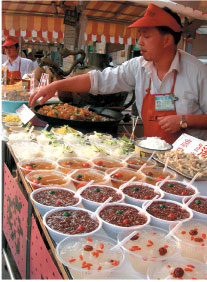
Donghuamen night market
Situated at the entrance of North Street Wangfujing, Donghuamen Night Snack Street is the most famous in Beijing. Kebabs of squid, liver, shrimp, scorpions, grasshoppers, eel, centipede and seahorse are all there for those who dare. They are fried in oil and served with a sprinkle of spices, and are ideal for a bite on the walk home. Dessert? Try live sea snails.
Panjiayuan antique market
Also known as the Dirt or Ghost Market, it is Beijing's biggest and best-known arts, crafts, and antiques market. Prepare for crowds and heavy haggling, but most importantly, soak up the lively market atmosphere. In addition to artworks and antiques there are jewelry, beads, home dcor, shoes, art supplies and every other Chinese curio or knick-knack imaginable. Also a huge selection of Buddhist statues and temple artwork. The market opens very early on Saturday and Sunday and winds down around 4:30pm. Arrive early for the best finds.
Houhai Lake
A great place for dinner, and then migrate to nearby nightspots, including disco pub Zone, La Baie Des Anges, and Aladdin. With the glow of lights over the lake Houhai takes on a magic atmosphere. A mix of old Beijing and the modern, the area is perfect for a romantic stroll by the lake. Also check out the range of unique fashion stores and nearby Nanlouguxiang.
Beihai Park
With the Forbidden City and Jingshan Park to its east, Zhong Nan Hai to its south, Beihai Park is one of the oldest, largest and best-preserved ancient imperial gardens in China located in the center of Beijing. The royal park is famous for White Pagoda, Hao Pu Creek Garden, Quiet Heart Studio, Nine-Dragon Screen, and Five-Dragon Pavilions. Water lilies, peonies and other water plants make Beihai a natural beauty. Entry 10 yuan . 6am-9pm
Bus from South Gate: 101, 103, 109, 812, 814, 846; North Gate: 107, 111, 118, 701, 823
Lantern festival
At Longtan Lake Park, Chongwen District, lanterns of all shapes and sizes will light the way for those boating on the lake. Besides the display, the festival atmosphere is heightened with a concert, folk performances and a lantern riddle competition. It is the largest lantern show in Beijing, featuring 45 groups of lanterns. Entry 2 yuan before 4pm; 10 yuan from 4pm to 10pm. Until December 7.
Bus Nos 6, 60, 807, 812 or 116
Old Observatory
A haven of tranquility, the Old Observatory is one of the world's oldest astronomical sites, located in the Dongsheng district next to the Jianguomen metro station. Here, you will find the 14 meters Ziwei Palace, plus Chinese ancient astronomical equipment and astronomy exhibited on its roof. Once you have experienced the stunning view from the roof of the Ziwei Palace, take a closer look at the observatory's inner courtyard. Peaceful and shaded by trees, one can find numerous small exhibitions that give a more detailed account of the history of astronomy. Entry 10 yuan. 9-11 am; 1-5 pm. Closed Monday and Tuesday.
(China Daily 09/27/2007 page16)