Top Biz News
Measures to bring down surplus
By Dai Yan (China Daily)
Updated: 2006-03-29 06:14
 |
Large Medium Small |
China will need up to three years to achieve a trade balance and the surplus will be brought down by means other than currency adjustments, the central bank's chief has said.
"We reckon China may need two to three years to achieve a balance in international trade" after a mix of measures were introduced, Zhou Xiaochuan, governor of the People's Bank of China (PBOC), said in a speech delivered on March 20 but published on the bank's website yesterday.
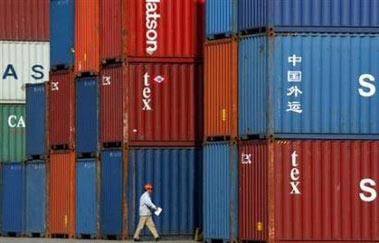 A worker walks past containers at the Longwu Port in Shanghai, February 13, 2006. [Reuters] |
But even if China rebalances its global trade, the United States might still incur large deficits and it would still be very difficult to achieve a bilateral trade balance, the governor said. "So the ball is not in China's court."
Ahead of President Hu Jintao's visit to Washington, pressure is building over the yuan's value and the United States' stated US$202-billion trade deficit last year with China.
US Senators Charles Schumer and Lindsey Graham will decide this week whether to seek a vote on a bill that would impose tariffs on Chinese imports unless the yuan is allowed to strengthen more rapidly.
"Some US economists assume that the exchange rate is the key to fixing the trade imbalance However, such assumptions failed in statistical tests by using the trade data and the real effective exchange rate recorded in China over the years," Zhou said.
There are also complaints in China that the United States has been slow in taking concrete measures to reduce its budget and current account deficits; and improve the savings rate, Zhou pointed out.
The governor said joint efforts are needed to address the Sino-US trade imbalance.
PBOC spokesman Li Chao said in an interview, also posted on the bank's website yesterday, that China would further improve the yuan's exchange rate mechanism and develop the foreign exchange market.
China allowed the renminbi to appreciate by 2.1 per cent against the US dollar to 8.11 and linked it to a basket of foreign currencies instead of only the greenback on July 21 last year.
Market forces will be key to gradually let the currency move freely and China doesn't plan one-off adjustments of the yuan's value in the future, Li reiterated.
Instead of another revaluation, the government will allow demand for the yuan and changes in the value of other currencies play a bigger role in setting its value, Li said.
(China Daily 03/29/2006 page1)