Wintry fun a hot draw for tourists from near and far









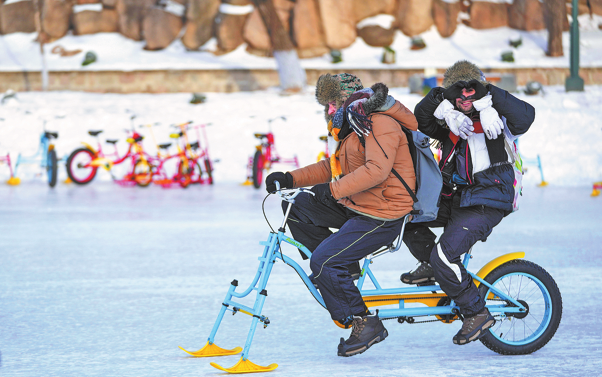
A burly tractor rumbles across the vast snowfield, hauling two snaking lines of adventurers. Each is nestled in an inflatable snow tube, all roped together, gliding effortlessly through the howling wind and swirling snow with cries of delight.
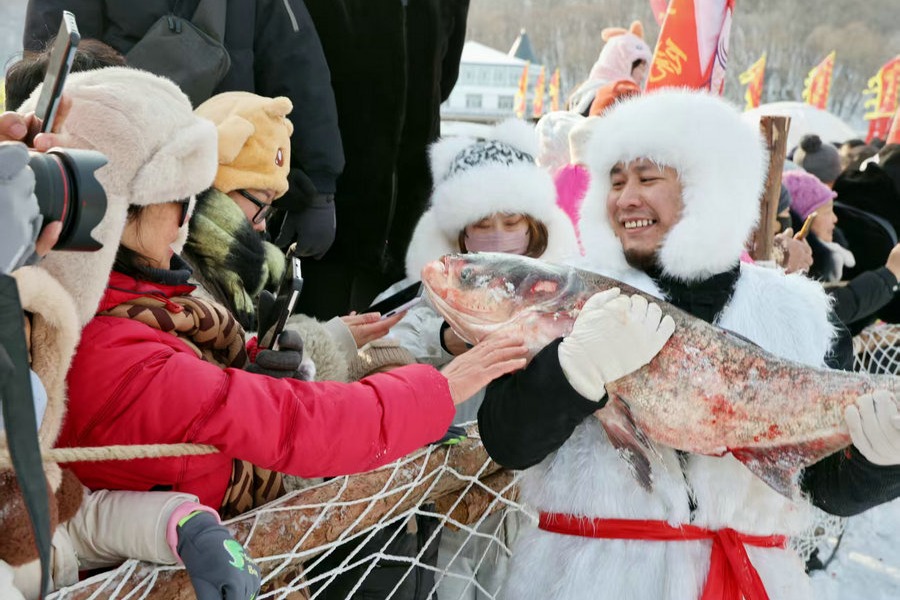
At the Jingpo Lake scenic area in Ning'an, Heilongjiang province, the sled takes them to the lake's frozen heart to witness the traditional winter ice fishing.
The fishermen chant and carefully lower a massive net into the icy depths. The climax comes when dozens of them work together to haul the net up, revealing a spectacular harvest of fish leaping onto the ice.
"The cold bites, but the excitement is so real," said Liao Xiaohan, a 32-year-old tourist from Chongqing, who's bundled up from head to toe against the approximately — 18 C cold, with frozen eyelashes.
"The picturesque view of Jingpo, a magnificent volcanic lava barrier lake featured in school textbooks, has captivated me and made me long to see it for myself."
The city of Ning'an was historically a dreaded cold frontier and a harsh land of exile during the Qing Dynasty (1644-1911). It was called Ningguta during the Ming and Qing dynasties (1368-1911). Its very name was once enough to make one tremble. Now, it draws visitors eager to delve into its poignant past, many of whom first heard of it through costume dramas.
Growing up in the downtown area of Chongqing, where snow scarcely falls, Liao, like many people from China's warmer southern regions, said she always longs for the crisp chill and endless white expanse of a true northern winter.
In addition to traditional winter sports like skiing and skating, China's unique snow-based activities and immersive winter experiences are attracting domestic tourists such as Liao, as well as inbound tourists who benefit from China's facilitative visa-free policies and their expansion to more countries.
During the ongoing ice and snow season, there is also a significant surge of inbound tourists to various winter destinations across China.
Data from the General Administration of Sport of China showed that, in the first month of this year's ice and snow season, ski resorts across the country received a total of 35 million visitor trips, a year-on-year increase of 10 percent. The number of inbound visitors reached 190,000, marking a 66 percent increase compared with the same period last year.
According to travel platform Trip.com Group's latest data, as of December, inbound bookings for ice and snow destinations have nearly doubled overall year-on-year. Among the most popular destinations, the Xinjiang Uygur autonomous region saw an increase of 158 percent, while bookings for the Inner Mongolia autonomous region rose 141 percent and those for Hebei province were up 130 percent.
Booking data showed that the majority of inbound visitors came from Singapore, Malaysia, Thailand, South Korea, Russia and Australia.
Wu Liyun, a professor at Beijing International Studies University's China Academy of Culture and Tourism, said, "The popularity of Chinese winter destinations is extending to snow-scarce Southeast Asia, as well as to Russia, which is itself a winter destination.
"For these inbound visitors, the draw is not just ice and snow, but also the diverse cultural experiences and festive activities in the winter setting," Wu said.
According to Wang Xiaoxue, deputy head of the Mafengwo Tourism Research Institute in Beijing, popular winter destinations in northeastern China are upgrading their infrastructure and developing innovative offerings that blend ice and snow with live concerts, auroras, intangible cultural heritage, folk culture and travel photography.
Wu added that Harbin, the capital of Heilongjiang province, recently began offering direct chartered flights to more Southeast Asian countries, which has also increased visitor arrivals.