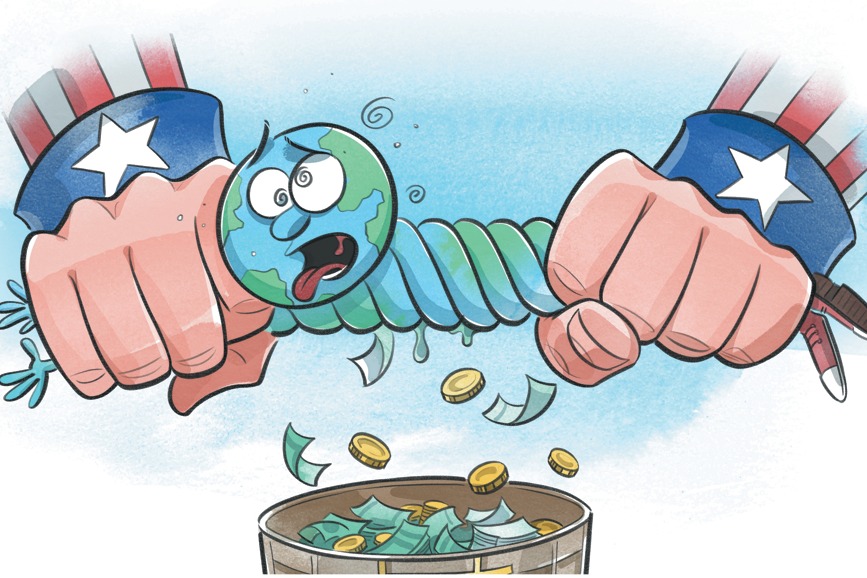
Politicizing normal business cooperation undermines market rules and shared interests









In a letter to US Commerce Secretary Howard Lutnick and another to Ford CEO Jim Farley, John Moolenaar, who chairs the US House Select Committee on China, sought to cast suspicion on normal, market-based cooperation between US-based and Chinese enterprises.
Moolenaar’s actions follow the now familiar pattern of overstretching the concept of “national security”, politicizing economic and technological exchanges, and substituting conjecture for evidence.
Such moves run counter to market rules, hurt US companies and consumers, and undermine the stable development of China-US economic and trade relations.
Responding to the latest accusations, Liu Pengyu, spokesperson for the Chinese embassy in the United States, made China’s position clear: China has consistently opposed the politicization of trade and technology issues and the abuse of “national security” pretexts, and hopes the US side will take concrete actions to keep global industry and supply chains stable.
This stance is fully aligned with the consistent statements of China’s commercial authorities, which have repeatedly emphasized that China-US economic and trade relations should be based on market principles, with mutual benefit and win-win outcomes as their essence.
The facts surrounding the cases cited by Moolenaar speak louder than rhetoric. The congressman alleged that Nvidia’s cooperation with Chinese companies and Ford’s partnership with CATL pose “security risks”. But as Nvidia stated, China has ample domestic chips for its needs and it would make no sense for China to depend on US technology. Ford, for its part, stressed that expanding lithium iron phosphate battery production in the US through licensed technology is an investment in US workers, local economies and energy security, while complying with US laws and tax credit requirements.
What is conspicuously absent from Moolenaar’s latest China-targeted lobbying campaign is substantiated evidence. Assertions that “inevitable” violations will occur if US companies engage with Chinese partners amount to presumption of guilt by association. Such reasoning ignores due process, commercial reality, and the fact that companies operate under regulatory oversight.
Moolenaar’s political theater also raises a practical question the congressman has yet to answer: if US companies such as Nvidia, Ford, and many others, were to follow his urges and sever ties with Chinese partners and suppliers, who would pay for the resulting surge in production costs? Market competition has demonstrated that many Chinese products and services offer outstanding cost-performance advantages. Forcing abrupt “decoupling” would translate into higher costs for US manufacturers, reduced competitiveness, and ultimately higher prices borne by US-based consumers.
Studies by the Federal Reserve system, the National Bureau of Economic Research, and the Peterson Institute for International Economics have consistently found that trade with China has significantly lowered US consumer prices, effectively increasing households’ purchasing power.
One widely cited finding shows that a 1 percentage point increase in Chinese import penetration is associated with roughly a 1.9 percentage points decline in consumer prices. These are not ideological claims, but empirical conclusions drawn from rigorous analysis. Ignoring them is a sign of obdurate prejudice.
China-US trade supports large amounts of jobs on both sides of the Pacific, stabilizes global supply chains, and contributes to the well-being of the US economy. From affordable consumer goods to advanced manufacturing inputs, the benefits are tangible. Attempts by some China hawks in Congress to rewrite these realities through political posturing risk inflicting real harm on the very constituents they claim to represent.
As lawmakers with significant influence over US policy on the world’s most consequential bilateral relationship, members of Congress bear a responsibility that extends beyond partisan posturing. They should show professionalism and pragmatism, grounding proposals in facts and outcomes rather than illusion and personal ideological prejudice. Abandoning zero-sum thinking is not a concession; it is a prerequisite for safeguarding US economic interests.
In this regard, Chinese Foreign Minister Wang Yi’s remarks during his meeting with a visiting US House delegation in September remain highly relevant. He expressed the hope that US lawmakers would understand China accurately, view differences rationally, and explore cooperation actively, noting that the hard-won stabilizing trend in China-US relations should be cherished. China and the US, he stressed, are partners rather than rivals or enemies, and need to enhance dialogue, avoid misjudgment and promote mutually beneficial cooperation.
History and economics both show that politicizing normal business cooperation leads nowhere. If Moolenaar and other like-minded US lawmakers truly care about US prosperity and global stability, they would do well to heed market rules, respect facts, and let cooperation — not confrontation — prevail.