Power of education shines in Xizang
Dedicated teachers make deep personal sacrifices to ensure opportunities for youngsters










Extended commitment
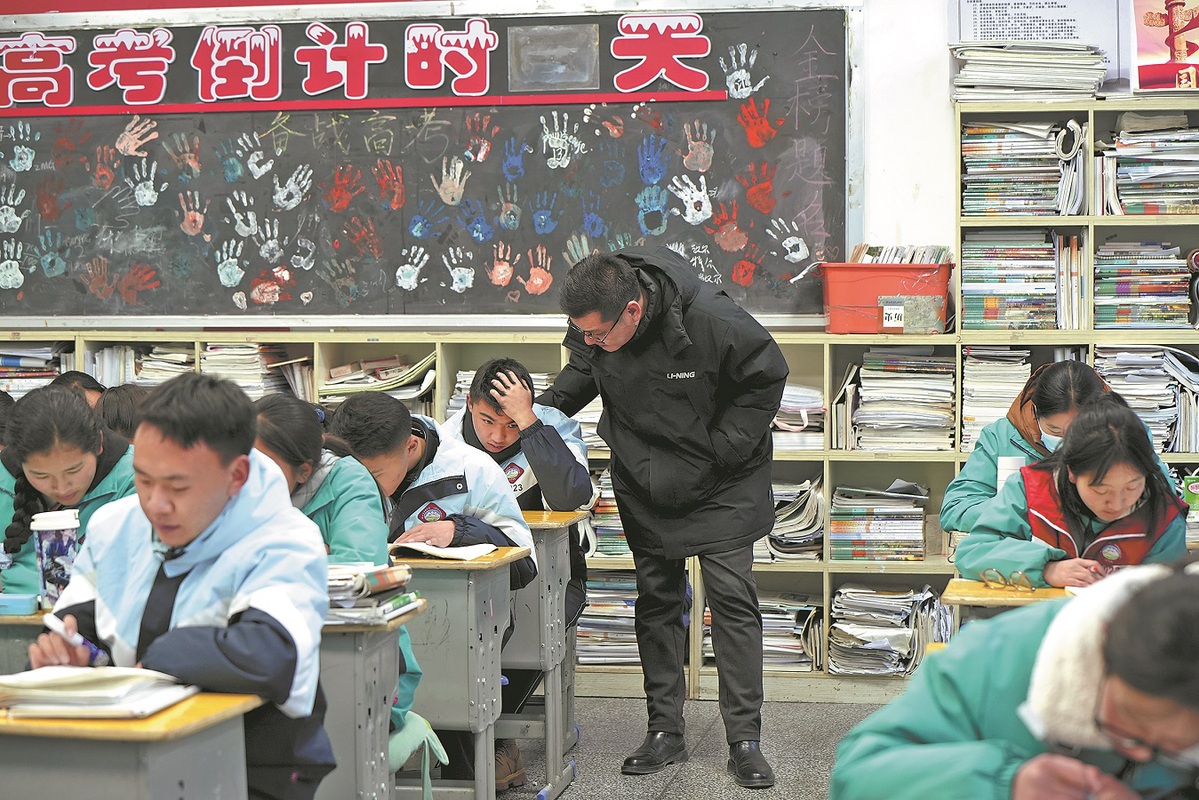
Zhang Yi, another SNNU graduate, has spent 18 years in Nagchu, at an average altitude of 4,500 meters — the highest prefecture-level city in China.
When he first arrived in the city in the early 2000s, he lived in a student dormitory with five others, fetched water from a well, and burned dried yak dung for heat and cooking during winter. He recalled the terror of using a pressure cooker for the first time: "When the steam shot up, we all ran out and shut the door."
Why stay? "Modern education in Nagchu only started in 1956. The foundation is weak. I feel I can realize more of my value here," Zhang said.
He has served as a teacher, a municipal education bureau officer, a primary school Party secretary, and now a high school leader. "From the beginning, I told my students and colleagues: I'm not an outsider. I am here to work for Nagchu."
He said he became used to the high altitude very quickly. Zhang describes Nagchu as "a land where no trees grow".
Yet, he holds a firm conviction that through dedicated educational work and sustained support for the region, seeds of knowledge and talent can be sown.
"These seeds will one day grow into towering trees, providing a continuous stream of vitality and robust intellectual support for the development of this ancient land," he said.
As a school administrator, he hopes that more people will come to Xizang, and specifically to Nagchu, to take root and build their lives there. He acknowledges the formidable challenge of the high altitude but emphasizes that the local people's yearning for quality educational resources is more urgent than anywhere else. For graduates who choose to stay, it is here that they can maximize their potential and realize their fullest value, he said.
A critical bridge between SNNU and Xizang is its internship program, which is led by Pang Wei, an associate professor in the School of International Studies at the university who has taken students to the plateau for four years. Since 2020, she has accompanied 184 interns, all but three of whom stayed to teach after graduation.
Pang's role goes beyond academic guidance. She brings pulse oximeters, oxygen supplies, and glucose to monitor and treat students' health. To ease their anxiety, she rents tents and organizes gatherings where interns from different schools share experiences.
The interns bring not only manpower but new teaching methods. Nyima Phentok, vice principal of Lhasa No 2 Senior High School, said the SNNU students "inject fresh vitality" into the teaching corps.
Pang witnessed the remarkable transformation of her students over the three months on the plateau. She recalls that upon first arriving in Xizang, the students were filled with anxiety due to the high-altitude hypoxia and unfamiliar environment, constantly asking, "When will this internship end?" Yet, as their departure neared, their reluctance was palpable. "They didn't want to leave," she said.
Pang said teaching on the plateau isn't like the dramatic portrayals in films and TV shows. "There are no legends of scores jumping from 10 to 100."
Especially in schools located in remote, high-altitude border areas, she noted that students often have a relatively weaker foundation, making significant academic improvement in a short time very difficult. "But the meaning of education," she emphasized, "lies in quiet dedication and perseverance".