Funeral services by hospitals banned









Medical institutions across China are explicitly prohibited from providing funeral services, outsourcing morgue operations or deceiving bereaved families into making high-cost purchases, according to a regulation issued on Monday by the National Health Commission and five other government entities.
The document, aimed at standardizing postmortem services in medical and healthcare institutions, lays out detailed protocols for handling the affairs of deceased patients. It seeks to ensure dignified treatment of the dead, improve the medical service environment and establish clear operational procedures for healthcare facilities.
The move follows a nationwide campaign launched in October 2024 to combat corruption in the funeral and burial industry, as well as a subsequent crackdown targeting irregularities within medical institutions.
In line with the new rules, medical facilities are required to establish a traceability system for death certificates. Health authorities at all levels must also strengthen coordination with public security and civil affairs departments to prevent and punish the illegal issuance or resale of death certificates.
To improve the efficiency of body transfers, the regulation allows hospitals to set up temporary corpse storage areas when necessary. These facilities may be located near key departments or in centralized areas within the institution to temporarily hold bodies until transportation arrives.
The regulation reaffirms that medical institutions must focus on their core responsibility of providing healthcare and are barred from engaging in funeral services.
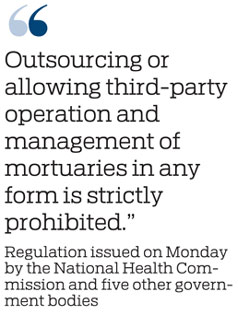
"Outsourcing or allowing third-party operation and management of mortuaries in any form is strictly prohibited. Medical institutions are also forbidden from introducing outside organizations or individuals to provide funeral services on their premises through renting space, cooperation agreements or service procurement," the document said.
Hospitals are instructed to strengthen inspections in key areas to prevent and stop external personnel from conducting funeral services inside their facilities.
Medical institutions are also barred from displaying or selling funeral supplies, lighting incense or candles, or burning sacrificial items on their premises. They are prohibited from receiving or storing bodies from external sources and may not provide body storage services on behalf of other institutions.
The use of hospital vehicles — including pre-hospital emergency and nonemergency medical transport vehicles — to transfer human remains is also forbidden.
To strengthen the protection of personal information, medical and health institutions must establish systems to safeguard the data of deceased patients and their families.
Hospital employees are barred from contacting funeral service providers on behalf of bereaved families, disclosing family information, recommending specific providers or colluding with them to induce families into high-cost purchases.
The regulation also calls for stronger interdepartmental cooperation to curb misconduct in the sector, including unauthorized body-handling services, pricing violations, illegal charges, monopolistic practices and unfair competition by funeral operators near hospitals.
Any irregularities discovered during inspections must be dealt with severely to create an effective deterrent. Violations of the law will be referred to relevant authorities for further action.





Today's Top News
- PBOC cuts rates on targeted monetary tools
- Legal tools essential for AI regulation
- China calls for dialogue on Iran situation
- Denmark rebuts Trump's Greenland security claims
- China, Canada vow to enhance bilateral ties
- Xi's speech at Central Urban Work Conference to be published