Caracas moment









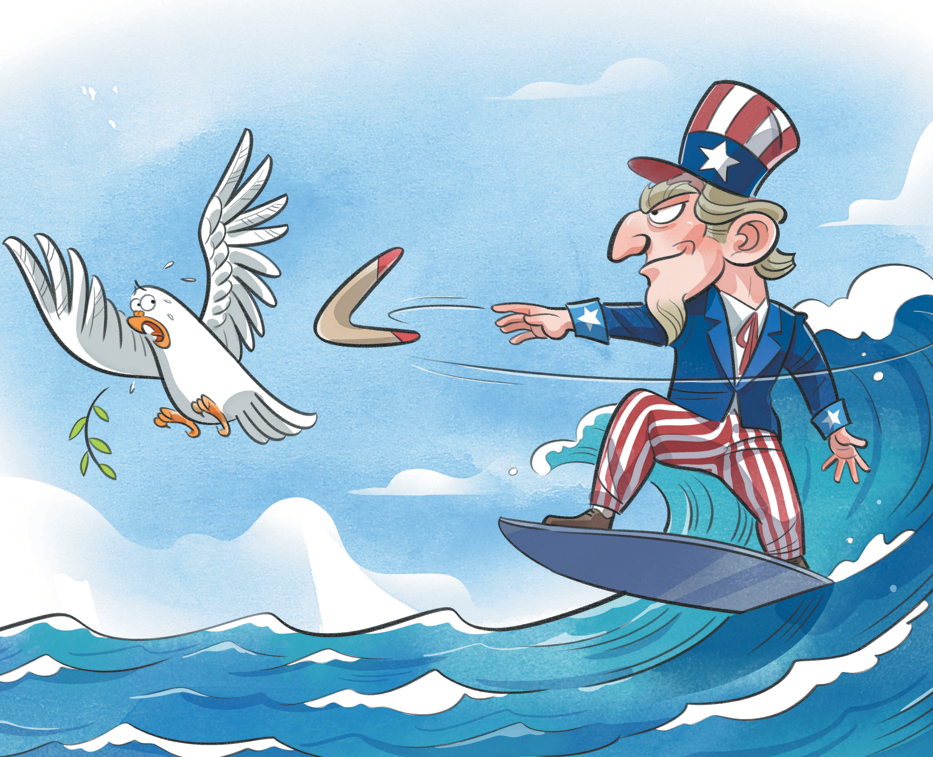
By invading Venezuela, the US has shown that it has not learned the lessons of its past military adventurism
The United States launched a military attack against Venezuela on Jan 3, and within a few hours, seized Venezuelan President Nicolas Maduro and his wife, and took them to the US.
The US has repeatedly stated in the media that "Maduro leads a huge drug trafficking organization" and that "the drugs they sell seriously harm the United States".
This is just the most presentable reason for action that the US government can publicly disclose. In essence, the US aims to achieve two objectives through this military action: to seize Venezuela's resources, particularly oil; and to convey the message to the world that the Americas remain the US' domain.
On Jan 6, the US announced that the interim government of Venezuela would transfer 30-50 million barrels of oil to the US; this oil will be sold at market prices, and the proceeds will be regulated by the US government, which says it will ensure that these funds are used "to benefit the people of Venezuela and the United States".
On Dec 2, 2025, the White House issued a presidential proclamation introducing the so-called Trump Corollary of the Monroe Doctrine, emphasizing that "the American people will always control their own destiny in our hemisphere". On Dec 4, the new version of the National Security Strategy report of the US declared its intention to restore its "outstanding position" in the Western Hemisphere. On Dec 6,US Defense Secretary Pete Hegseth publicly stated that the US will rebuild its political and economic privileges in the Western Hemisphere with its superior military strength.
The US has won a tactical battle but lost the strategic one. It is too early to say that the US has fully attained what it wants by taking this military action in Venezuela.
The US has incurred significant costs in terms of its national image and international moral standing as a result of this action, which may far exceed what the US can get from Venezuelan oil revenues. This action is a blatant military invasion by the US, grossly violating Venezuela's sovereignty, territorial integrity and national dignity. It shows that the US is pushing the world toward the law of the jungle. But it is no longer the colonial era, and the international power structure has undergone fundamental changes and international law has replaced the law of the jungle. In this era, Global South countries are rising collectively and are increasingly unwilling to tolerate reckless unilateral actions by the US.
Faced with the brutal action of the US, the UN Security Council held an emergency meeting on Jan 5, during which representatives from multiple countries stated the US military action against Venezuela violated international law. UN Secretary-General António Guterres issued a statement saying that the US' actions did not respect international law; the UN Charter prohibits the use or the threat of use of force against the territorial integrity or political independence of any country. Russia, China, Brazil, Mexico, Chile, Cuba, Colombia, Belarus, Iran and many other countries have condemned the US for its lawbreaking, demanding the immediate release of President Maduro and his wife. Even many Western countries have not stood clearly with the US.
Prior to this, people got the impression that the US had learned the lessons of its failed military adventurism; it was no longer fixated on wantonly using military force; and it had started strategic contraction to focus on solving its domestic problems. Now it seems that the US has only "shrunk" to the Western Hemisphere. It has not stopped using force to achieve regime change. It is reported that the US has appointed a "governor of Venezuela" and is studying whether to station US troops in Venezuela. Even if Washington can foster a pro-US regime in Venezuela, it cannot "take care of" Venezuela simply by giving orders. The US may have to continuously invest manpower and resources in that country, which will not help the US solve its own problems. Instead, it may exacerbate these problems. This will intensify internal political chaos in the US.
Even in terms of decision-making procedure, the military invasion of Venezuela by the US is not flawless. The US Constitution stipulates that only Congress has the authority to declare war on other countries, but the military action against Venezuela was neither declared nor authorized by Congress. Some members of Congress have expressed their opposition to this military action, questioning its legality. Some Democrats are demanding the president's removal. This will exacerbate already-existing contradictions between the US executive and legislative powers, as well as between the two political parties, not to mention that many US citizens do not support what the US administration has done. US political scientist John Mearsheimer said this demonstrates that the US is a "rogue state", and there was "no threat from Venezuela".
In the current "energy revolution" that is in full swing, the US will be left even further behind. Throughout history, all technological and industrial revolutions were triggered by energy revolutions. The US administration has a particular fondness for highly-polluting and unsustainable fossil fuels, resisting clean, safe and sustainable new energy sources. This is one of the main driving forces that pushed the US to launch its military invasion of Venezuela. By controlling Venezuela, the US can easily seize that country's abundant oil resources. But, it can be foreseen that as more countries embrace new energy and even the "petrodollar system" begins to disintegrate, the US will find itself in a very awkward position. Its outdated methods of energy acquisition and utilization hinder its ability to lead technological and industrial revolutions. The oil it plunders from other countries is of declining value.
The military action in Venezuela will not make the US "great again". Instead, the international community has witnessed once again the defeat and loss of credibility of the US. The US may have to face a "Caracas Moment" after experiencing a "Saigon Moment" and a "Kabul Moment".
The author is the former Consul General of China in Rio de Janeiro. The author contributed this article to China Watch, a think tank powered by China Daily.
The views do not necessarily reflect those of China Daily.
Contact the editor at editor@chinawatch.cn.