Dishing up dynasties
From the Tang to the Song, immersive restaurant performances turn Chinese history into a multisensory feast, Yang Feiyue reports.










From spectator to participant
The foundational idea driving these experiences is a reimagining of the audience's role.
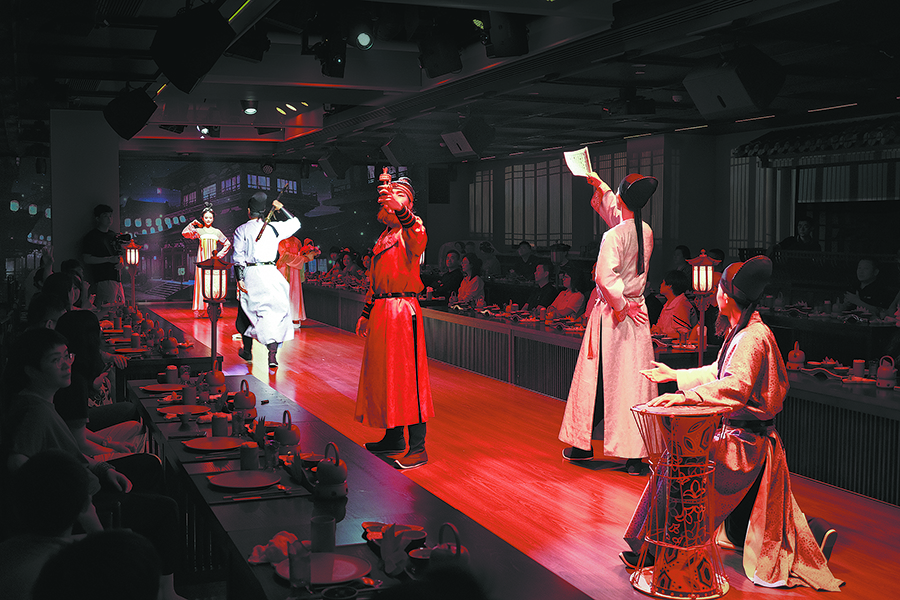
"When audiences come here, it's not just about having a meal or watching a show," explains Sun Ting of Fu Rong Yan. "They are completing a three-dimensional understanding of the Tang Dynasty".
For her, the critical distinction of a successful dining show is the seamless fusion of dining and entertainment, not a clumsy amalgamation of the two.
She emphasizes that the entire creative philosophy revolves around "aesthetic feeling", which encompasses the inherent beauty of Tang culture, the visual beauty of creative design, the artisan beauty of Chinese cuisine, and the deeper beauty of human emotion.
"I tried to turn the flat, static history of museums into a three-dimensional, flowing experience right before the audience's eyes," she says.
The show ingeniously uses the traditional 24 solar terms as its structural backbone, which Sun Ting says are like "an elegant framework".
"They give the whole experience a chapter-like rhythm and an internal cultural logic," she says.
Likewise, Jianzhou Grand Feast in Fujian also applies the solar terms concept.
"The core design is to let culture permeate without a single dead angle," Sun Ze explains.
The Jianzhou feast is divided into three main chapters: Welcome, Offering and Farewell. The Offering chapter is further split into four seasonal segments, each featuring a thematic dish with a local intangible cultural heritage performance and an interactive element.
For instance, during "Autumn", the dish Golden List Inscription — a crispy, golden pork knuckle, its name a homophone for "top of the exam list" — is served.
The stage then erupts with the Jianzhou fish-dragon dance, with actors weaving through the tables with glowing fish lanterns, as carp transform into dragons and leap over the "dragon gate" on the giant screen.
"This dialogue between the symbols of carp leaping the dragon gate and the idea of acing the imperial exams showcases Jianzhou's accumulated cultural deposits as a place of Neo-Confucianism," Sun Ze explains.
Elsewhere, Song-style maidens demonstrate the ancient method of whipping tea, while local inheritors of the bow-fishing technique thread grass rope through fish gills, tying it to their tails as a way to keep fish attached to the boat but alive and fresh for days.
"Contrary to a passive reception of knowledge, our format of eating, watching, and participating simultaneously turns culture into an experience of active perception," Sun Ze says, adding that this multisensory approach helps the audience "discover the approachability of tradition and better understand the life philosophy and humanistic spirit behind it".