Real-world retail beckons China's youth
Amid algorithm blues, Gen Z consumers flock to redesigned malls that prioritize atmosphere and social exploration









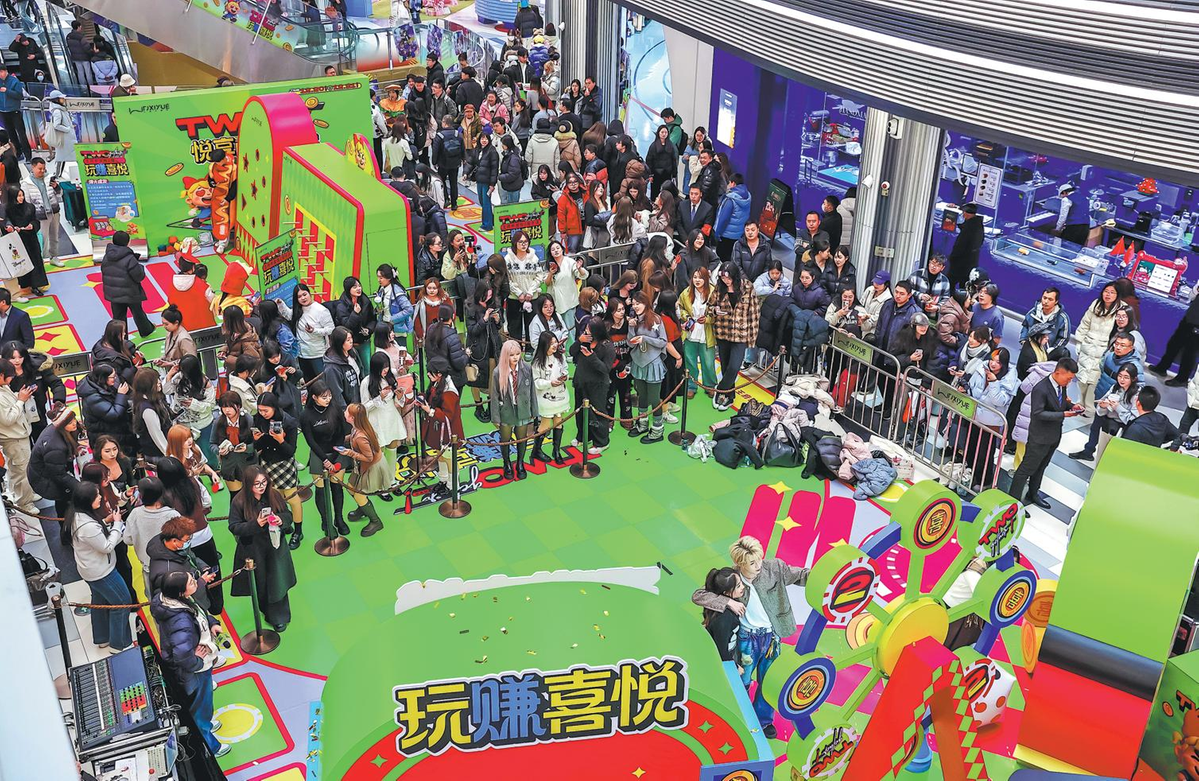
Despite growing up as digital natives, many young Chinese consumers in their 20s are spending more time in brick-and-mortar stores, a development that has drawn attention in a retail landscape long dominated by e-commerce. It's a trend that points to changing expectations of what offline commerce should offer.
Traditional shopping malls have struggled for years with declining foot traffic, outdated formats, and intense competition from online platforms that excel in convenience and price. In response, a growing number of commercial spaces are undergoing large-scale renovations and repositioning. Instead of focusing solely on transactions, these venues are expanding their roles to include social gatherings, interactive experiences, and cultural exchanges, evolving into what operators describe as urban lifestyle centers.
These revamped spaces emphasize experiences that reward physical presence. Role-playing games, handicraft workshops, immersive theaters, themed exhibitions, and gatherings built around shared interests, such as anime, comics, and games (ACG), have become standard features. Scarce products, niche buyer's shops, and designer-curated boutiques add to the sense of discovery that many young consumers feel is missing from algorithm-driven online shopping.
"Generation Z consumers are flocking back to offline venues," said Hu Shan, principal of consultancy Roland Berger. Some are motivated by interest-based communities, such as ACG culture and trendy toys, while others are drawn by social interaction, experiential activities, or limited-edition products and distinctive concepts that cannot be fully replicated online.
Gen Z refers to those born between the mid-1990s and early 2010s.
Across China, these shifts have prompted frequent renovation and upgrading projects. A survey conducted by the China Commerce Association for General Merchandise showed that in 2024, 66 percent of surveyed enterprises reported an increase in renovation projects compared with the previous year. While many traditional retail formats continue to face pressure, malls that clearly define their positioning and audience are beginning to show signs of renewed vitality.
Trendy renewal
At the WFJ XIYUE Mall in Beijing, young shoppers trade ACG souvenirs and gather around boxes with collectibles hidden inside to try their luck at obtaining the character they want. Since its relaunch at the end of 2023, the mall has become a popular destination for Gen Z consumers. It was previously known as the Beijing New Yansha Golden Street Shopping Plaza, which had suffered from sluggish foot traffic before its renovation.
During its two-year anniversary celebration from Dec 20 to 21, sales surged 76 percent year-on-year, while foot traffic rose 35 percent, according to the mall. Its overall commercial performance has continued on an upward trajectory this year despite broader market headwinds.
Zhang Yixing, 25, said he often visits the mall to pick up merchandise. "The ACG vibe in the mall is great, and people's acceptance of the culture is much higher," he said. "I usually dress up in cosplay to hang out there, which makes the experience immersive. When I'm with friends, we take photos or short videos, and even passersby will ask to take photos together."
While Zhang acknowledged that online shopping remains convenient, he said he prefers offline stores when it comes to collectibles. Physical stores offer a wider selection and allow customers to inspect items directly, reducing the risk of misleading product descriptions. "The process of hunting for collectibles is sometimes more fun than the items themselves, as it brings more emotional value," he said.
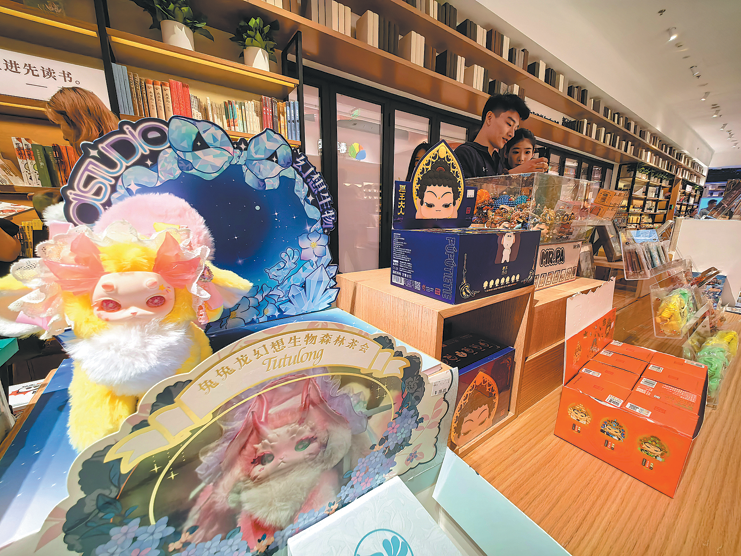
Targeting primarily young consumers, the 78,000-square-meter mall spans seven floors above ground and two underground. It hosts Beijing's first Disney store, North China's first Fluffy Market, a trendy perfume store, and Super Rare, a blind box store featuring K-pop merch. Beyond retail, it includes a talk show theater, a bookstore that sells coffee and hosts cultural salons, and a specialty shop selling products with auspicious meanings, such as God of Wealth blind boxes and lucky fridge magnets.
The mall routinely organizes ACG fairs, themed dances, card gaming activities, and promotional campaigns tied to well-known intellectual properties, including Harry Potter, Crayon Shin-chan, and hit television series. Popular vloggers and idols are invited from time to time to attract fans and increase foot traffic.
"Against the backdrop of booming e-commerce, our core competitiveness lies not in mere selling goods, but in creating offline experiences and social-emotional value unavailable online," said Mia Ma, a manager of the mall.
She explained that popular IP-driven brands provide immersive retail spaces, exclusive items, and interactions where young shoppers can check in and splurge. The mall's diverse offline social and cultural experiences create space for visitors to explore novelty for fun and relaxation.
Ma believes the mall is gradually becoming a source of psychological comfort, cultural exchanges, content planning, and community management.
Hu from Roland Berger said the contrast between struggling traditional malls and revitalized, clearly positioned venues highlights growing polarization in physical commerce. While many record declining sales, those with distinct characteristics continue to achieve growth in visitors and revenue.
Among retail enterprises above a designated size in China, the retail sales of department stores and brand specialty stores decreased by 2.4 percent and 0.4 percent year-on-year in 2024, respectively, data from the National Bureau of Statistics showed.
Immersive experience
Similar transformations are taking place in other cities. Shanghai Bailian ZX Creative Center, China's first dedicated ACG-themed commercial complex, has gained high recognition among Gen Z consumers. Known to older generations as the Hualian Commercial Building, the site was repositioned following renovation.
In 2024, the center hosted nearly 700 events. Its annual sales increased by 70 percent year-on-year, while customer footfall rose 40 percent, and the number of registered members exceeded 260,000, according to data from the center.
In Beijing's Haidian district, Zhongguancun Art Park reopened on Dec 19 after a three-year renovation of the former Zhongguancun Shibao Street and Zhongguancun Plaza. During its trial operation period, the new commercial complex received 120,000 visits per day.
At lunchtime on a weekday in December, students and office workers from nearby universities and tech companies filled the halls. Some arrived for lunch, while others lingered in cafes and public spaces. Despite the cold weather, long lines formed outside an artistic bakery that has become a hit online.
Twenty-five-year-old Shuai Huan, a college student in the area, gave a thumbs up to the shopping mall's transformation, which he has witnessed during the past few years. "It was once a food hall," he said."Except for restaurants, you could hardly see any other shops here. As the mall's renewal wraps up, the list of shops here has greatly expanded. It's convenient for college students to enjoy more kinds of services here, like reading, coffee bars, and bakeries. We don't have to travel a long way to Xicheng or Dongcheng districts anymore to enjoy these."
The park features a 20,000-square-meter rooftop garden and five courtyard-style sunken plazas. Public art installations have become popular backdrops for photos, often showing young visitors holding coffee cups as they pose.
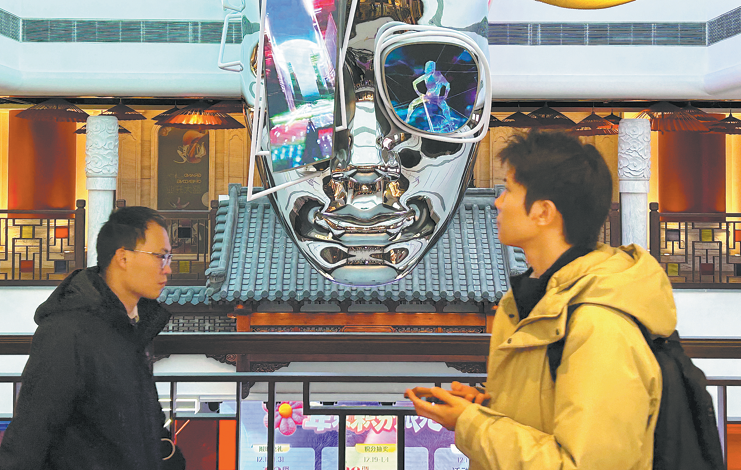
Another newly-opened commercial block, Weigong Fanghuali, has also attracted attention since opening in September. Located near colleges and high-tech companies in Haidian, the complex combines art, fashion, health, and culture. Futuristic installations, including two large artistic structures and an interactive metal face, create a cyberpunk-style atmosphere. A pink pig-themed train has become a popular attraction for nearby residents.
The block made the list of Beijing's top 30 new internet-famous check-in spots of the year, released by the Beijing Bureau of Culture and Tourism.
Inside the complex, a 1,300-square-meter National Library Cultural Center creates an eye-catching reading space. Designed to feel relaxed rather than strictly quiet, the space features dynamic lighting systems, art installations inspired by oracle bone script, and areas for reading and discussion.
Zhang Chengzhi, 20, a college student, shared that he often studies there with friends. "The environment of the school library is too quiet," he said. "Modern scientific research shows that studying with some white noise may actually yield better results. This place plays pleasant music, creating a cozy atmosphere."
Zhang Bowen, manager of the center, said the goal is to promote offline reading by creating three-dimensional and immersive cultural experiences. Visitors can peruse facsimiles of rare ancient books, attend cultural salons, art exhibitions, and handicraft workshops, and purchase themed souvenirs inspired by classic Chinese literature.
To attract students during exam season, the center introduced a promotion offering coffee for one yuan (14 cents), which significantly increased visitor numbers, particularly during evenings and weekends.
"Many young people have met like-minded peers through these events and formed stable offline communities," she said, adding that the rising visitor flow also drives the center's sales.
Irreplaceable value
Experts say physical commerce offers advantages that online platforms cannot fully replicate. Offline environments allow consumers to explore without algorithmic recommendations, giving them greater initiative in discovery.
"Physical spaces provide tangible touch-and-feel, perceptible atmospheres, and immediate experiential feedback, elements that cellphones and screens cannot replicate," said Hu from Roland Berger. "These elements fulfill a basic human need for authenticity and certainty."
Li He, an associate professor of sociology at Renmin University of China, said modern daily life has become highly digitized, with sensory experience often reduced to visual and auditory forms in online spaces. From a phenomenological perspective, cognition and emotion are closely tied to physical interaction with the world.
"Offline consumption compensates for a weakened sense of existence," Li said."Young people want to confirm their existence as a physical body in the real world. Shared behaviors such as cheering, applauding, or participating in the same activity at the same time help individuals feel part of a larger community, offering emotional support and a sense of belonging."
Rachel Lee, general manager of consultancy Worldpanel China, said that while young people's purchasing behavior in the fast-moving consumer goods market continues to shift online overall, the growth rate of that trend has slowed noticeably. Offline formats such as snack assortment stores, discount stores, and neighborhood supermarkets are gradually becoming new favorites among young consumers for their convenience and relaxed shopping environment.
"Gen Z attaches greater importance to experience and emotional connection during consumption," she said.
To attract young consumers, she added, physical retailers need to clearly define their target groups and design products and services around specific usage scenarios rather than relying solely on scale or price advantages.
Qi Zichen contributed to this story.





Today's Top News
- FM's Africa visit reaffirms commitment
- China widens net in battle against graft
- New US dietary guidelines trigger widespread concern
- China eyes space leap with record satellite filings
- Defiant Iran says it's 'ready' as Trump swings tariff stick
- Multiple satellite filings demonstrate transparency, responsibility and ambition