Mandarin fever: It seems everyone's getting it
In learning the language, US citizens are getting a handle on China









Editor's note: Chinese lessons have become popular in the United States, with twice the number of people studying the language than almost a decade ago. China Daily looks at this linguistic and cultural fervor.
When Adam Murray walks in Flushing, Queens, an enclave for newly arrived Chinese immigrants in New York, he likes to speak with the residents in Mandarin. Those he talks to are likely to be surprised to encounter a Gen Z who can speak fluent Mandarin.
Murray's fascination with the Chinese language and culture started when he became enamored with Chinese tea culture as a 12-year-old. Looking for quality tea, he contacted small artisan tea farmers in China. He then realized that if he were to learn about tea and find the best product he would need to start studying Chinese.
"The problem was, tea farmers usually don't speak English," Murray said.
Murray studied Mandarin for two years at the University of Pittsburgh. "Those two years of study were very intense," he said. From Monday to Friday, he went to a class at 8 am, where only Mandarin was spoken. Every Monday and Wednesday he went to a grammar class at 2 pm, where the class was partially taught in English. While the speaking classes consisted of five to eight students, the grammar classes consisted of about 30 or more.
About 400,000 students in the US are learning Chinese, double the number in 2015, the US-China Strong Foundation in Washington said. More than 200,000 schools and kindergartens across the US have Chinese courses in their curricula, said Chinese Puzzle, a documentary produced by SMG News of Shanghai Media Group. More than 40 people studying Chinese in the US were interviewed for the documentary.
"At the beginning, we thought that the 'Mandarin fever' was a phenomenon in the US," Tao Qiushi, deputy director of SMG News, said. However, while producing the documentary, the team found people's enthusiasm for learning Chinese was "beyond our imagination", he said.
Chinese grammar is not difficult to learn because Chinese verbs have no tense, and its word order is very similar to English, Murray said. For him, the writing system and the tones are the hardest part of the language.
When Kendall Kracke, 25, a graduate student in Chinese language and special education at Portland State University, started learning Chinese at the age of 18 she lamented having to write and read Chinese characters.
"They're probably the hardest part for me. There are so many strokes, and every character is different. That was hard.
"If you were to ask me to handwrite an essay it would be really difficult. But I can type an essay relatively well. And now the hardest part for me, I think, is the tones, and using more advanced vocabulary and grammar forms."
Opening doors
After graduating from high school, Kracke, whose Chinese name is Li Xiaoyu, decided to travel to China to teach English for a year. Before leaving, she took two Chinese classes at a community college, hoping that she would be able to communicate with the locals. This experience opened doors for Kracke to get to know more about the Chinese language and culture.
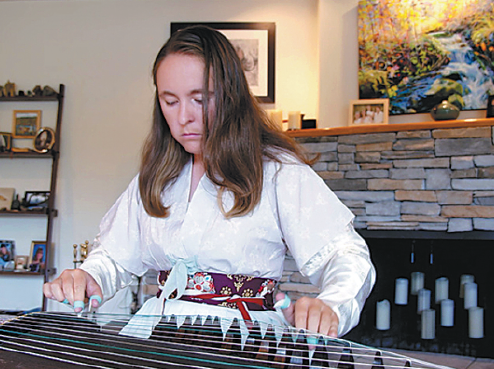
Last year Kracke won the 20th Chinese Bridge Chinese Proficiency Competition for Foreign College Students. During the competition, the audience was particularly captivated by her ability to play the guzheng, a Chinese stringed instrument with a history of more than 2,500 years.
"When you're playing guzheng it feels like you are also like part of that community that goes through history, which is fun to be a part of," Kracke said. "And when you play the songs you can still play traditional pieces that are the same ones people used to play 1,000 years ago. And it's like you get to experience Chinese history."
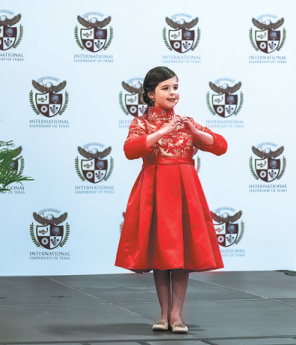
Chinese is a compulsory course for students studying in an international school outside Dallas, Texas.
Eddie Conger, the school's founder and superintendent of International Leadership of Texas, Garland High School, said that by last year about 21,000 youngsters were learning Chinese at the International Leadership of Texas.
By learning the language, and more importantly about Chinese culture, "it only draws us closer together to be able to solve very important problems", he said.
Nicholas Goldring, a graduate of International Leadership of Texas who gained a full scholarship at Beijing Language and Culture University in Beijing, said that on the first day of his Chinese class, "something inside of me woke up".
He found that for him Mandarin was easy. "I've made it my life goal to master this language. And to this day it's gone to a point where I can communicate with a native speaker with relative ease, even though I still have a lot more to learn."
A study by LingoAce, a company in Singapore that offers Chinese courses online, found that only 20 percent of students in the US under the age of 18 are learning a foreign language in school, and only 3.5 percent are learning Chinese. However, the study also found that Chinese immersion programs for K-12 students have grown on average 16 percent a year over the past decade.
A Chinese immersion program means that for the participants at least half the day in school is taught in Chinese and that academic subjects are also taught in Chinese, not simply that the Chinese language is taught, according to the Center for Advanced Research on Language Acquisition of the University of Minnesota.
By November, 380 schools in the US were reported to have Chinese immersion programs. More schools with such programs will open within the next four years, said the Mandarin Immersion Parents Council, a platform for families about Mandarin immersion education.
Utah is a national leader in implementing English and Chinese dual-language immersion, with more K-12 students studying Chinese than in any other US state.
By 2020 about 15,000 students in 76 schools across Utah were studying Chinese language and culture through the Dual Language Immersion Program started in 2008.
Wang Taofeng, chief director of the Chinese Puzzle documentary, said: "When filming interviews for the documentary, many Americans could answer questions in fluent Chinese. The popularity of Chinese in the US was beyond my imagination. I didn't expect that there would be so many schools in the US with Chinese immersion programs."
Wang said he was especially impressed by Galal Walker, a professor of Chinese in the Department of East Asian Languages and Literatures at Ohio State University.
The university opened the first doctoral program in Chinese language teaching in the US. The program has trained 25 doctoral students and hundreds of master's students in Chinese education, according to the documentary.
Walker is "a leader in Chinese education", Wang said. "His understanding and familiarity with Chinese classical literature make me ashamed as a Chinese."
Tao of SMG News said: "Language is the greatest bridge of communication. In today's world, many issues cannot be avoided around China, and everyone wants to understand China. This is the basis of the Mandarin fever."







Today's Top News
- China looks to strengthen LAC relations with release of policy paper
- Group of Friends of Global Governance established
- China's CPI up 0.7% in November
- Governance of China an inspiring path
- Sharper focus on expanding demand seen
- FM: Facts prove Tokyo wrong on Taiwan