Green Belt project highlights VW's ecological transformation goals









Guo Xi, 37, has the goal of stopping desertification in Gulang county in Northwest China. The county, in Wuwei city of Gansu province, sits between the Tengger Desert and the Badain Jaran Desert.
It was a job started by his grandfather in the 1980s, when the Tengger Desert eroded the county's farmland by 7.5 meters a year, threatening to unroot the locals who had been there for generations.
Six villagers aged more than 50 years old then took action — Guo Chaoming, He Falin, Shi Man, Luo Yuankui, Cheng Hai and Zhang Runyuan went on to establish a collective forest farm called Babusha.
Through a joint production contract, they worked to control 75,000 mu (5,000 hectares) of quicksand. By 2000, Babusha's desertification was effectively under control, with a windbreak and sand control zone measuring 80 square kilometers.
"They were resolute, but said they were too old. The job would be passed on to their sons and when the sons were too old, their grandsons would take over," said Guo Xi, who has worked at the farm since 2016.
Now, each year, he and his co-workers spend almost two-thirds of their time at the forest farm, planting and tending to young trees and shrubs, always bearing in mind the commitment of the Six Old Men, as locals would call them.
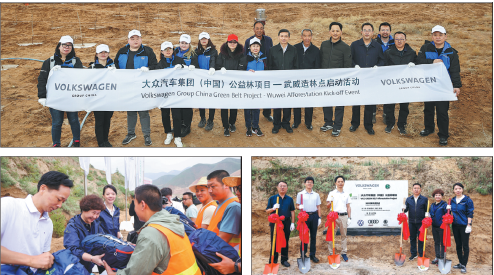
German carmaker Volkswagen, one of the earliest and most successful international partners of China's automobile industry, joined the desertification fighters in April 2021 in collaboration with the China Green Foundation, a non-governmental organization for forestry development.
Volkswagen Group China, together with Volkswagen brand, Audi and Skoda, launched the Green Belt afforestation project in Gulang, as the first step of a 10-year commitment to environmental protection and improving the lives of people in rural areas.
The aim of this first stage of the project is to create an ecological barrier spanning around 26 km along the Gantang-Wuwei railway line.
The goal is to prevent further desertification, help restore the local ecological balance and protect the railway tracks and local people's living and farming facilities from erosion.
So far, more than 850,000 trees and shrubs, all suited to the local environment, have been planted in Gulangthe northern part of China's largest eco-immigration area, located in Wuwei.
It has benefited around 62,000 villagers with over 23,000 additional, short-term working opportunities and creating millions of yuan in additional income.
The Green Belt project will continue for 10 years and involve the planting of around 8.5 million trees in ecologically fragile locations stretching across the vast northern region of China.
The expanse ranges from Gansu and Qinghai provinces to the Inner Mongolia and Ningxia Hui autonomous regions, each of which plays a strategic role in protecting China's environment.
The total afforested area will cover more than 40 million square meters, equal to roughly twice the size of Volkswagen Group's industrial footprint in the country, said the carmaker.
It said the project is intended to prevent further desertification, restore biodiversity, revitalize local economies and improve the lives of local people.
Earlier this year, the project reached the Tu autonomous county of Huzhu in Qinghai province.
Located in the eastern part of Qinghai province, Huzhu is the only Tu autonomous county in China. Surrounded by mountains and rivers, the area has an extremely fragile ecology, where water and soil loss are serious and persistent problems.
Around 850,000 locally suitable trees have been planted in the county's Tangchuan town, transforming a barren and mountainous area covering 4 million sq m, which benefits more than 40,000 villagers.
It has provided food, shelter and habitat for nearly 30 species of local wildlife, and helped promote local biodiversity.
In 2023, the Green Belt initiative will arrive in Jiuquan city, Gansu province, and continue to support local ecological restoration through reforestation.
These regions are culturally and historically significant, as they are home to diverse ethnic groups and constitute a significant farming zone in northern China that serves as China's core area for animal husbandry, said the carmaker.
The carmaker said the Six Old Men had the vision and dedication to create a better life by building a green, habitable ecological environment and Volkswagen Group China shares this vision.
It said it aims to inspire people from all walks of life, as well as its employees, to devote themselves to environmental protection.
In Gulang, desertification fighters have devised modern, scientific desertification control methods, such as grass barriers, drip irrigation and plastic tarps.
Through their efforts, they are forcing the sands to retreat instead of trying to stop the encroaching sands.
In Qinghai's Huzhu county, Volkswagen via the Green Belt project has donated professional equipment to more than 400 forest rangers and provided them with targeted training in forest management, to help them better carry out patrols and forest management.
"I did not have a very good education, but I would like to learn more about forest protection when I am free. I can do the job better and better, and that is good, isn't it?" said Ren Wenqing, a forest ranger in Huzhu.
Volkswagen Group China said it will uphold the vision of helping China's sustainable development and take practical actions to realize its 10-year green commitment.
Globally, the carmaker is vowing to address climate change through its global "goTOzero" strategy, and plans to achieve carbon neutrality across its entire product life cycle by 2050.


Today's Top News
- Beijing accuses Manila of trying to smear China's actions in the South China Sea
- Scientists using Chinese telesecope capture evolutionary process of mysterious flashes
- Xi: Advance building of China-Canada new strategic partnership
- Xi receives credentials of new ambassadors to China
- China's giant radio telescope observations unravel origin of cosmic enigmatic flashes
- Xi meets Canadian prime minister