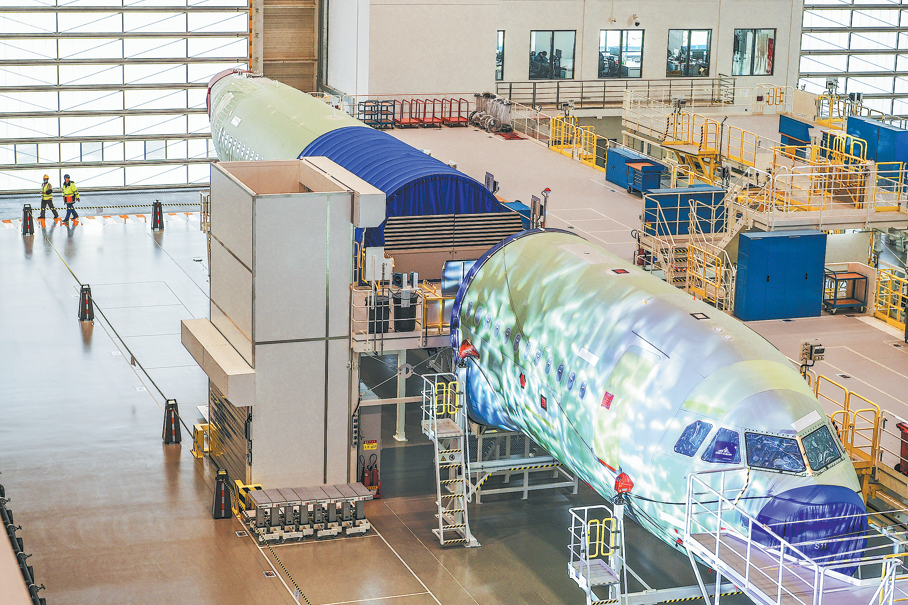
Companies invest in R&D, advanced facilities to improve competitiveness









With China entering a new era of green and innovation-led growth, a growing number of German companies have shifted their investment focus from building conventional plants to establishing more innovation and service facilities in the country to stay competitive, said analysts and business leaders.
Given China's ongoing manufacturing transformation and the growing number of middle-income earners, German companies, such as tire maker Continental and technology and industrial group Siemens, have all invested heavily in building research and development centers for various business segments over the past three years, according to information released by the Chinese Ministry of Commerce.
Zeiss Group, a German optics company, started construction of a new R&D and production base in Suzhou, Jiangsu province, in mid-October.
It was the first time that the German company had purchased land and built its own project in China, indicating the company's strength of business in the country.
Zeiss has always been confident in China's growth and the new facilities reflect its commitment to this market, said Maximilian Foerst, president of Zeiss China.
Alfred Karcher, a German cleaning systems provider, invested 100 million yuan ($13.69 million) to build a high-tech R&D center in Suzhou in June.
"Despite the disruption caused by the COVID-19 pandemic, we are still fully confident in the Chinese market and our long-term plans in China will not change," said Tang Xiaodong, president of Karcher's China unit.
Ma Yu, a researcher at the Chinese Academy of International Trade and Economic Cooperation in Beijing, said China's dual-circulation development pattern will continue to create more space for the growth of multinational corporations in services, innovation-driven areas and businesses related to digital empowerment.
The dual-circulation growth paradigm recognizes the domestic market as the mainstay, with the domestic and foreign markets reinforcing each other.
The development of globalization is inseparable from international industry and supply chains, as well as international cooperation and competition, according to Liu Chang, president of the Government Affairs Forum at the European Union Chamber of Commerce in China.
Liu is also vice-president for China (rail system) of Knorr-Bremse, a Munich-based braking and control systems provider for commercial vehicles and trains.
To assist this integration, German and European companies can use their technological advantages and international vision in the development of the dual-circulation growth paradigm, she said.
After revealing innovation centers in Beijing and Suzhou for rail system and commercial vehicle divisions early this year, Liu said her company will strive for digital innovation by integrating world-leading technologies and knowhow in China.
"In terms of digitalization, China has broad application scenarios and abundant industrial resources," she said, stressing the new digital solutions and innovative products will not only help Knorr-Bremse expand its business in China but support the group to expand in global markets.
After acquiring Phenox, a Bochum, Germany-based technology and solution provider for the treatment of neurovascular diseases in April, Wallaby Medical Holding, a Shanghai-headquartered company focusing on developing, manufacturing and commercializing neurovascular interventional products for treating strokes, plans to introduce more high-quality products from Phenox to China in the coming years.
"By doing this, we will have opportunities to save more patients suffering from strokes, which is also the common strategic goal after the merger," said Liu Bing, Wallaby's chairman and founder.
Wallaby is tapping into the wealth of expertise, business-friendly policy environment and market potential in both China and Germany to drive global healthcare innovation, elevate treatment standards and eventually benefit patients around the world, said Liu.
As the fifth China International Import Expo will be held in Shanghai from Nov 5-10 at the National Exhibition and Convention Center, Norbert Noisser, a senior adviser for China at the Chamber of Commerce and Industry of Giessen-Friedberg, said that the CIIE plays a key role in opening up the Chinese market to foreign investors.
"China is a driver for innovation and an important partner with a huge domestic market. This opens great opportunities for German companies," he said.


Today's Top News
- Denmark rebuts Trump's Greenland security claims
- China, Canada vow to enhance bilateral ties
- Xi's speech at Central Urban Work Conference to be published
- China completes over 8 million hectares of land greening in 2025
- FTZ helps Kashgar invigorate regional commerce
- Canada, China should eye a fresh start