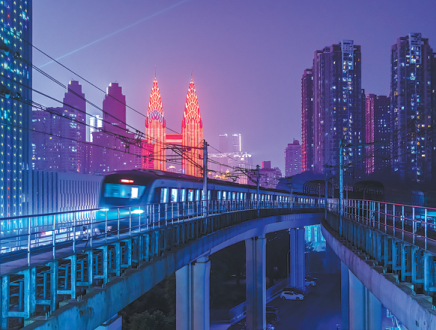
Transit loop scoops international award









Several years ago, Liziba Station on Chongqing Rail Transit's Line 2 became one of the world's most famous stations after videos of a metro passing through a 19-story residential building went viral on social media. China's southwestern municipality once again caught the world's attention recently with a newly built rail transit project that scooped the FIDIC Project Awards, which is sometimes known as the "Nobel Prize" of engineering.
On Sept 13, the Chongqing Rail Transit Loop Line won the 2022 Outstanding Project of the Year (Large) at the FIDIC Project Awards, which was announced at an industry gala dinner in Geneva.
The FIDIC, Federation Internationale des Ingenieurs Conseils (the International Federation of Consulting Engineers), is an authoritative international organization part of the global engineering consultancy sector. The FIDIC Project Award, which was established in 2013, recognizes engineering projects with outstanding applications for global economic and social development each year.
Notably, three of the nine project winners of this year's award came from China. The other two projects were the Tianfu International Airport project and the Wudongde Hydropower Station.
FIDIC CEO Nelson Ogunshakin said that both winning and highly commended projects were chosen from an international selection drawn from China, the United States, Australia, Mexico, Nicaragua, Brazil, France, India, Mongolia, Somalia and Vietnam.
"The strength of this year's winners is a testament to the enduring excellence of the work of consulting engineers and the value that our industry brings to society by delivering excellent construction and infrastructure projects that transform people's lives," he said.
According to Chongqing Rail Transit, the Chongqing Rail Transit Loop Line began operations in October 2013 and was fully operational by January last year. It is 50.8 kilometers in length with 33 stations, including 13 transfer stations.
"The Chongqing Rail Transit Loop Line has the world's longest operating mileage, the largest number of transfer stations and the greatest difficulty faced in bridging a river, but achieves the highest operating efficiency and the best connectivity rates," said Le Mei, general manager of the group.
"Building a perfect rail transit network in an urban core separated by two rivers and three mountain ridges is quite difficult," Le said, adding that the city's only loop line connects the five central urban districts of Shapingba, Jiangbei, Yubei, Nan'an and Jiulongpo, and plays an important role in its urban transportation network.
She also noted that the line has resulted in multiple technical breakthroughs, both in design and construction, including the Communication-based Train Control System, which solves a global difficulty in rail transit signal system interoperability, as well as the making of a special rail transit vehicle suited to mountainous or hilly cities.
"The project has resulted in good social and economic benefits. More importantly, it pushes the urban rail transit industry forward," she said.
Last year, China announced that it had attained what the central government calls "a moderately prosperous society in all respects", and would try to achieve modernization in the next 15 years. Its transportation infrastructure has paved the way to the goal.
According to a report from the National Bureau of Statistics released on Sept 21, over the last decade, China has made notable achievements in the construction of a comprehensive transport system.
During the 2013-2021 period, investment in the national transport industry topped 27 trillion yuan (about $3.88 trillion).
For instance, by the end of last year, the length of China's operational railways surpassed 150,000 km, surging 54.4 percent from 2012, and the length of highways rose 24.6 percent from 2012 to 5.28 million km.
China has also accelerated the establishment of a high-speed transportation network, with high-speed railways, expressways and civil aviation facilities as pillars.
As a comprehensive international transportation hub, Chongqing recently released its Transportation Planning Outline for 2021-35.
According to current statistics, 80 percent of the city's districts and counties are connected by rail, 97 percent by highways and 75 percent by waterways, while airports cover 95 percent of the population within a 100-km radius.




Today's Top News
- China completes over 8 million hectares of land greening in 2025
- FTZ helps Kashgar invigorate regional commerce
- Canada, China should eye a fresh start
- US playing with fire on thin Arctic ice
- Party conduct key to clean governance
- US to pause immigrant visa processing from 75 countries