Development boosts Xinjiang's business edge
Entrepreneurs are reaping the rewards of government measures to eradicate extremism. Cui Jia reports.









Editor's note: To mark the 20th National Congress of the Communist Party of China, China Daily is producing 10 profile stories to show the changes in the subjects' fields in the past decade. This is the eighth in the series.
Abdula Umur said he clearly remembers a conversation he had with his father when he was 18.
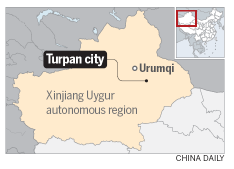
The young man wanted to know why the grapes the family grew in Turpan city, Xinjiang Uygur autonomous region, were not being sold in other parts of China at a higher price.
"My father said that he didn't know how to find distributors and was worried about the uncertainties in logistics. I've been trying to find solutions ever since, and I think I've succeeded now," the 27-year-old said.
Abdula's family has been growing grapes for generations in Turpan, which is known as the cultivation center for about 20 percent of the grapes grown in China.
When he was studying at a university in the regional capital of Urumqi, Abdula realized that e-commerce could help the family's business expand to a new level.
"I grew up surrounded by vineyards and often saw my father feeling frustrated about the poor sales of our quality grapes, even though they are famous across China. I was determined to learn more about e-commerce and return home to help him," he said.
Gaining insights
After graduating from university in 2015, he found a job at an e-commerce company in Changsha, Hunan province, to gain insights. He also studied business administration techniques in his free time.
With hands-on experience and an ambitious attitude, he returned home in 2017. However, he quickly became the target of religious extremists. For a period, religious extremism was widespread in the region and many young people were affected. Under such influences, some even carried out terrorist attacks.
Statistics from the regional government show that from 1990 to the end of 2016, separatist, terrorist and extremist forces launched thousands of attacks in Xinjiang, killing large numbers of people.
"I met some religious extremists who operated under the disguise of business owners. They often took me to gatherings and sent me videos containing violent and terrorist content. Gradually, my thoughts and behaviors were deeply influenced by religious extremism," Abdula said.
He started to share the videos with others. Moreover, he strongly opposed his sister going to school because he believed that such establishments were not halal, and he refused to do business with non-Muslims. Furthermore, he abandoned his business ambitions.
Determined to protect people's lives, the regional government has undertaken a series of measures to fight and prevent terrorism, including setting up vocational education and training centers in accordance with the law to help those who were influenced by extremism and terrorism. All trainees had graduated by October 2019.
Persuaded and encouraged by his family members, Abdula took part in the courses at a center in Turpan in January 2018.
"The center helped me see the real intentions of the extremists clearly. They weren't there to make me a better person, but to groom me to achieve their political goals. It's still scary to think about what I might have done if I had continued to follow them," he said.
At the center, Abdula learned about the importance of abiding by the law. He also chose to take courses on computer skills and how to be a tour guide.
"I was shocked to hear that some people and Western media called the centers 'internment camps'. They are just schools offering useful courses," he said.
"The center helped free me from thoughts of religious extremism. It felt like I had been given a second chance," said Abdula, who graduated in April 2019.
Back on track
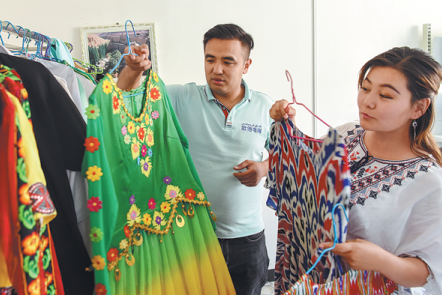
After graduation, Abdula put his business plan into action. Supported by the local government's entrepreneurship policies, he set up Oubai E-commerce, which sells local specialties, including the grapes grown by his father.
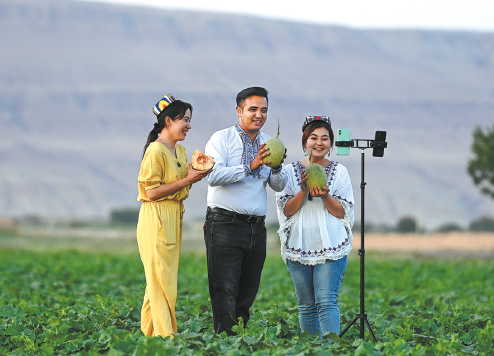
In 2020, he started to expand the business via livestreams on social media platforms, and helped local farmers sell their fruits so they wouldn't need to worry about sales like his father once did.
Encouraged by Abdula, his father, Umur Rexit, joined Oubai's team of livestreamers. Umur, who enjoys wearing traditional Uygur costumes and introducing the Uygur culture during his livestreams, now has more than 300,000 followers on social media platforms.
Last year, the company generated sales of 5 million yuan ($700,000) while providing 25 jobs for local farmers. Abdula plans to get more farmers involved so they can also benefit from e-commerce in the future.
"My life is now back on the right track. I am sure it will get better as Xinjiang continues to develop at high speed. Returning home is the best decision I ever made," he said.






Today's Top News
- China completes over 8 million hectares of land greening in 2025
- FTZ helps Kashgar invigorate regional commerce
- Canada, China should eye a fresh start
- US playing with fire on thin Arctic ice
- Party conduct key to clean governance
- US to pause immigrant visa processing from 75 countries