For herder, opportunity sprouts from sand
Mongolian has worked to make a life in harsh terrain for her family and fellow villagers









When Bao Hua first moved to Shariin Khudag village over 20 years ago, there was nothing but vast, endless desert as far as she could see.
Born in 1968, Bao Hua is Mongolian and used to herd sheep and camels in Yavuulai town, about 200 kilometers from Shariin Khudag in the Inner Mongolia autonomous region.
"We moved here in response to the call to return land to forest and grassland," she said.
However, their new home, which is close to both the Badain Jaran Desert (the third-largest in the world) and the Tengger Desert, was prone to strong winds and sandstorms at first.
"The conditions were harsh," Bao Hua said.
"It was frustrating to watch newly planted crops and plants blow away in the wind, as if all our work had been for nothing."
Many residents chose to return to their former homes because of the economic loss.
"I hesitated to return because I had already sold my camels and sheep. I didn't know what I could do if I went back, so I decided to stay and deal with desertification here," she said.
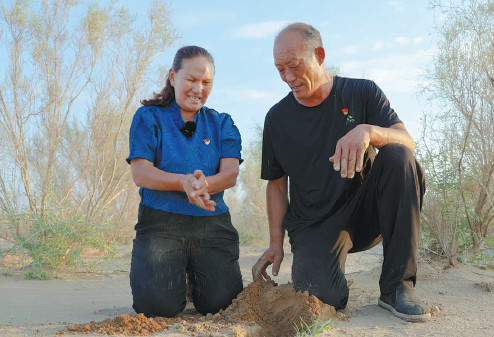
As tough as the trees she planted, Bao Hua consulted experts and residents, and then she and her husband used their savings to plant saxaul, a kind of shrublike tree that can survive dry conditions and withstand strong winds.
Dressed in thick coats and hats, the pair would plant small trees in the strong, cold wind before sunrise. Having no watering equipment, they would carry water to each tree individually.
"It was quite difficult because we lacked equipment," she said. "With 10 other households, we'd take the water and water the trees, one by one."
They usually finished planting around 10 pm. Bao Hua said the trees were their hope.
As the years passed, the villagers were delighted to see the saxauls grow taller. In the last 20 years, they have planted about 33,000 hectares of them.
A recent rainfall in Shariin Khudag delighted Bao Hua, who was happy to see the trees turn green again. The rain, which arrived just in time, saved them around 80,000 yuan ($11,500).
"It costs 200,000 yuan each month to pay for water and labor to care for our plantation," she said.
While the trees are good at mitigating the effects of sandstorms, they have little economic value.
To raise earnings, Bao learned to plant cistanche deserticola, a holoparasitic plant also known as desert broomrape, near the saxaul. Used in traditional Chinese medicine, where it is known as roucongrong, the plant can be sold for a good price.
The first harvest in 2003 earned her 30,000 yuan. "I was so happy, I cried," she said.
More villagers followed Bao Hua, and they set up a cooperative.
"We sold 5 metric tons of roucongrong this year, each kilogram for 22 yuan," she said.
As she does not speak Mandarin, Bao Hua's husband, Shi Mingbin, who works as Party secretary of Shariin Khudag, helps out when needed.
"He helped me write in Chinese, and we planted trees together," she said. "He has always been by my side."
Business opportunities flourished as the environment improved.
In 2012, Bao Hua proposed starting another cooperative to raise sheep for sale.
To ease the villagers' concerns, she invited three households to help her raise 100 sheep she bought, with the promise that the profits would be distributed among them all.
"We are family regardless of our ethnicity, and I hope that the entire village is able to live a life of happiness and wealth, not just me," she said.
With a son and a daughter both now grown up and independent, Bao Hua is free to enjoy life.
But she is still busy every day, getting up as early as 5 am to run errands.