Retiree recalls career conserving rock carvings in Chongqing's Dazu









CHONGQING-From remote counties in China to far-flung corners of the world, 86-year-old Guo Xiangying has been on the move throughout his career.
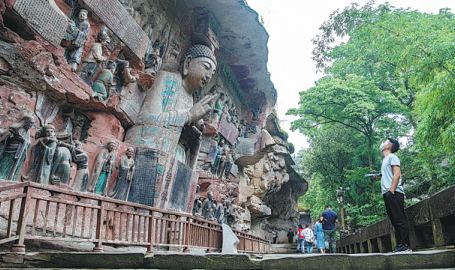
He has been focused on one purpose: conserving and popularizing the 50,000-odd rock carvings, dating to between the 9th and 13th centuries, in the grottoes of Dazu district in Chongqing municipality.
"At first, I didn't like the carvings that much. But later, I came to see them as my lifeline," he said. "My devotion to them developed during a long period of loneliness."
A conservator at the Dazu Rock Carvings UNESCO World Heritage site and the first president of the Chongqing Art Museum of Dazu Rock Carvings-now the Academy of Dazu Rock Carvings-Guo has been protecting the site for nearly five decades.
Born and raised in Chongqing, he was admitted to a secondary teachers' school in what is now Dazu district. After graduation, he studied traditional Chinese painting techniques and worked as an art teacher at a number of primary schools for 10 years.
It wasn't until 1974, when the then 37-year-old started work in the county cultural relics depository, that he began to develop a passion for ancient carvings.
Although they were already listed among the key historical sites under State protection, many locals in the city didn't know that Dazu was home to such treasures.
More than 50,000 statues are scattered across 75 sites. They are mostly concentrated in the Baoding, Beishan, Shizhuan, Nanshan and Shimen mountains.
Guo was dispatched to Beishan in 1974. After he arrived, he realized that conditions were not what he'd expected; there was no electricity or running water, and he didn't even have any neighbors.
"I had to wait for rainy days so that I could carry and store up to 100 kilograms of water at a time for everyday use," he said.
Rather than feeling sorry for himself, Guo decided to make the most of the opportunity. He took about six months to settle in-drilling wells, growing vegetables, planting trees and patrolling the area to prevent vandalism and theft.
"Even though life was bitter, I was happy to be surrounded by such works of art," he said.
As time passed, his primary focus switched from patrolling to exploring. He thought about how the stone carvings had been made and what the stories behind them were, devouring books in search of answers.
In 1980, the National Cultural Heritage Administration launched a project to create archives at national cultural relics units, with images an indispensable component of the work.
Without a camera or professional surveying and mapping personnel or proper measuring equipment, Guo volunteered to help document the site through sketches. He crafted and repaired tools himself.
He would tie colored strips of cloth to the end of a rope when measuring statues taller than 20 meters in height, red representing 1 meter and white representing half a meter.
He led a busy life, measuring the statues by day and sketching them by kerosene lamp at night. His nostrils would blacken with the smoke.
It took him two years to complete two sketches of the carvings. Measuring a total of 40 meters in length, they featured more than 10,000 statues.
The site gradually became famous, attracting tourists from home and abroad, as well as academics. "Many officials and experts had said for years that we needed to make the carvings 'go global', but how could we achieve that goal?" Guo asked.
One conversation gave him a direction. In 1987, he heard about the World Heritage List while chatting with conservators.
He learned that the Dazu carvings had been included on a preliminary list drafted by the National Cultural Heritage Administration for submission to the organization.
In 1990, he set up the Chongqing Art Museum of Dazu Rock Carvings.
To prepare for the application, he visited most of the country's major grottoes to study them.
"After making comparisons, I found that the Dazu carvings have distinctive features, integrating elements of Confucianism, Buddhism and Taoism with Chinese folk culture," he said.
With the help of city and county-level governments, foul-smelling pools of water, cluttered stalls and heavily polluted pigpens on the site were tidied up.
The efforts paid off. In December 1999, the Dazu Rock Carvings were placed on UNESCO's World Heritage List following several rounds of assessment, becoming the second world cultural heritage grotto site in China after Mogao.
According to the UNESCO website, the Dazu carvings are remarkable for their aesthetic quality, rich diversity of subject matter-both secular and religious-and the light that they shed on everyday life in ancient China.
They provide evidence of the harmonious synthesis of Buddhism, Taoism and Confucianism.
Guo retired in 2003, but has remained stationed near the site to conduct research on the statues, teach classes and write books.
In 2007, one of Dazu's best-known Buddhist statues, an 800-year-old sculpture of the 1,000-handed Bodhisattva Qianshou Guanyin was found to be suffering severe erosion and weathering. Its colors had faded, some of its gold foil covering had peeled off, cracks had appeared and pieces of its fingers had fallen off.
Guo joined a team of national experts to draft a customized restoration plan for the statue. The project took the team nearly eight years and used a number of different materials as well as about 440,000 pieces of gold foil.
"People engaged in cultural relics work should not only think about the present, but also about the future, so that the coming generations can also see them," he said.
Since Guo retired, others have taken up the baton and carried on.
"We will continue to improve the protection of the site, perfect monitoring and early warning systems to ensure the safety of the statues, and continue to tell their stories," said Li Fangyin, president of the Academy of Dazu Rock Carvings.
Xinhua





Today's Top News
- China's CPI up 0.8% in Dec
- Report slams Tokyo's nuclear weapon aims
- Nation's crime rate touched record low last year
- Nation's space program records stellar year of firsts
- Top Party leadership hears series of annual work reports
- 'Great ship' of shared future sails onward