Museums promote cultural confidence
Visitors at Three Sus temple, Sanxingdui Ruins learn the importance of traditions, moral precepts









Editor's note: China has seen tremendous changes nationwide, from economic growth to environmental protection, from social improvement to cultural progress. In this series, China Daily maps the changes and tells the stories of the people who lived through them.
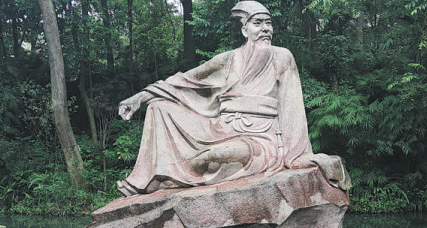
Despite the COVID-19 epidemic, people from different parts of Sichuan province are still visiting the Ancestral Temple of the Three Sus in the center of the city of Meishan, Sichuan province.
The temple, which was the former home of literary masters Su Xun (1009-66) and his two sons Su Shi (1037-1101) and Su Zhe (1039-1112), was transformed into a memorial site and gardenlike museum. The Three Sus are among eight of China's most famous literary masters, who lived during the Tang (618-907) and Song (960-1279) dynasties.
Most visitors come to the museum with their children to encourage them to learn more about Chinese traditions, according to Yang Zhengnan, a 68-year-old resident who lives nearby. Visitors stream in every day after the museum gate opens. Many were inspired to come after President Xi Jinping visited on June 8, said Yang, a photographer who has taken photos there for 25 years.
Xi has quoted the Three Sus' words of wisdom on multiple occasions. In 2019, while presiding over a session reviewing and adopting the Communist Party of China Central Committee's decisions on some major issues, including ways to uphold and improve the system of socialism with Chinese characteristics and to advance the modernization of Chinese governance, Xi cited words taken from a piece written by Su Shi, the best-known of the Three Sus, "Overcome the hardest part and pursue the highest target."
During his visit to the museum, Xi learned about the life experiences, literary achievements, moral precepts and family traditions of the three masters. He said that China has a civilized history of more than 5,000 years, and that the nation's people should respect Chinese traditions and strengthen their cultural confidence.
The temple was built during the Song Dynasty. During a reconstruction project in 2019, more than 500 repairable cultural relics were excavated, and it was determined that the excavation site consisted of objects from the same era as the Three Sus.
The literary masters left behind a large collection of writings and poems about moral precepts. Their own guiding principles led them to eventually leave their hometown to serve their countrymen. Su Shi refused to fret over possible misfortune and insisted on benefiting the people as an official, and he served them well.
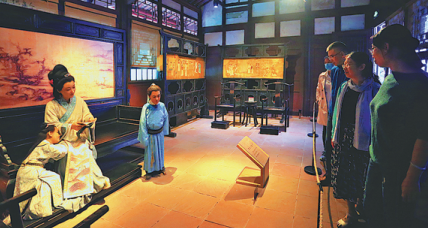
Museum visitors view the paintings and statues depicting how Su Xun's wife taught their two sons the importance of clean living and of serving the people, said museum curator Chen Zhongwen.
Xi holds such a precept in high regard.
He has asked leading officials at all levels to take the lead in promoting the precept and Chinese families to carry it forward.
About 150 kilometers from the temple is the Sanxingdui Museum, which houses priceless cultural relics from the Sanxingdui Ruins in Guanghan, Sichuan.
Covering 12 square km, the ruins include the remains of an ancient city, sacrificial pits, residential quarters and tombs.
Scholars believe the site was established 2,800 to 4,800 years ago, and archaeological discoveries show that it was a highly developed and prosperous cultural hub.
The site was discovered in 1929 when Yan Daocheng, a villager in Guanghan, unearthed a pit full of jade and stone artifacts while repairing a sewage ditch on the side of his house.
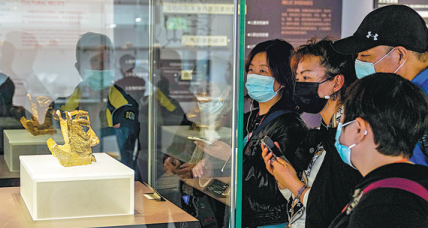
Since the 1930s, numerous archaeologists have conducted excavations at the site. They had a major breakthrough in 1984, when the remains of large palaces and parts of the eastern, western and southern city walls were found at the site. Two years later, two large pits full of bronze artifacts, including masks and figurines, were unearthed.
The discoveries confirmed that the site comprised the ruins of an ancient city that were the political, economic and cultural center of the Shu Kingdom. In ancient times, Sichuan was known as Shu.
The site is considered to be one of the most important archaeological discoveries in China in the 20th century.
Since 2020, six new pits, which are next to the first two, have been excavated. Archaeologists have discovered artifacts including a bronze altar, a net covering a vessel shaped like a tortoise shell, a human figurine with a serpent's body carrying a zun-a vessel used for rituals-on its head, and a bronze artifact shaped like a dragon with a pig's nose.
Ran Honglin, an archaeologist at the Sichuan Provincial Cultural Relics and Archaeology Research Institute, said that archaeologists had never seen anything like these items before.
The six new pits were discovered by a team set up by the institute and schools such as Peking University and Sichuan University. According to Zhu Yarong, deputy curator of the Sanxingdui Museum, 18,000 relics have been unearthed from the eight pits at the Sanxingdui Ruins. Many important discoveries made at the first two pits in 1986 are on display at the museum.
The museum remains a popular site amid the COVID-19 epidemic. There have been so many visitors that most cannot find a guide, Zhu said.
Emboldened by the discoveries at Sanxingdui, Sichuan has seen new archaeological achievements.
Last year alone, new achievements were made in the archaeological excavation of the Luojiaba, Chengba and Baodun Ruins. Over 10,000 relics pertaining to Zhang Xianzhong (1606-47), leader of a farmers' uprising in the Ming Dynasty (1368-1644), were unearthed from the Minjiang River in Pengshan, a district of Meishan.
The relics were sunk in the river 376 years ago after Zhang's army was ambushed by Qing (1644-1911) troops, said Li Bei, deputy director of the Sichuan Provincial Cultural Heritage Administration.
More than 100 Paleolithic ruins were also discovered in the province last year. The Piluo Ruins is by far China's best preserved archaeological site from the Paleolithic period dating back to between 2.5 million to around 10,000 years ago, she said.
Xiao Feige contributed to this story.




Today's Top News
- China reports economic growth and ecological gains in Yangtze River Economic Belt
- Xi holds talks with ROK President Lee Jae-myung
- Xi holds welcome ceremony for ROK President Lee Jae-myung
- Xi congratulates Doumbouya on election as president of Guinea
- Xi says major countries should take lead in abiding by intl law, UN Charter
- Xi meets Taoiseach of Ireland