For orange growers, villagers, digitalization pays dividends
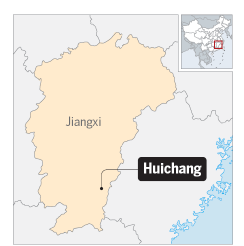
Technology is aiding rural areas, especially in terms of business and governance. Sun Shangwu and Yang Zekun report from Huichang, Jiangxi province.









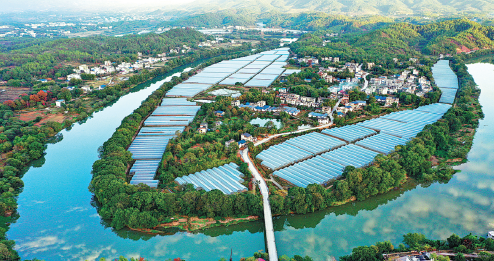
Although digital farming equipment has been installed in his navel orange orchards to monitor the growth of the fruit, Wu Chengxiao still gets up at around 6 am each day to inspect the plants, just as he used to do.
Over the 40 years he has spent growing oranges, Wu, 55, relied on his instincts as he weeded and pruned plants and sprayed for pests.
Now, he and his wife, Wang Qiongfang, are enjoying new technologies that allow them to monitor soil, fruit growth and the number of pests, and that give them precise advice to tackle emerging problems.
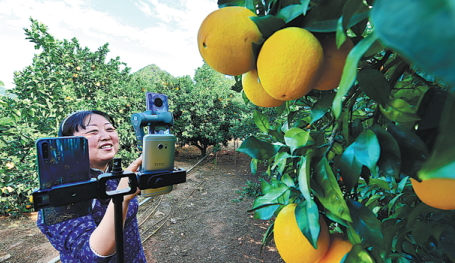
Wang said digitalization has benefited their business, especially when it comes to marketing and monitoring.
"The rapid development of e-commerce and digital farming has helped us a lot," she said. "I can see problems with diseases and pests in the orchards by following an app connected to the farming system, and then take specific measures."
She added that the technologies are helping them avoid the old, wasteful practice of applying fertilizer and spraying pesticides indiscriminately.
"We used to carry a 25-kilogram tank to spray pesticides for days to prevent pests and diseases in orchards. Especially in summer, the braces we wore on our shoulders to carry the spray would cut into our skin, and the slightest touch on a wound would cause pain," she said.
Rocky road to success
In 2002, Wu and his family traveled 1,000 kilometers from their hometown in Zigui county of Hubei province to Xiaomi township of Huichang county, Jiangxi province, to grow navel oranges.
His family had planted oranges in Zigui for about two decades before moving to Huichang, having saved about 200,000 yuan ($29,821) from selling the fruit.
When they arrived, Wu and his three elder brothers planned to lease 26.67 hectares of land, but supportive policies led them to invest all their savings and lease about 67.
"After planting in 2004, we encountered financial challenges that lasted until our business started to make a profit in 2011," Wu said.
"Based on our experience in our hometown, we believed after three years the trees could produce enough fruit to cover our startup costs," he said. "However, we didn't do enough research or have technical support. The soil in Huichang is not fertile, so we had to use more organic fertilizer, which caused the investment to exceed our budget. After three years, we were very short on funds."
Wang said their financial situation was indeed serious.
"It may sound ridiculous, but it was true that every time I went back to my hometown and met my relatives and friends, the first thing that came to my mind was, could this person lend me some money?" she said. To help offset their financial woes, the couple raised pigs, grew watermelons and pruned other people's orchards. Wang said their employees earned 12 yuan a day at that time and worked for eight hours, while she and Wu worked for more than 12 hours a day and did a large part of the work themselves to save money on costs.
"We got up before 5 am and often worked until nearly 8 pm. While many farmers were finishing their dinners, we were still collecting farm tools in the fields or riding our tricycles back home," she said.
When their watermelons were ripe, the couple would head to the fields at 4 am to harvest them. Their 18-month-old daughter would still be sleeping, so they would put her in a basket while they worked. Then they would go door-to-door selling the fruit after breakfast.
By 2011, the couple had paid back all of their roughly 600,000 yuan debt as their orange business began to make a profit. They currently employ 60 workers, most of whom are age 50 and older, to grow and manage about 46.67 hectares of oranges and about 8,000 chickens.
Key to development
The application of digital technology in the agricultural industry is key to the overall promotion of the development of the digital economy, and the central government has frequently proposed using science and technology to bolster the development of agricultural and rural areas.
While presiding over a study session of the Political Bureau of the Communist Party of China Central Committee in October, Xi Jinping, general secretary of the CPC Central Committee, said authorities need to promote the integrated development of the digital and real economies, grasp the direction of digitalization, networks and intelligence, and promote digitalization in industries such as manufacturing, services and agriculture.
Xi also asked authorities to make use of new internet technologies to transform traditional industries in an all-around way, raise productivity and make good use of digital technologies to boost economic development.
In January, the CPC Central Committee and the State Council jointly issued a document on the work of comprehensively promoting rural vitalization this year. It asked authorities to promote digitalization growth in villages, promote the development of smart agriculture, strengthen farmers' digital literacy and skills training, empower rural public services with digital technology, focus on solving practical problems and expand the application scenarios of agricultural and rural big data.
To promote its digital economy, Huichang county worked with JD Farm, the agriculture management and retailing service of e-commerce operator JD.com, to provide technology, brand empowerment and marketing support for digital agriculture projects and carry out production standardization and digitization exploration.
JD Farm also provides access to high-tech facilities and software to help monitor the soil, the weather and pesticide use. It also makes real-time recordings of the growth of crops such as rice and navel oranges, and it helps train farmers and business operators to ensure production meets quality standards.
Scoring system
To advance governance in rural areas, Huichang has built a scoring system for its residents based on its digital rural platform to ensure villagers are law-abiding and socially and environmentally conscious. The authorities and the village committees evaluate and score the residents based on their deeds and activities.
For instance, participating in volunteer services and helping seniors or children earns the family credits, but if a person harmed the environment or participated in illegal activity, points will be deducted.
Each family has a code through which members can check the credits they have earned or lost. The residents can use the credits to buy daily necessities such as food and toiletries in designated stores that are subsidized by the local government.
"The evaluations are mainly done online, and staff members from government departments or village committees will give marks according to people's situations," said Lai Yuanping, an official in Huichang's Zikeng village. "Meanwhile, the employees are also supervised and graded by the masses. This digital system has benefited rural governance in many ways."
Lai said that many villagers, even some who are unemployed, are now actively participating in public welfare activities.
Once a month, the village committee invites people age 70 or older to gather at a local ancestral hall to chat and enjoy free food. Many villagers help with cooking and cleaning up after the event.
"Goods bought with credits are not worth a lot of money, but mainly serve as an incentive and guide," Lai said. "What matters is that residents being rewarded for the positive things they do gives them a sense of achievement. Participation and respect is important, and some people have changed their attitudes toward life through such works."






Today's Top News
- Trade-in subsidy aims to drive more consumption
- Cooperation can boost cross-Strait integration
- State-owned firms register stable performance
- Global experts hail Xi's people-centered message
- Trips promote equality and coexistence
- Tech crucial factor shaping China-US ties