



SINKHOLE SPRINGS SUBTERRANEAN SURPRISE









Explorers and researchers are investigating a recently discovered sinkhole in South China's Guangxi Zhuang autonomous region to assess the flora and fauna preserved inside the massive pit.
According to the Institute of Karst Geology at the China Geological Survey, researchers are closely observing the walls of the sinkhole and the caves inside to evaluate the scientific and conservation value. They will also undertake research on the sinkhole's development and evolution.
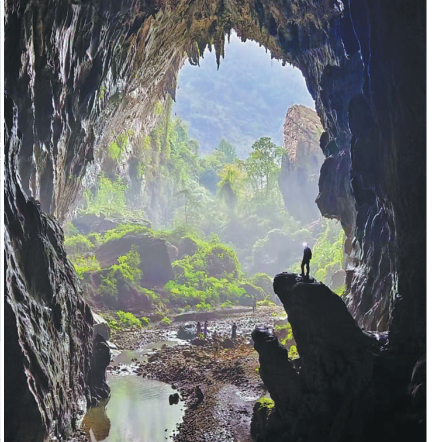
In May, they discovered the sinkhole through satellite images and drone photography during a field survey in the region, together with three caves in the sinkhole and a well-preserved primitive forest.
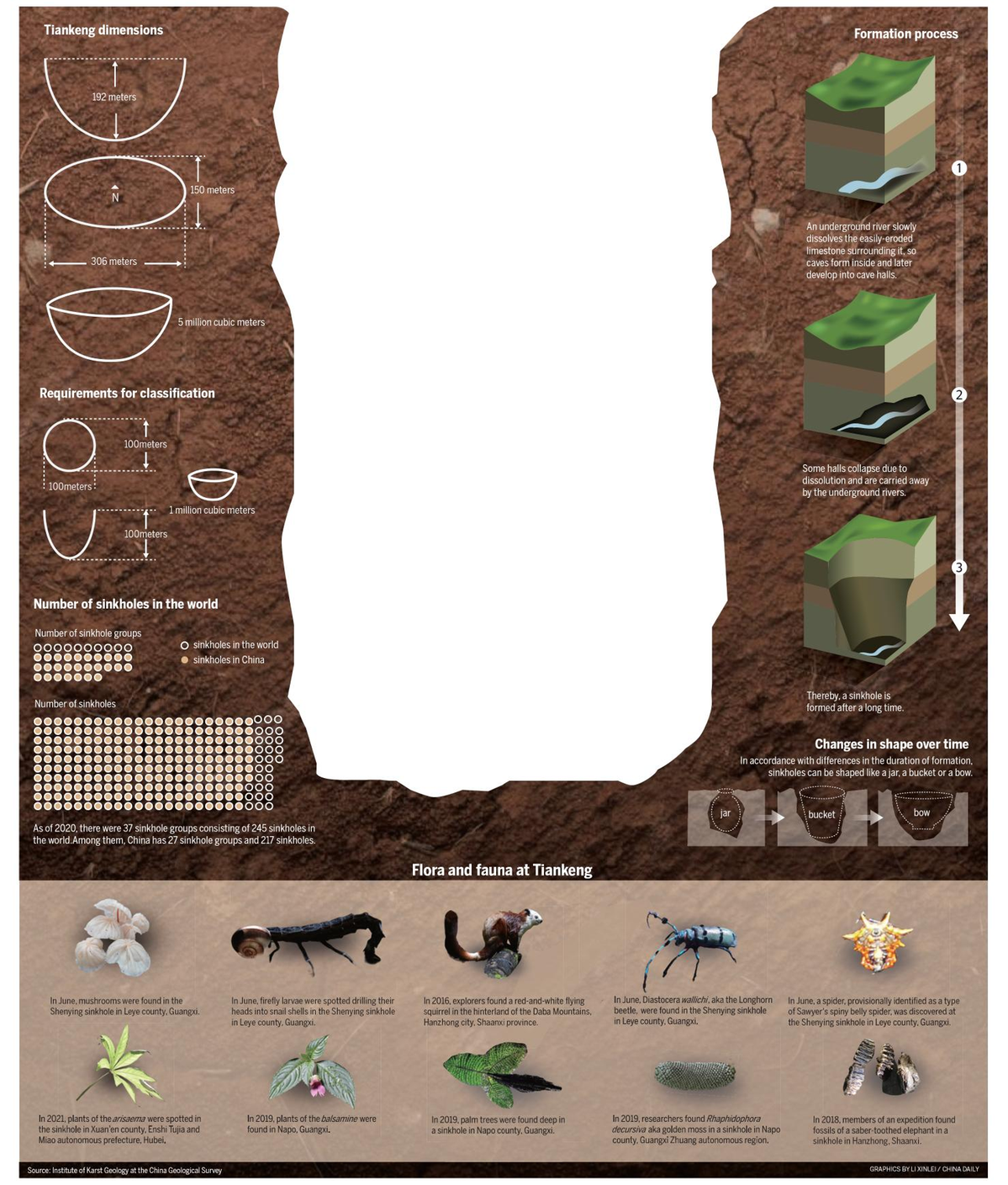
In an article posted on the institute's website, Zhang Yuanhai, a senior engineer with the establishment, said the sinkhole is located near Ping'e village in Leye county. Its maximum depth is 192 meters and its volume exceeds 5 million cubic meters, equal to about 2,000 swimming pools. Known as Tiankeng in Mandarin, it is a well-preserved standard sinkhole, according to the institute.
The Karst landscape is highly valuable for geological and environmental research because it can show the evolutionary process of a sinkhole and contains unique ecosystems, according to the survey.
Chen Lixin, leader of the exploratory team that took part in the expedition, said that after members descended more than 100 meters to the bottom by rope, they were astonished by the scene.
"We descended through lush bushes to get to the bottom. We were fascinated by the plants there. The trees were nearly 40 meters tall. Vines, bamboo and other plants made it hard for us to get around and explore further. We also found a type of falcon in the sinkhole, but due to the dense plants we couldn't identify its species," he said.
Plants that grow profusely cover the sinkhole's mouth, so it had not been spotted until researchers analyzed the satellite images.
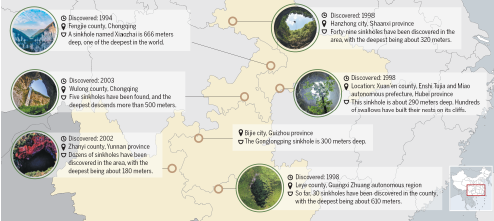
It is the 30th sinkhole to be found in the county so far, the institute said.
Surrounded by mountains, the landscape can be hard to reach and investigate. It is full of mystery, according to a documentary titled Tiankeng made by the China Geological Survey.
The sinkhole is a relatively closed ecosystem. With weak light, low temperatures and high humidity levels, it is a paradise for fungi, ferns and herbs that flourish in shady and humid environments. Bats, flying squirrels, blind fish and blind shrimps also thrive there, the documentary said.
Guangxi has favorable natural conditions for sinkhole formation. Soluble rocks are widely distributed around the region, which has abundant annual precipitation and rich underground rivers, according to the article on the institute's website.
"This discovery and the research of the sinkhole in Guangxi has triggered a boom in exploring the landscape nationwide. Tiankeng has provided a spotlight both at home and abroad due to its scientific, landscape and exploration value," Chen, the team leader, said. He added that he hopes more people will learn about the sinkhole and help protect it.






Today's Top News
- China reports 20% rise in inter-regional trips on first day of holiday
- China rebuffs criticism over drills around Taiwan
- Mainland pledges deeper cross-Strait integration in 2026
- Lai's 'separatist fallacy' speech rightly slammed
- Xi's message for New Year widely lauded
- Swiss bar fire kills around 40, injures more than 110








