Students learn lessons during quarantine
Extended stay on campus has prompted many young scholars to develop new interests. Zou Shuo reports.









On May 20, a quasi-Valentine's Day in China, Shanghai graduate student Zhang Yaqiang and a female peer he had recently met decided to have their first official date via WeChat's video channel.
Having been quarantined in his dormitory at East China University of Science and Technology for more than two months and used to wearing casual clothes, the 25-year-old put on a tie and white shirt and wore his favorite cologne and some makeup.
His new friend, Jin Jing, a senior undergraduate student at the university, also made considerable preparations for the date, which was their first opportunity to see each other clearly.
"We both value formality and we each wanted to give the other a good impression for our first date," Zhang said.
The online meeting lasted more than two hours, with Zhang standing on his dormitory balcony and Jin responding from her dormitory stairwell.
That evening, the pair held a video conference so they could watch a concert by Jay Chou, their favorite pop star and singer, together.
As COVID-19 outbreaks hit Shanghai and Beijing, college students under campus quarantine have found new and creative ways to spice up their daily lives.
Depending on the severity of the outbreak, the quarantine measures vary for universities in different areas. Those in Beijing generally sealed off their campuses early last month, and students were only allowed to leave for emergencies.
Shanghai students were under stricter quarantine measures, and some have been unable to leave their dormitories since March.
However, authorities in both cities recently allowed students to return to their hometowns if they wished, but said they were also welcome to stay at their universities if they preferred to do so.
Love blossoms
The love story between Zhang and Jin began online, when Zhang's dormitory building was one of several sealed off on March 12 after a number of positive COVID-19 cases were discovered.
On March 16, Zhang saw news that the tulips at the university had started to bloom. As he was unable to leave the dormitory and see the flowers himself, he started looking for photos of them on posts on the social media platform Sina Weibo, using its location function to find posts sent by people nearby.
"I came across beautiful pictures posted by her (Jin) and fell in love with them instantly, so I checked her other posts and mustered the courage to send her a private message," he said.
"We started chatting. The more we talked, the more we discovered that we have so many similarities. We both love reading, enjoy the same types of food, have the same tastes in fragrances and love physical training."
Two days later, Jin visited Zhang's dormitory building to borrow a book from him.
Under the watchful eyes of the dormitory manager, the two had a brief encounter, with Zhang lending Jin the book and her giving him two bottles of coffee. Both wore face masks during the exchange.
Zhang had sprayed his favorite cologne on the book, and he was surprised to find that Jin had done the same on the coffee bottles, albeit with a different fragrance.
"Our relationship has been purely platonic, and we grow fonder of each other every day. The main method of communication is to send each other carefully crafted WeChat messages to exchange views about shared hobbies, future plans and world views," Zhang said. "She also sent a love letter, which moved me deeply."
Picnics, cards
Liu Hongbin, a second-year undergraduate at Beijing Foreign Studies University, said he has made new friends and found new hobbies during the quarantine period.
Since he started college, Liu had always been very busy, so not being able to leave the campus slowed his life down.
"Before, I was always running for the next class, activities, gatherings with friends and other events, which meant I did not have much free time. However, in the past few weeks, I have had time to just sit in the campus playground and do nothing."
Every night, many students go to the playground and do all kinds of activities to try to enjoy their quarantine life together, he said. There are picnics, card games, drinking and even mahjong. Not being able to go outside means it is possible to make friends with previously unknown schoolmates, or even deepen friendships with classmates and roommates who have also stayed on campus, he added.
"I go to the night gatherings with friends on weekends. They bring their friends, and pretty soon we get very close and just have a good time together," he said.
He has also started street dancing two or three times a week. He learned the techniques during childhood but had not used them for many years.
Liu runs, swims and plays badminton. He also writes and records music, which has been a favorite hobby since he was a boy.
"I have adapted to life under quarantine better than many of my peers. I am there for them when they need emotional support," he said.
Liu left school and returned home on May 25.
Homemade games
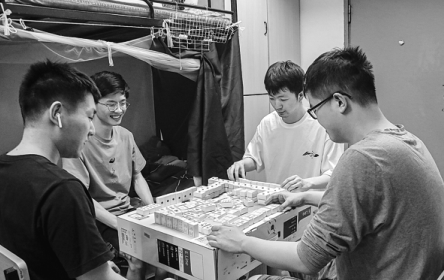
Having been quarantined in their dormitory for more than a month, Cao Lingfeng, Yang Yuguo, Yao Keyu and Li Hongtao were so bored that they decided to make mahjong tiles out of the inner packaging of rapid antigen test kits.
The four graduate students at East China University of Science and Technology in Shanghai are sent self-reporting quick antigen tests every day, so they collected their packages and those of other students on the same floor.
On the evening of April 26, they drew the patterns and wrote characters on the small boxes to make the mahjong tiles.
"It only took one night to make them, and we started playing mahjong the next day," Cao said.
As second-year graduate students in information technology, all their courses were completed during their first year, so being quarantined in their dormitory means they have little to do other than conduct research and write papers.
"We try to find something interesting to do to get away from the undesirable situation. Happily, we now have the mahjong tiles to pass some time," Cao said.
They left school and returned home on Sunday.
Taking pictures
Cheng Jie, an undergraduate at Beijing Foreign Studies University, said life under quarantine has allowed her to focus on photography, a hobby she intends to pursue as a career after graduation.
In September, she started working as a part-time portrait photographer, but she struggled to balance her studies and her photographic interests.
Cheng is majoring in Spanish, but she said she has never really liked the language. She was happy when the university started offering online-only courses early last month, as the change of pace allowed her to pay less attention to classes and devote more time to her side business.
"Taking beautiful photos of people and trying different techniques, locations and styles offer me a sense of achievement that learning Spanish does not," she said.
"I am finally doing something I am good at, and I feel I am not wasting my time."







Today's Top News
- Mainland pledges deeper cross-Strait integration in 2026 message
- Lai's 'separatist fallacy' speech rightly slammed
- Xi's message for New Year widely lauded
- Swiss bar fire kills around 40, injures more than 110
- New Year's address inspiring for all
- Xi congratulates Science and Technology Daily on its 40th anniversary