Life for residents of Red area improving
Tea, TCM and loans help Jinzhai county dwellers prosper as they emerge from poverty









Editor's Note: China Daily is running a series of stories on old revolutionary bases with profound history and heritage that are striving to lead local people on the road to prosperity in the new era.
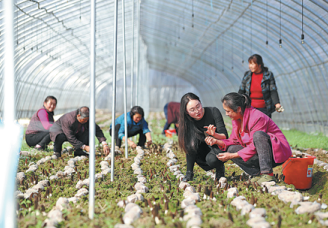
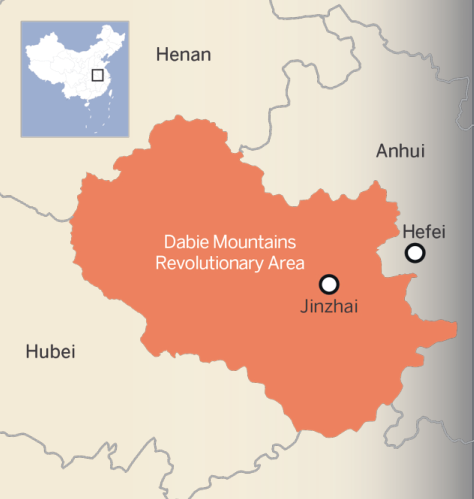
Luo Xianping has been busy overseeing the harvest of Corydalis tuber, a traditional Chinese medicinal plant that belongs to the poppy family, in the mountains of Jinzhai county in Anhui province.
Last autumn, the resident of Banzhuyuan township planted about 53 hectares of the plant, which is used to relieve pain.
"The plantation should bring in about 3.2 million yuan ($473,300) this year," said Luo, who hired farmers to take care of his land and encouraged others to grow more of the plant on their own farmland.
Luo, who is in his 50s, calls his farm "Tushengjin", which translates as "soil becomes gold".
A member of the Communist Party of China, he said he was happy with his business and life, though his family experienced difficulties in the past. In the late 1920s, Luo's grandfather and five brothers joined the CPC army to take part in the revolution. Only one returned alive, but badly wounded.
It wasn't until after the founding of New China that the family learned that the others, including Luo's grandfather, had died while serving. "They paid with their lives in hopes that their descendants could live happy lives," he said.
Records show that more than 2,000 people from Banzhuyuan-which currently has a population of 20,000-were martyred during the revolution.
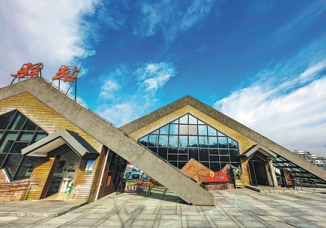
Jinzhai county was one of the birthplaces of the people's armed forces and of the Chinese revolution. About a third of its 300,000 residents participated, and most died in battles, according to the Jinzhai Revolution Museum.
President Xi Jinping visited the museum and a memorial hall for the Red Army on April 24, 2016, and laid a wreath at a monument commemorating those who had fallen during the revolution. He also visited five households in Dawan village, the hometown of 65 revolutionary martyrs, in neighboring Huashi township.
Jinzhai, which was governed by Lu'an city, was among the country's poorest counties, and Dawan was on the county's list of the 71 most poverty-stricken villages, with 242 of its 1,032 households registered for poverty alleviation measures in 2014.
Thanks to the measures taken, Dawan was removed from the list in 2018, and the county was taken off the national poverty alleviation list in 2020.
At the five homes he visited, Xi listened to ideas and suggestions from the villagers on poverty alleviation measures.
He also sought their views on migration and resettlement.
Chen Zeshen, now 73, had been living alone in a rundown, brick-and-clay house for decades before Xi's visit. His only son died in 2003, and his wife in 2007. In keeping with an old superstition, Chen had changed the location of the house's front door twice, hoping to reverse the family's misfortune.
In 2015, Yu Jing was sent to Dawan to serve as its first Party secretary for poverty alleviation. She helped Chen secure a loan of 8,000 yuan to install photovoltaic power panels that could be used to generate additional electricity for the power grid. The electricity generated earned him about 3,000 yuan a year, half of which was used to repay the loan.
Yu also persuaded Chen to take out a second bank loan to purchase goats to raise. The interest for both loans was paid by the government.
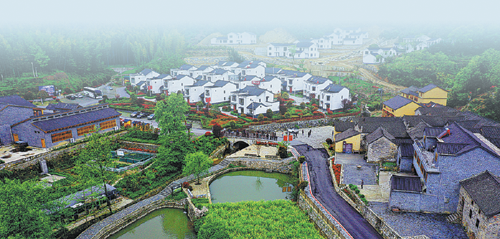
The same year, the local government started to build a community in the village, with dozens of new two-floor houses to resettle poverty-stricken residents.
In May 2017, Chen moved into a new 80-square-meter house. He received 90,000 yuan in compensation for giving up his old house to the local government for tourism development.
A tourism development company was founded in Dawan in 2019, and the village received 300,000 tourists. Last year, 400,000 tourists visited, bringing in around about 80 million yuan, according to the local government.
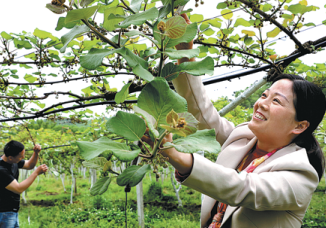
"We also planted more tea trees and traditional Chinese medicinal herbs," Yu said.
Dawan is now home to 330 hectares of tea. "The favorable policies of the Party and the government opened a new door, one that lead me out of poverty," Chen said.
He added that he was thrilled to meet Xi in 2016.
"I will never forget chatting with General Secretary Xi Jinping that day," he recalled. "He sat in the front yard of my house for a meeting with the villagers and officials and asked me if I had any wishes, and I said I hoped my income would double that year. That wish was later more than fulfilled."





Today's Top News
- New Year's address inspiring for all
- Xi congratulates Science and Technology Daily on its 40th anniversary
- Xi congratulates Guy Parmelin on assuming Swiss presidency
- China Daily launches 'China Bound'
- Manufacturing rebounds in December
- PLA wraps up military drills around Taiwan