PhD cop polices busy streets
Academic expertise has helped officer tame notorious road accident hotspots









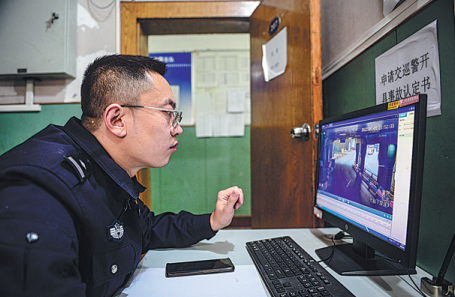
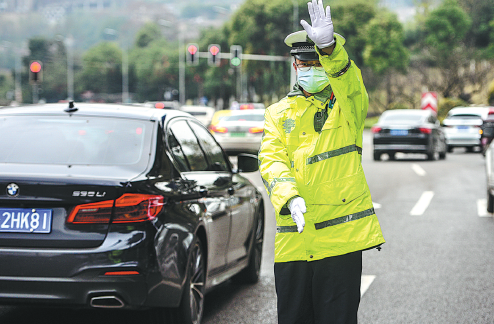
Eleven years ago, a senior engineer with a PhD decided to get a job as a traffic police officer in Southwest China's Chongqing. With his keen eye for potential danger and analytical approach to safety, he has been able to design and improve 60 traffic facilities, eliminate 52 potential dangers, publish five academic papers and produce six traffic safety patents.
That man is 37-year-old Wang Hui, an officer with the Jiangbei Traffic Police Detachment's Accident Handling Brigade. He is one of the few front-line traffic police officers in China to hold a PhD.
Born into a farming family in 1984 in Jinan, Shandong province, Wang graduated from the transportation and planning management department at Chang'an University in 2011, where he obtained his PhD in engineering. Located in Xi'an, Shaanxi province, the university is one of the country's top ranking institutes for traffic safety management.
Wang said that his former mentor Liu Haoxue, a top authority on the subject, was the one to suggest he study traffic safety.
Home to more than 5 million registered cars, Chongqing ranks third nationally in terms of the number of vehicles, according to a report from the Ministry of Public Security on Jan 11.
"Traffic is always very busy in Jiangbei," Wang said, adding that most of the district is urban.
In fact, it's one of the city's most developed areas. Jiangbei covers an area of 220.8 square kilometers, has a population of 925,800 and produced a GDP of 132.5 billion yuan ($20.9 billion) in 2020.
Statistics show that last year, Jiangbei's pedestrian death and injury tolls accounted for about half its traffic casualties.
Normally, Wang deals with 15 to 20 ordinary traffic accidents, including two to three involving injuries such as bone fractures, every day.
He said that although public safety awareness could be one influence on those figures, traffic management, planning and facilities must also be improved to reduce accidents. "When I'm on the street, I don't think of myself as a PhD graduate," the refined man in glasses said. "I'd rather be thought of as a hidden danger doctor."
Wang's rather unusual hobby is playing traffic detective. When he drives around the city after work, he pays attention to traffic facilities and planning and tries to think of ways to improve them.
His expertise has also helped him determine responsibility in a number of major accidents over the years.
"Wang has a strong sense of responsibility, and of the 17 officers in our brigade, he has solved the most cases by far," said Xu Ming, leader of the brigade, adding that the requirement for becoming a traffic officer is a college degree or higher, but that Wang is the only PhD graduate on the force. "The edge his PhD gives him in improving traffic is obvious," said Chang Shan, one of Wang's colleagues.
If cases involving hidden dangers he's uncovered are already closed, Wang sends suggestions for improvement to the Accident Prevention Brigade. He said they are generally adopted.
Jiangbei's Haier Road, a 20-km stretch crowded with trucks traveling between nearby businesses and Chongqing's free trade port, was once known as "death road" for the dozen-or-so fatalities and 1,000 to 1,500 accidents that happened along it every year.
In 2015, Wang proposed a series of road improvements. By adding overpasses, central green belts, road lights and speedtrap cameras, the number of accidents was brought down significantly to between 400 and 600 each year, and fatalities were reduced to under five.
Last year, similar improvements were made to Beibinyi Road, where people like to stroll after meals on the riverside footpath. Wang said that previously, four pedestrians had been killed while crossing the road, but there have been none since the improvements.
On top of suggesting improvements and helping eliminate road dangers, Wang has published five academic papers during his 11 years in the traffic police, three of which are listed in the Science Citation Index, which was originally published by the Institute for Scientific Information.
He has also obtained six traffic safety patents. One for a device used to identify an emergent lane change or braking by the vehicle in front is being used by a car safety testing institution in Xi'an.
Wang said that last year, four Jiangbei residents died in traffic accidents in older residential areas, all of them open communities with hidden dangers, particularly for the young and the elderly-children running across community roads, older people lacking traffic awareness, and drivers not driving or parking according to regulations. He plans to thoroughly research the communities to improve internal traffic and parking regulations.
In addition, he is also working on a mechanism to prevent traffic accidents through statistical analysis.
"Life is not only about good jobs and high salaries," Wang said. "For me, study and research are like air and water, and they give me more enjoyment."