



Hospital schools bring hope and health amid adversity
In-house establishments ensure that children with leukemia can continue their studies as they receive treatment for the disease. Zhang Yangfei reports.









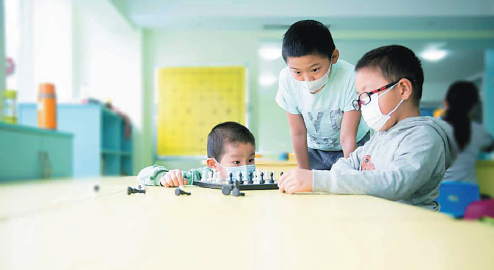
These are schools where the children can attend classes whenever they want and choose whatever subjects they wish. They have no homework and do not have to take any exams.
The 37 institutions across the country have been dubbed "the happiest schools" by some people, but they are more commonly known as "hospital schools" because they operate either inside or near medical establishments.
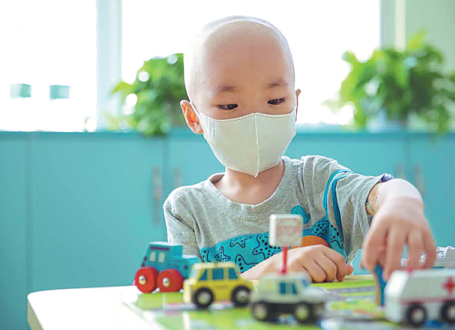
Most of the students, who are ages 3 to 14, have leukemia and are receiving treatment in the hospitals.
The project was launched in 2012 by the New Sunshine Charity Foundation in Beijing. Wang Anhua, the project director, said leukemia is the form of cancer with the highest incidence rate among children and it requires about two to three years of treatment.
During that time, the children either have to be hospitalized or live near the hospital, but their fragile immune systems mean they cannot enjoy a normal school life like their healthy peers.
Official statistics show that the five-year survival rate for children with leukemia from newborn babies to age 14 is about 70 to 80 percent.
They will return to normal life if they recover, but their prolonged absence from society makes it difficult for them to adapt to a regular existence. The hospital schools were established to help maintain their learning skills and social adaptation abilities.
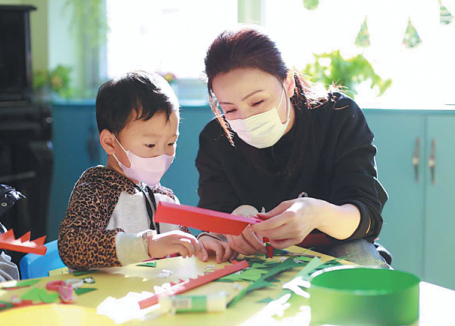
On Sept 3, Shi Dixin, the teacher who oversees the school at Beijing Boren Hospital, held a handicraft class online (the school moved all classes online as a result of the COVID-19 epidemic).
The five children, ages 5 to 7, who joined the session via a video link chatted happily when they saw each other. One child was shown in a hospital ward, while others sent greetings from Yunnan and Henan provinces.
Shi said treatment is not continuous, but is staged over several months. Because there are not enough hospital beds, many children have to live in rented properties near the hospital or return home between therapy sessions.
Though, the epidemic prompted the online classes, the move turned out to be a convenient way for children who have returned home to join classes from afar.
Each week, Shi posts the schedule in a group chat for parents, and the children can sign up for the classes they would like to take. There are usually four classes every week, each lasting 90 to 120 minutes, and the curriculum varies from the arts to English.
Sensitive approach
The classes are no different from those at regular schools, except that there are some things the teachers must never say.
The first is that they must never use gender-specific titles because many of the children have lost their hair after long-term chemotherapy, which makes it difficult to tell their gender by appearance. There have been occasions where volunteers have mistakenly called a little girl "little brother".
"Communicating with these children is different from physically healthy children. Because they have lost their hair, they are very sensitive, especially the little girls. They are really self-conscious about being bald," Shi said.
"When they lose their hair, it is very difficult to tell if they are boys or girls, so I always tell new volunteers not to use gender-specific titles such as 'little brother' or 'little sister'. If you confuse their gender, it hurts them very much."
She added that the best approach is to remember every child's name, which is also a way of showing respect.
The second thing the teachers must avoid mentioning is death. Data from the China Children Leukemia Diagnosis and Treatment Registration Management System, administered by the National Health Commission, show that there are about 8,000 new cases of leukemia in children age 14 and younger each year.
At a school established at the Beijing Lu Daopei Hospital, which specializes in treating blood diseases and tumors, one child only managed to attend classes for a week before he died. Teachers working at these special schools know that they will have to cope with such news some day.
"We just try not to remember these bad things," said Li Jing, a supervisor at the school close to the Beijing Children's Hospital.
Shi said the first time parents gave her the bad news about their child, she couldn't bear it and began to doubt if her job had any meaning. "I thought that if the children would eventually die, what I was doing didn't seem to make any difference," she said.
But after one child's death, the parents contacted her and said that during the last chemotherapy session, the young patient had endured great pain, but the only thing the child looked forward to every day was attending Shi's online classes.
Although the child was too weak to sit upright and join the conversation, just listening to the chatter of the other children provided hope and comfort. "As a teacher, I was really touched and healed when I heard that," Shi said.
When Shi teaches, she pays attention to the development of good habits among the students.
Sharing, caring
When the COVID-19 situation improved in Beijing and she was able to resume offline classes, she only distributed one set of watercolor pencils for four children to use together, so they would learn to share. She also asked them to properly dispose of the pencils, papers and garbage after use.
"These children spend most of the time with their parents, who tend to spoil them because of their long-term hospitalization, so they don't understand some norms on certain occasions," she said.
The parents certainly appreciate the schools. One, whose child attended the school at Beijing Children's Hospital, said: "The children were lucky to be able to meet a good teacher at their most difficult time. The hospital schools provide a loving harbor for these children between long, dull treatments. At first, my boy was too shy to turn on his webcam but now he's very happy taking the classes. He said he feels happy learning and chatting with the others."
The teachers maintain contact with most children when their treatment ends and they return to regular life.
"There is no happier thing than seeing them recover quickly and reintegrate into society," Li said.
She recently received a message from parents who sent a photo of their child's midterm exam results with a note that said: "A good start. A fresh start. Thank you, teacher."
Not all parents are willing to share updates, though. Shi said some sever all connections related to the treatment once their child has been cured and has returned home because they don't want to recall such difficult times.
"They have been through too much and have too many painful memories. Once the child returns to a normal environment, the parents take the initiative to cut off all connection to the illness, including the teachers. I fully understand them," she said.
"I am happy they have survived such a difficult time and returned to a stable life. The children must just head on straight into their new lives."




Today's Top News
- Revised law to spur high-level opening-up
- High-speed rail mirror of China's modernization
- China will deliver humanitarian aid to Cambodia
- The US 2025: a year of deep division
- China to expand fiscal spending in 2026: finance minister
- China's finance minister pledges expanding fiscal spending in 2026








