EVEN UNDER WATER, THE GREAT WALL GETS A MAKEOVER
Challenging five-year project in Hebei province should be finished by the end of this year









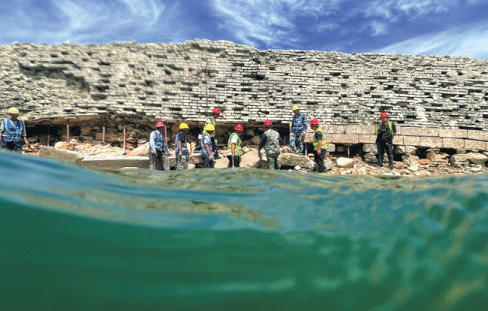
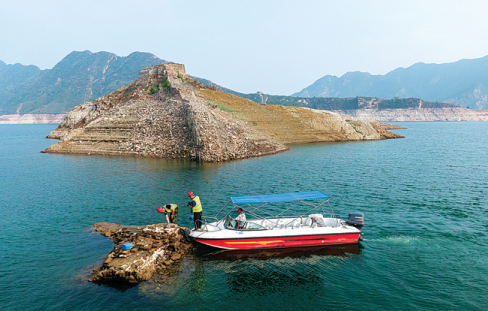
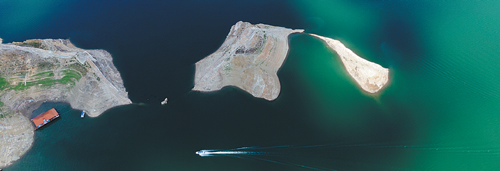
The Panjiakou section of the Great Wall in Tangshan city, Hebei province, was built in the 1380s during the Ming Dynasty (1368-1644). In the 1970s, part of it was flooded during the construction of the Panjiakou Reservoir, which resulted in the unique sight of a section of the Great Wall underwater.
Fluctuating water levels caused by seasonal changes have resulted in the submerged section becoming badly eroded. "Our workload increases as the water level falls," said Meng Qi, an expert at the Hebei Ancient Architecture Conservation and Research Institute.
In June, he and a team of workers began repairing a section of the dilapidated wall, which had been exposed by falling water levels. They carried out hasty repairs and tried to finish their work before the rainy season.
Zhang Yong, a senior engineer at the institute, is responsible for the project. Funded by the China Foundation for Cultural Heritage Conservation, repair work started in September 2016 and encompasses three watchtowers and two stretches of the Panjiakou section of the Great Wall, a total length of 1,005 meters. The project will be completed this year.
Zhang said the team follows a principle of minimum intervention and uses traditional methods and materials, with the aim of making the repaired sections match the rest of the Great Wall.
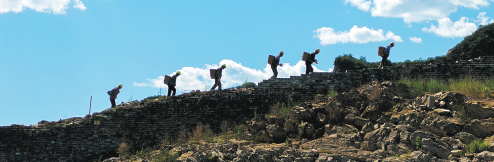
The underwater section stands in the middle of the reservoir, so bricks and other building materials have to be taken to a dock, loaded onto a boat and unloaded at the site. Each brick weighs 15 kilograms. At most, workers can carry two at a time.
"After several rounds of carrying bricks, our backs were beginning to blister, and after working for several days, our clothes were becoming worn," a worker named Liang Wenfu said.
Engineers and workers live at the site in the middle of the reservoir.
A boat delivers supplies of food, water and daily necessities once a week. One of the engineers, Cao Huibin, once stayed on site for 45 days in a row.






Today's Top News
- China hosts talks to cement Cambodia-Thai ceasefire
- Fiscal policy for 2026 to be more proactive
- Revised law to spur high-level opening-up
- High-speed rail mirror of China's modernization
- China will deliver humanitarian aid to Cambodia
- The US 2025: a year of deep division