Guarding relics easier than keeping staff
Despite more visitors and better research and infrastructure, some problems at Yulin Caves still hard to solve









In Northwest China's Gobi Desert today, there's little water and even fewer traces of humans, though the presence of many exquisite works of art suggests this was not always the case.
Just over a century ago in 1900, a Taoist monk discovered a cache of fine Buddhist art and scripts in the desert outside the ancient town of Dunhuang in Gansu province. Since then, the Mogao Grottoes, which are also known as the Thousand-Buddha Caves, and the location where the cache was discovered have become famous for their large-scale, well-preserved and precious treasures of Buddhist art.
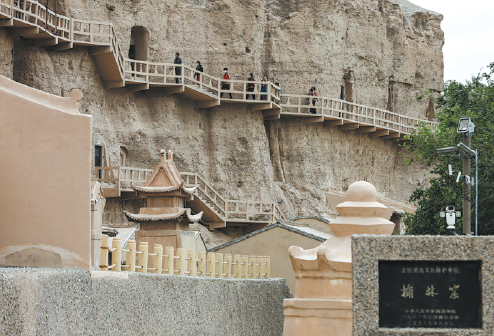
While another Buddhist site-the Yulin Caves, some 168 kilometers to east of the Mogao Grottoes, in Guazhou county, Jiuquan city-remains less trodden, its murals and painted sculptures are of the same value as those of its more famous counterpart.
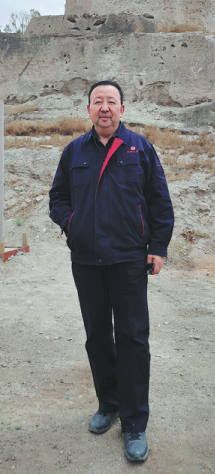
Song Zizhen, a cave guardian and director of the cultural relics conservation research institute of the Yulin Caves, has spent the last 14 years protecting and researching antiquities at the site and has seen Yulin rise from nothing.
"When I first arrived, employees barely made a living, let alone managed to attract tourists," he said.
Song said the nearest county is about 70 km away. Since they didn't own a car at the time, they had to grow vegetables and farm around the caves. "A dozen of us worked and lived here. In the spring, we planted trees, while in the autumn, we swept leaves," Song said. "When winter came, we swept the snow together."
"Drinking water was also a problem since the nearby river is often dirtied by mudslides, so we had to renovate the water processing facilities," he added.
The staff members withstood these harsh conditions for decades, attempting to preserve Yulin's exquisite murals, which extend over 5,200 square meters, and the 257 painted sculptures in the 43 remaining grottoes.
"Before 2007, fewer than 3,000 tourists visited our caves each year," Song said.
He worked closely with restorers to reinforce the cliffs and restore the statue, filling in missing pieces using modern techniques. "Preventing water seepage to stop the murals from peeling off is a slow process," he said.
"After those problems were resolved, the murals could be restored to their original appearance."
From the 2010s, visitors began to arrive in droves. In recent years, Yulin Caves have received between 70,000 to 80,000 tourists a year, with hundreds also flying in from abroad.
Living conditions for employees have also improved. Song said he was able to get a four-story workstation with an area of more than 4,600 square meters built near Guazhou through self-funding.
"The workstation is somewhere for our employees to hang out after work," he said. "It has fully furnished apartments, office space, living rooms and dining areas.
"It seems to me that research shouldn't mean researchers going to the grotto every day on field study, when they could live better while getting their jobs done at the same time."
The 60-year-old is retiring this year, but he has concerns about the future of Yulin Caves.
"Although the infrastructure has been improved over the past decade, and there are now more than 60 researchers working there, it's still hard to retain talent," Song said. "Younger researchers usually stay for three years and then leave for a variety of reasons."
Song said that the protection and tourism development of Yulin Caves, together with building up a talented team, have become the main focus of their work over the years. However, their weakness at retaining talent has become more obvious in the last few years when compared to the achievements made in protecting the caves themselves.
"In the future, I hope we can find better ways to attract, train and retain more talented workers," he said.





Today's Top News
- China's finance minister pledges expanding fiscal spending in 2026
- CPC leadership meeting urges steadfast implementation of eight-point decision on improving conduct
- Autumn grain purchases exceed 200m tons in China
- Wang to meet foreign ministers of Cambodia, Thailand in Yunnan
- China's top legislature concludes standing committee session
- Thailand and Cambodia agree to temporary ceasefire