Junior care is child's play for seniors
Retired women are giving hard-pressed parents a helping hand. Deng Rui and Tan Yingzi report.









"If the kids can't feel a granny's love, we like to act as replacements," said Huang Zejun, a "shared granny" in the southwestern municipality of Chongqing. "Actually, we warm each other's hearts through our mutual company."
A group of senior women in Chongqing who serve as shared grannies-helping working parents by picking up their children from school and accompanying them as they do homework and play-has won a lot of praise online recently.
The team, from Shipingcun community in the city's Jiulongpo district, consists of nine female retirees, mostly "empty nesters", ranging in age from 66 to 74. These volunteers shoulder the responsibility of taking care of 25 pupils from the community's Yangshilu Primary School.
Before the summer break, the school could only offer after-class services for the students until 5:30 pm every Tuesday to Friday.
On Mondays, however, the students got off school at 3:30 pm, earlier than usual, but their parents or relatives were unable to spare the time to collect them. By chance, the Chongqing Amber Social Work Service Center, a public service organization, was established in the district in November.
In April, the center introduced the municipality's first shared grannies program, with the aim of integrating the joint efforts of families, the school and the community to support the children.
To provide care and public services for both young and old in the community, the program recruits healthy retired women and also invites younger volunteers to tutor the children with their homework and oversee them as they play.
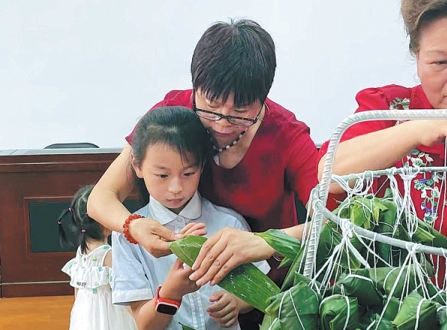
It provides a series of public welfare activities-such as free talent training, like making zongzi (balls of glutinous rice with various fillings) to celebrate Dragon Boat Festival, planting vegetables or growing flowers.
Moreover, during traditional holidays, the center arranges for the families to pay visits to the grannies as a way of thanking them for their efforts, according to Mao Yu, a 26-year-old volunteer.
The program gained a lot of positive feedback in just a few months.
On Sina Weibo, China's Twitter-like social media platform, one netizen commented, "The model is great and worth promoting in other places in the country."
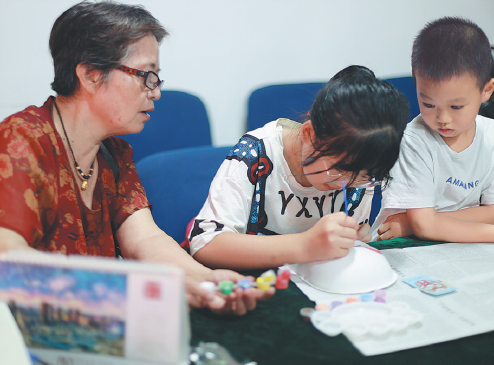
On July 27, during the summer vacation, the center provided a free lecture about Peking Opera for the children and grannies in a community function room. The attendees sang and performed Peking Opera, and painted the distinctive face masks together.
Meaning and progress
Deng Lihong signed up for the program as soon as she saw the recruitment advertisement.
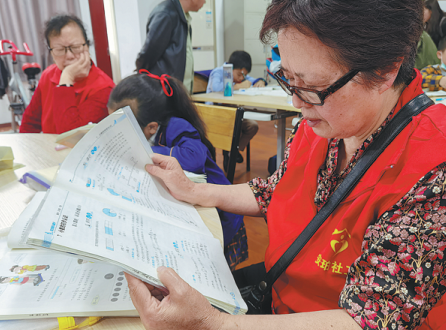
At 3:30 every Monday afternoon, the 66-year-old collects children from school and stays with them as they do their homework and play in the community room until their parents pick them up.
"This is exactly what I've wanted to do since retirement, and I see nothing to boast about. I feel young when I'm with the kids, and my retired life is meaningful," she said. "The initiator (of the program) has done a really good thing!"
Cui Jingqin has been sending Wu Ruili, her 10-year-old son, to the community since the program started. The 40-year-old self-employed laborer said her parents-in-law are in poor health and need to be cared for. Moreover, she and her husband don't have enough time or education to help with their son's studies.
"The learning atmosphere here is good. My son has made progress this semester, especially in math," Cui said.
Huang Zejun retired from her job as a government employee in 2001 and now lives alone.
"It's a matter of social concern: If the young people are strong, the country will be strong," the 74-year-old said. She noted that children who lack the love and care of pre-occupied family members, as well as society, are more likely to experience loneliness and depression, which could result in social problems.
Peng Mei, secretary of the Party committee of Shipingcun community, said: "We mobilize retired senior women in the community to participate in this public service. The interactions between the families in need and the shared grannies are mutually beneficial. The sense of fulfillment and happiness means a lot to them."
Cao Yidan, chairman of the center, said, "The team is still expanding."
This semester, the primary school will provide after-class services every workday, so the center is seeking further cooperation with the school and families.
"Shared services for the grannies to take the children to and from school or 'shared lectures' might be a direction to go in. As the saying goes: 'A friend nearby is better than a relative far away'," Cao said. "I want to link all the residents in the community to produce an interdependent model for young and old."






Today's Top News
- China to expand fiscal spending in 2026: finance minister
- CPC leadership meeting urges steadfast implementation of eight-point decision on improving conduct
- Autumn grain purchases exceed 200m tons in China
- Wang to meet foreign ministers of Cambodia, Thailand in Yunnan
- China's top legislature concludes standing committee session
- Thailand and Cambodia agree to temporary ceasefire