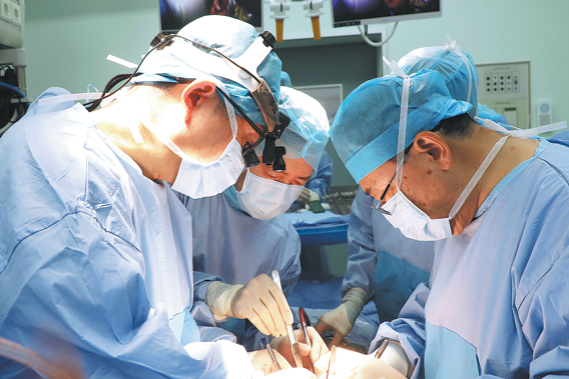
Taiwan people join front-line COVID fight
In Fujian, many volunteers from the island help with testing, report Zhang Yi in Beijing and Hu Meidong in Fuzhou.









When the latest COVID-19 outbreak hit Fujian in September, many people from Taiwan who live in the eastern province volunteered to work on the front line with locals doing virus prevention and control work.
Fujian, the closest mainland province to Taiwan, has many people from the island who come to invest, start businesses or work. Many of these frequent travelers from across the Taiwan Straits consider the province their second home.
On Sept 10, there was a resurgence of the outbreak in Fujian and it quickly spread to four cities in the province. Thousands of people have been under medical observation since then. No confirmed cases have been reported among Taiwan people living in Fujian, authorities said on Sept 15.
Taiwan business and investment associations in cities across the province started an initiative on Sept 14, calling on businesspeople from the island to cooperate with local governments in epidemic prevention and control work.
"Looking back to last year, we joined hands to overcome difficulties and worked together to promote the resumption of production and business after the epidemic. We believe this time, we will do it the same," the associations said in a joint statement.
As mass nucleic acid testing for COVID-19 was conducted in four Fujian cities to trace the virus and find potential cases, many residents, including those from Taiwan, volunteered to take part in the work.
In Xiamen, where there were more than 200 infections in September, two rounds of nucleic acid testing for more than 5 million residents were completed.
Su Fei-chun, who hails from Taiwan and works as the general manager of Xiamen's Hotel Discovery Inn, is head of a Taiwan business association in Huli district.
On Sept 16, she gathered 20 Taiwan compatriots living in the district to set up a volunteer team to help local authorities organize mass testing. They were assigned to a testing site set at a primary school in Huli, which was responsible for collecting samples from about 10,000 residents.
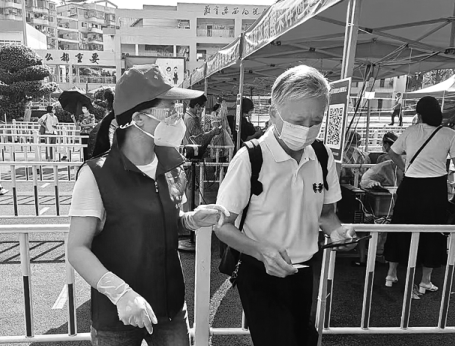
Wearing purple vests and red hats, the volunteers guided people on how to scan health codes, register their status and wait in line. They also answered people's queries about the testing process and maintained order.
"This volunteer team of 20 people was organized at short notice. They also have the experience of daily epidemic prevention volunteer work in their communities," Su said.
Members of her team work in optoelectronics, hotel management, environmental protection, health, and the arts, while others are retired, she said.
Having organized hotel quarantine as part of her work, Su has a great deal of knowledge about how to protect yourself from the virus.
Before they undertook the work, Su trained the volunteers on self-protection and testing site procedures. She prepared N95 masks, protective goggles and gloves, as well as a bottle of disinfectant for all the volunteers.
"I found that local people in Xiamen are quite self-disciplined. There were no people who didn't follow the rules, so our work went smoothly," she said.
Su said she will continue to encourage more Taiwan compatriots to join the volunteer work as there will be more mass testing in the city.
In February last year, when the country was facing a severe outbreak, the hotel Su works in was designated as a quarantine hotel for travelers returning from overseas, as it's located near Xiamen's airport. Travelers staying in the hotel were required to do two weeks of self-quarantine. Medical staff were stationed at the hotel to check the temperatures of guests every day and collect test samples, she said.
Hotel staff have to disinfect public areas of the building, such as corridors and lobbies, and clean the air conditioners every day, Su said.
"We take good care of the guests and make their stay here worry free," she said. On Sept 21, the Mid-Autumn Festival, the hotel gave cash rewards to staff members and offered mooncakes to the guests staying there.
Sacrifices made
Su hasn't returned to her hometown of New Taipei City, Taiwan, since the outbreak began last year and was unable to reunite with her family in Taiwan for this year's Mid-Autumn Festival.
"The outbreak this time is a bit severe. We will follow the prevention and control work as required," she said. "As long as people receive a nucleic acid test and the spread of the virus is stopped, Xiamen will soon survive and recover."
Another resident from Taiwan, Cheng Ya-ping, 47, runs a restaurant on Meizhou Island, a seaside resort in Putian, Fujian.
The sudden outbreak in Putian pushed the pause button on the island's tourism industry, which was supposed to welcome visitors during the Mid-Autumn Festival holiday.
Residents were told to stay put while epidemic prevention staff were busy taking people at risk of being infected into quarantine.
In the early days of the outbreak, food was relatively scarce as people were discouraged from entering or leaving the island.
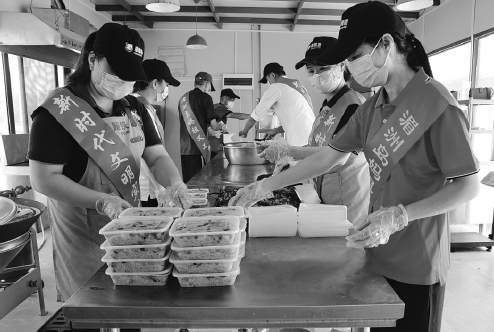
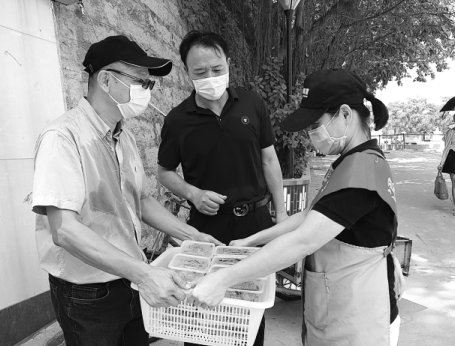
On Sept 13, Cheng and her staff made 125 Taiwan-style rice with stewed pork lunches and gave them to medical workers, police and volunteers on the front line of epidemic prevention work. "I had some ingredients in stock and I wanted to offer help in my own way," she said.
When she learned that the island would conduct nucleic acid tests on all residents on Sept 17, Cheng decided to make free lunches again.
This time, they made about 900 packed meals. In addition to the pork rice, she also prepared Taiwanstyle salted duck rice for those who don't like fatty meat as well as fishball soup. Cheng and her staff cooked the food and volunteers from Mazu Temple on the island helped with the packing and delivery.
"There was a lot of food to pack. The volunteers provided vehicles to send packed lunches to villages," she said. "Local people were warmhearted. The Mazu spirit advocates good deeds and great love."
The island is believed to be the birthplace of Mazu, the popular sea goddess worshipped mainly in the mainland's coastal areas and also in Taiwan. Many Taiwan compatriots come to Meizhou for pilgrimages and sightseeing.
Cheng, who is a follower of Mazu, opened her restaurant in January 2019 and since then has often traveled back and forth across the Straits.
When the mainland was struck by a COVID-19 outbreak during the Lunar New Year holiday last year, Cheng, who was in her hometown Kaohsiung, Taiwan, was unable to return to the mainland due to epidemic control measures.
Worried about residents of Meizhou, she collected about 200 items of medical protective clothing, thermometers and medical gloves and sent them to the island by express delivery before returning to Meizhou in August last year.






Today's Top News
- Autumn grain purchases exceed 200m tons in China
- Wang to meet foreign ministers of Cambodia, Thailand in Yunnan
- China's top legislature concludes standing committee session
- Thailand and Cambodia agree to temporary ceasefire
- NPC's 4th annual session slated for early March
- Civilizational links for a fairer world