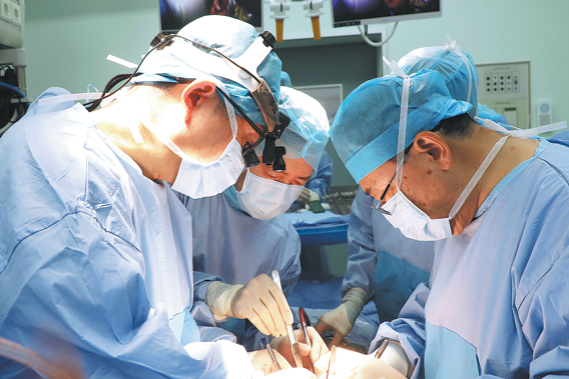
Nationwide moves reinforce the efforts to combat the outbreak









Scientist grasps true worth of her role
Pan Xiaozhu said she realized the true meaning of her work after chatting with a taxi driver in Guangzhou, capital of Guangdong province, last month. She had taken the cab to go home after a night shift at a temporary laboratory, and the driver told her he had taken several nucleic acid tests recently, and all the results had been negative.
He also told Pan that he had two COVID-19 vaccination shots, meaning he was "very safe", he said, making Pan feel that all her hard work has been worthwhile.
The 25-year-old is also a group leader at lab in Yangzhou, Jiangsu province, which provides nucleic acid tests for local residents. She was sent to Yangzhou last month, after working in temporary laboratories in Guangzhou and Nanjing, Jiangsu province.
Pan said that when she was in Yangzhou earlier this month, she was very happy when she took a walk at night. She saw many locals taking leisurely strolls on the shores of a lake after the lifting of a lockdown that had required many residents to stay home for weeks to help prevent and control the spread of the novel coronavirus.
"Our work interacts with epidemic prevention and control measures, which is of great significance and directly affects the government's next decisions on prevention and control of COVID-19," she said.
The lockdown in Yangzhou was lifted after the outbreak was brought under control last month, while no large-scale outbreaks of COVID-19 had been found in the country, she said. The temporary labs, known as the "Falcon Cube Laboratory", are operated by KingMed Diagnostics Group. They provide quick, high-quality testing and track key groups by using advanced technologies, playing a role in helping to control the COVID-19 outbreak.
Pan usually works shifts of more than 12 hours in her lab, which can test more than 180,000 samples a day.
City delivers both nucleic acid samples and safety
This summer, Zhao Yong and his colleagues delivered more than 2.1 billion nucleic acid test samples in Nanjing, capital of Jiangsu province, in two weeks.
On July 20, several cabin cleaners at the Nanjing Lukou International Airport tested positive for COVID-19. The government of Nanjing, which has a population of more than 9 million, immediately launched citywide nucleic acid tests to contain the spread of the virus.
Zhao, one of several deputy heads of the Nanjing Comprehensive Administrative Law Enforcement and Supervision Bureau of Transportation, said the samples had to be delivered to the labs within six hours of being taken.
"There are 2,747 sample swabbing centers in the city. After being collected, the samples were delivered to 107 transfer centers before being sent to 25 labs for testing," he said. "It was a great challenge. We used professional monitoring equipment, cooperated with health departments and dispatched many vehicles to guarantee timely transportation." During the first two rounds of testing, the samples were delivered to the labs directly. However, some labs received samples that exceeded their analytic capabilities and failed to yield test results in time. In response, the transportation bureau improved its delivery procedures.
That meant the samples were first sent to transfer centers, then delivered to labs that could begin analysis immediately.
All the boxes containing the samples were fitted with temperature control systems and GPS. If the trucks became stuck in traffic or a large number of samples flooded in from swabbing centers at the same time, the bureau sent motorcycle couriers or extra trucks to deliver the samples quickly.
The transportation bureau said that from late July to early August, it sent nearly 1,000 drivers and workers, and dispatched more than 300 refrigerated trucks to transport the samples.
"Many drivers and staff members worked day and night at sample swabbing and transfer centers, and they all wore protective clothing on hot summer days," Zhao said. "Their hard work enabled the citywide testing efforts to progress extremely smoothly."
Foreign manager happy to join the fight
David Gravier, a manager at BOMESC Offshore Engineering Co, a privately run Chinese company in the northern port city of Tianjin, has been featured on local TV as a result of his efforts to twice help facilitate a large number of nucleic acid tests.
"We can say it's kind of voluntary work, but I think it's 'part of my job' to do it," the French national said.
He also applauded the efforts of some foreign colleagues. "I should say that wasn't just me. Four other French managers and one Canadian manager also joined the efforts during the tests last year. It was a commitment to everyone in our company, including workers and managers, as well as to our community," he said.
Gravier arrived in China in January last year, "just one week before the outbreak of the COVID-19 epidemic", he recalled.
The first test was launched in February last year, when the company needed to resume business in a bid to get back on schedule for a project that began in October 2019.
Following government requests, a massive nucleic acid testing effort was launched for all BOMESC's staff at its different sites, including Tianjin's coastal Binhai New Area.
The second test was launched in November, when the area saw another outbreak and new tests were required everywhere within the area.
"We have some 300 international staff, and they have about 20 children with them. We hope to build a 'family environment' for all the staff members, so I asked the volunteers, including David, to help," said Chen Yankui, a manager for BOMESC's international staff.
Gravier said: "We five members just helped to provide guidance in terms of times and locations for the tests, and in particular, help to keep the kids (in line) in the big and cold courtyard during winter. The local government has done a great job in epidemic prevention."





Today's Top News
- Wang to meet foreign ministers of Cambodia, Thailand in Yunnan
- China's top legislature concludes standing committee session
- Thailand and Cambodia agree to temporary ceasefire
- NPC's 4th annual session slated for early March
- Civilizational links for a fairer world
- Manufacturing in China spurs global growth