New strain boosts barley









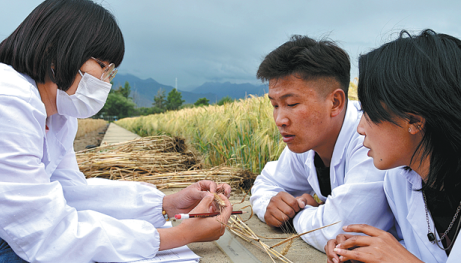
The Tibet Academy of Agricultural and Animal Husbandry Sciences hopes to soon introduce a new strain of Qingke barley that will help raise the quality and yield of this major crop across the Tibet autonomous region.
The strain, Zangqing 3000, which translates as Tibetan Qingke 3000, is currently undergoing assessment by the Ministry of Agriculture and Rural Affairs.
Once certified, it will be promoted across the region's major agricultural areas and is expected to raise Tibet's total production of Qingke barley by 10 percent, said Tang Yawei, the academy's deputy head.
He said the strain has a strong resistance to plant lodging, which occurs when the stalk collapses and the plant falls over. Tests show that just 5 percent of the crop experiences the problem under Zangqing 3000, compared with 30 percent under its predecessor, Zangqing 2000. The lower incidence of lodging will also help advance the mechanization of farming in Tibet.
"If a stem of barley collapses, it can only be reaped manually, which raises labor costs. If the crop can withstand lodging, then machines can reap the field and manpower can be liberated. More farmers will be free to do other work and activities that can raise their incomes," Tang said.
Qingke barley is the main grain grown on the Qinghai-Tibet plateau, and the region has China's largest Qingke barley cultivation area. Fields of the grain account for 143,333 hectares of Tibet's 250,666 hectares of arable land.
Tang said the plateau's farmers favor Qingke barley because the grain can withstand severe cold and will flourish despite inadequate fertilization. This ensures that food is always available, irrespective of the harsh natural conditions.
He added that in the past, Tibetan Qingke barley plantations were sparsely cultivated, with the stalks standing less erect and the spiky heads were less compact.
Before, Tibet's shortage of natural fertilizers, fuel and fodder for livestock made it difficult for crops to absorb nutrients, while large swathes of barley fell over during summer rains and wind.
To solve the problem, Tang and his team spent years working to develop new varieties of Qingke barley through crossbreeding. They tested seeds from home and abroad to gauge which had the best resistance to disease, higher protein content and could better adapt to different conditions in Tibet.
Traditional farming methods were also relatively crude. The farmers used cattle to pull the plow, and they threw the seeds and fertilizer onto the ground together, Tang said.
"This resulted in a severe waste of seeds. Farmers could sow up to 50 kilograms of seeds in one mu (0.07 hectares)," he added.
In response, academy researchers brought seeding machines and showed the locals how to use them, reducing seed use by 50 percent.
They also introduced the concept of "staged fertilization", which requires different amounts of fertilizers to be used according to the plants' nutritional needs at different stages of the growth process.
The current breed widely grown in Tibet-Zangqing 2000, developed in 2001-has an average yield of 5.7 metric tons per hectare. In 1952, the average yield per hectare was 780 kg.
After the seeds ripen, at least half of each stalk remains green and fresh, meaning they provide much more nutritious fodder for livestock.
Tang said if it is planted well, the Zangqing 3000 strain is expected to yield more than 6 tons per hectare.
The academy was initially known as the Lhasa 7-1 Agricultural Technology Experimental Field.
In 1952, Tibet's labor committee spent about three months clearing more than 100 hectares of land in Lhasa's western areas. This production base was later expanded and became experimental fields for the academy.




Today's Top News
- China's top legislature concludes standing committee session
- Thailand and Cambodia agree to temporary ceasefire
- NPC's 4th annual session slated for early March
- Civilizational links for a fairer world
- Manufacturing in China spurs global growth
- Taiwan lawmakers vote to pass motion to impeach Lai