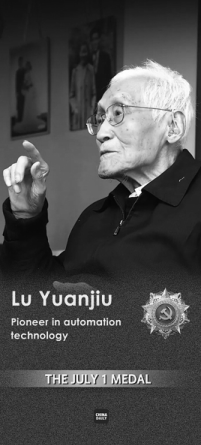
Scientist urges young to make full use of talents









Distinguished scientist Lu Yuanjiu, 101, has urged China's scientists, researchers, engineers and technicians to keep their missions in mind and make full use of their talents to contribute to the motherland and its people.
"People in my generation studied under enemy bombing and built our country from ruins and rubble," he said at his home in Beijing recently.
"My comrades and I spent our youth on sending our nation's rockets and satellites into space. Our successors have managed to place spacecraft on the moon and Mars, fulfilling the nation's thousand-year dreams of exploring the heavens.
"I really hope that our younger scientists, researchers, engineers and technicians can see their work as a long-distance race, stay true to their missions, and use all their passion and energy to advance the country's science and technology."
One of the founders of China's space industry, Lu played an important role in the design and construction of the country's first satellite, which was lifted into orbit in April 1970.
In recognition of his service and contribution to the nation and the Communist Party of China, Lu was one of 29 Party members awarded the July 1 Medal, the Party's highest honor, by Xi Jinping, general secretary of the CPC Central Committee, at a ceremony at the Great Hall of the People in Beijing last month.
The medal was conferred for the first time this year as part of the celebrations of the centenary of the CPC's founding.
Born in January 1920 in Laian county, Anhui province, Lu was a diligent student. He was admitted to the department of aeronautical engineering at the National Central University in Chongqing in 1937 and graduated four years later. In 1945, he went to the United States to research inertial navigation at the Massachusetts Institute of Technology under the direction of Charles Stark Draper, known as the "father of inertial navigation", who played a key role in the Apollo lunar landing missions.
After receiving his doctorate at MIT, Lu continued his research in the US until 1956.
Due to the political atmosphere at the time, many scientists and students of Chinese origin working and studying in the US were prevented from traveling or returning to China. The official reason was matters of confidentiality, but eventually, Lu was able to overcome the US government's objections and returned with his family to China.
Soon after his return, Lu was tasked with helping to establish the Chinese Academy of Sciences' Institute of Automation, later being named its deputy director. At the institute, he took part in the planning and design work for the country's sounding rockets-one- or two-stage solid-propellant rockets used for probing the upper atmosphere and for space research-and satellites. He also led the research and development of inertial navigation technology in China.
From 1978 to 1983, Lu was director of the Beijing Institute of Aerospace Control Devices and also chief engineer at the ministry of astronautics.
Under his guidance, many achievements were made in research on inertial navigation and control technologies, laying a solid foundation for the development of new carrier rockets and spacecraft.
Lu joined the CPC in 1982.
His academic accomplishments led to him being elected as an academician of the Chinese Academy of Sciences in 1980, an academician of the International Academy of Astronautics in 1985 and an academician of the Chinese Academy of Engineering in 1994.
He is currently a senior adviser to China Aerospace Science and Technology Corp and China Aerospace Science and Industry Corp, two leading space contractors.




Today's Top News
- High-speed rail reaches 50,000 km milestone
- China puts sanctions on US defense firms, execs
- Iconic hall reopens after decade-long renovation
- Sanctions show China's resolve to safeguard its sovereignty and territorial integrity
- China OKs three action plans to build pilot zones for a Beautiful China
- CPC leadership meeting stresses steadfast implementation of eight-point decision on improving conduct